
Most electric tricycle content is written for cargo. Buyers comparing platforms for a family or a child-minding route run into a different set of questions: how many children actually fit on the rear bench, what keeps a small passenger seated, whether the machine stays upright with an uneven load, and what the school run does to battery range over a week. This guide covers those questions using the real specifications of a delta passenger tricycle platform.
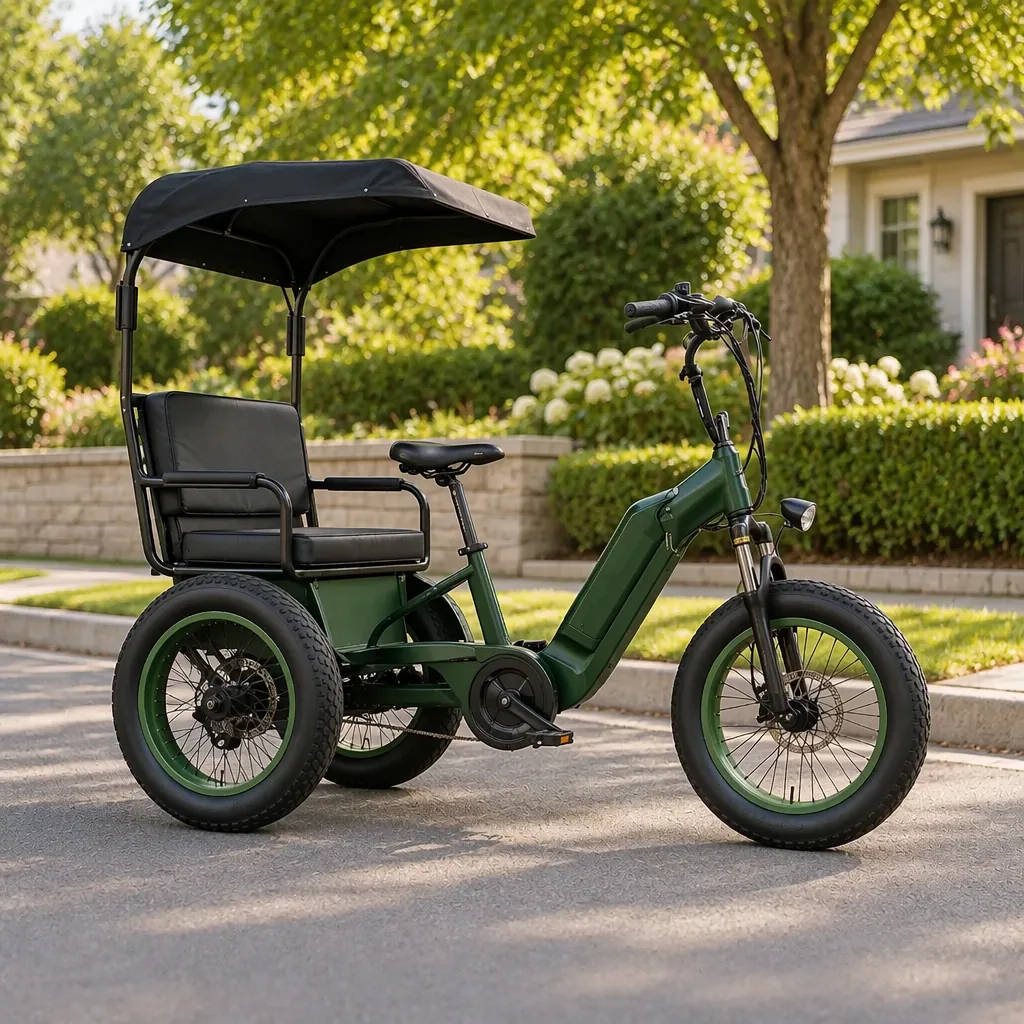
Why Families Choose a Three-Wheel Platform Over a Two-Wheel Cargo Bike
A two-wheel cargo bike carries children well at low speed and on smooth ground. The problem appears at the points where a family actually uses it: stopping at a kerb with a child already aboard, turning into a driveway across a camber, and holding the machine steady while a second child climbs on. A delta tricycle with one front wheel and two rear wheels does not need the rider to hold it upright at rest, because the two rear wheels already form a stable base. That single property changes the whole loading routine.
Those seated passengers are the same ones carried by any passenger e-tricycle platform, so the seating and stability behaviour described here carries over to taxi and shuttle configurations. For family use the relevant difference is not top speed or motor power. It is the ability to load and unload children without the vehicle tipping, and to keep a low centre of gravity when the passenger weight sits high on a bench. Three wheels do that job; two wheels ask the rider to compensate with balance at exactly the moment their attention is on the child rather than the road.
Seating Layout: What Fits on the Rear Bench
The passenger platform in our range mounts a front driver seat and a rear bench rated for two passengers, with a backrest and armrests built into the frame. That rear bench is the component that determines how a family actually uses the vehicle, so it is worth being precise about what the numbers mean.
- Rear bench capacity: two seated passengers on the standard bench, with the backrest and armrests forming a physical boundary on both sides.
- Total load rating: 300 kg for the whole vehicle, which is the driver plus passengers plus anything carried in the footwell or a small rear basket.
- Seating envelope: the bench is a two-person width, so the practical family configuration is one adult driver and two children, or one adult driver and one adult passenger with a child between them.
- Floor space: the flat footwell ahead of the bench takes a school bag, a folded stroller or shopping without occupying a seat.
Buyers who need to carry three children should look at the arithmetic before ordering. A 300 kg total rating with an adult driver of around 80 kg leaves roughly 220 kg for passengers and load. Two children at 25 to 35 kg each sit well inside that envelope with room for bags, while a third passenger starts to consume the margin that you also want for the week's shopping or a pram.
Child Restraint: What the Platform Accepts and What It Does Not
This is the point where a family buyer has to be honest with the supplier, because a tricycle is not a car. The platform provides a bench with a backrest and armrests; it does not ship with an integrated child seat or a three-point harness as standard. That matters for how you specify an order.
The frame accepts bolt-on accessories, and that is the route most family and child-minding buyers take. The practical options are a lap belt anchored to the bench frame, a child seat base that clamps to the bench with the child harnessed to the seat, and low side panels that stop a child from sliding sideways off the bench on a turn. Each of these is a fitment decision, so the useful thing to do at quotation stage is to tell the supplier the age and weight of the passengers and ask which anchor points the bench frame exposes.
The one thing the vehicle does not do is replace the judgement of the rider. A bench with armrests and a belt keeps a child seated; it does not make the tricycle a child car seat. Parents carrying very small children, under roughly four years, generally use a purpose-built child seat with its own harness mounted on the bench rather than a lap belt alone, because the lap belt geometry needs a child tall enough to sit with their back against the backrest.
Stability With Passengers Aboard: The Engineering Behind the Confidence
Family buyers describe the three-wheel layout as feeling stable, and it is worth naming the three things that produce that feeling, because they are also the specifications to check on any platform you compare.
- Delta wheel arrangement. One front wheel, two rear wheels. The two rear wheels carry the passenger load and form a base wide enough that a seated passenger shifting their weight does not steer the vehicle.
- Rear differential axle. Both rear wheels are driven through a differential, so the outer wheel turns faster than the inner one through a corner. Without a differential, a loaded tricycle scrubs its rear tyres and the rider fights the steering on every driveway turn.
- Low seating height. Passenger weight sits low on the platform rather than high on a two-wheel frame, which keeps the centre of gravity inside the wheelbase even with two children on the bench.
The full stability case, including track width and centre-of-gravity behaviour, is set out in our safety features guide. The counterweight is the load itself. A tricycle rated for 300 kg is at its most planted with passengers aboard, not empty. Riders who switch from a two-wheel bike sometimes report the first loaded trip as the point where the vehicle starts to feel trustworthy, because the passenger mass settles the machine instead of making it nervous.
Speed and Range on a Real School-Run Duty Cycle
Family and child-minding use is short-range, repeating and multi-stop. That shape of duty cycle plays to the platform's strengths, and it also makes the battery question simple to answer with arithmetic rather than a marketing range figure.
The platform runs a 500W or 800W brushless hub motor on 60V, with a 60V 20Ah or 60V 32Ah lithium pack and an LFP option for hot climates. Rated range is 40 to 60 km loaded at moderate speed, top speed 25 to 35 km/h, and charging takes 6 to 8 hours on the standard charger.
Take a child-minding operator doing a morning loop of four stops within a 6 km radius, then a repeat loop in the afternoon. That is roughly 24 km a day including the school gate detours, which sits comfortably inside a single charge of the 32Ah pack and leaves margin for an unscheduled trip. The overnight 6 to 8 hour charge refills the pack between days, so a family or child-minding vehicle does not need daytime charging infrastructure. Compare that with a 40 km full-range day on the 20Ah pack, which is where the choice between the two battery sizes starts to matter: the larger pack buys quiet margin, not a new capability. For the cell chemistry and BMS details behind those packs, see our battery pack guide.
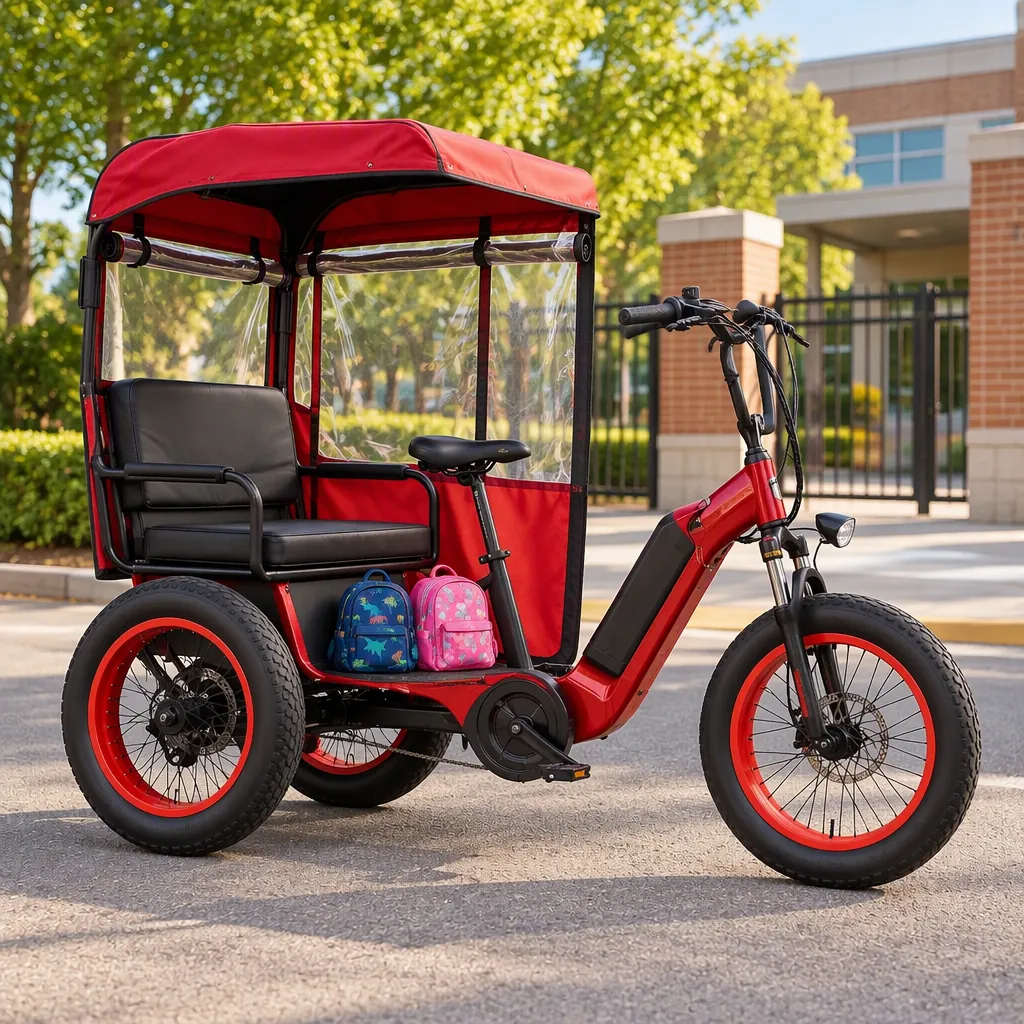
The canopy earns its place on this duty cycle for a different reason than comfort. A fabric canopy with roll-up sides keeps children out of direct sun and light rain on the school run, which is the difference between a vehicle a parent uses daily and one that sits in the garage whenever the weather turns. Canopy framing and fabric options are compared in our canopy guide.
Safety Equipment That Actually Matters for Child Passengers
Family buyers often start with the motor and end up focusing on brakes and visibility, because that is where the safety of a passenger, rather than the rider, is decided.
The platform carries a hydraulic disc brake on the front wheel at 180 mm and mechanical drum brakes on both rear wheels, plus a parking lock. That combination matters for a loaded tricycle at a school gate: the drum brakes on the loaded rear axle do the heavy work, while the parking lock holds the vehicle still on a slope while children climb on and off. Braking a loaded tricycle is a front-and-rear job, so a platform that pairs a strong front disc with dual rear drums handles the passenger load better than one with a single brake on the front only.
Riders carrying children should also check the legal classification for their market, covered in our US and EU classification guide. Visibility runs the other way and matters just as much. A passenger tricycle is a high-visibility vehicle by shape, and the platform ships with LED headlight, tail and brake lights, and turn signals as standard. Adding a canopy that keeps the children visible from behind, rather than a solid enclosure that hides them, is the configuration most family buyers settle on.
Choosing Between 20Ah and 32Ah, and Between NMC and LFP
The battery choice on a family platform comes down to how much margin you want and where the vehicle lives.
| Configuration | 60V 20Ah | 60V 32Ah |
|---|---|---|
| Typical loaded range | 40-50 km | 50-60 km |
| School-run days per charge | 1-2 short loops | 2-3 short loops |
| Best for | Single-route families, short city distances | Child-minding operators, longer loops, cold mornings |
| Charge time | 6-8 hours | 6-8 hours at the same charger rating |
On chemistry, the platform defaults to NMC lithium and switches to LFP for operators in hot climates, where ambient temperatures routinely push NMC packs toward derating. A family vehicle parked and charged outdoors in a hot region should be specified in LFP; a temperate-climate family route is well served by the standard NMC pack. Both options ship with cell, BMS and test-report documents in the export file. Charging behaviour on a daily school-run pattern, including the standard 6 to 8 hour cycle, is covered in our charger guide.
What to Put in the RFQ for a Family-Ready Platform
Family and child-minding buyers get a better quotation when the request describes the passengers rather than the vehicle. The supplier can then match the seating layout, restraint anchor points and battery size to the actual duty cycle instead of defaulting to a cargo-build specification.
- Number and approximate weight of the children you will carry, and whether an adult passenger is ever aboard at the same time.
- Daily route length and number of stops, so the 20Ah and 32Ah packs can be compared on real distance rather than rated range.
- Whether you need bolt-on restraint anchor points on the bench, and the ages of the smallest passengers.
- Canopy preference: fabric with roll-up sides for ventilation and visibility, in a colour that matches your branding or district fleet.
- Climate and parking: outdoor charging in a hot region should trigger the LFP option.
- Whether the vehicle carries your name as a district fleet livery, which moves the order into the custom-branded run.
Order Terms and Lead Time
OEM orders for the passenger platform start at 50 units per model, with a 15 to 30 day standard lead time and 30 to 45 days for a first custom-branded run. Pre-production samples ship before mass production, so a family transport fleet or a dealer can validate the seating layout and restraint fittings on a real vehicle before committing to a full order. The general maintenance and service schedule for a platform of this type appears in our maintenance guide. Battery chemistry, canopy fabric, seat upholstery and frame colour are all configuration choices inside the OEM programme rather than aftermarket additions.
For a dealer building a family and child transport line, that means the same platform can be specified in one configuration for urban families on short school runs and a second configuration, with the 32Ah pack and LFP chemistry, for child-minding operators in hotter markets. The rear bench, the dual rear drum brakes with parking lock and the canopy frame are shared across both builds, so a dealer can stock one platform family and cover the short city school run and the longer child-minding loop from the same parts catalogue. That shared platform is what keeps spares, servicing and rider training simple as a family transport line grows.
Spec a Passenger Trike Around Your Family Duty Cycle
Tell us your rider mix, the number of children you carry and your daily route length. We will send the platform configuration, seating layout, canopy and FOB pricing for a family-ready build.
