
Why Tooling, Not Labour, Sets Your First Order Quantity
Ask a first-time importer why the minimum order is 50 units and you will usually hear something about the factory needing volume. That answer is incomplete. Labour in a Chinese e-tricycle plant is not the constraint: a cargo trike rolls off a final assembly line where the longest station, the dynamometer and water-spray test, runs a 240-second cycle, and every other station from frame prep at 90 seconds to packing at 100 seconds is shorter. What actually forces the number up is the one-off cost of the fixtures, jigs and moulds that let the factory build your version of the product instead of theirs.
This guide is about that cost. It covers what each class of tooling actually buys, the real price bands a buyer should expect to see quoted, the four MOQ tiers those tools create, and the negotiation structures that let a 50-unit importer reach a customised product without writing a five-figure cheque for steel that stays in the factory when the programme ends.
What "Tooling" Actually Means on a Tricycle Programme
The word gets used loosely. On this platform it resolves into four distinct purchases, each with its own price, lead time and ownership question. Buyers who treat them as one line item on a quote sheet routinely pay for the wrong one.
| Tooling class | What it changes on the vehicle | Typical cost band (USD) | Who normally owns it |
|---|---|---|---|
| Frame welding jigs | Frame geometry: wheelbase, head angle, box mounting points, motor bracket position | 3,000 – 8,000 | Factory, charged to the order |
| Injection moulds | Proprietary battery housing, controller enclosure, plastics | 8,000 – 25,000 | Negotiable, often shared |
| Box fabrication fixtures | Cargo box dimensions, panel breaks, latch positions, drop-side geometry | Quoted per project | Factory |
| Paint and print setup | Your Pantone colour, decal artwork, pad-printed logo position | Setup fee, not capex | Factory |
The distinction that matters commercially is between the first column of costs and the last row. Frame jigs and injection moulds are capital: hard steel that exists only to make your part, and somebody has to pay for it before the first unit is built. Paint and print setup is a changeover cost: the same booth, the same pad printer, a different colour in it. Changeover costs are cheap and repeatable. Capital tooling is expensive and paid once, which is precisely why it drags MOQ upward.
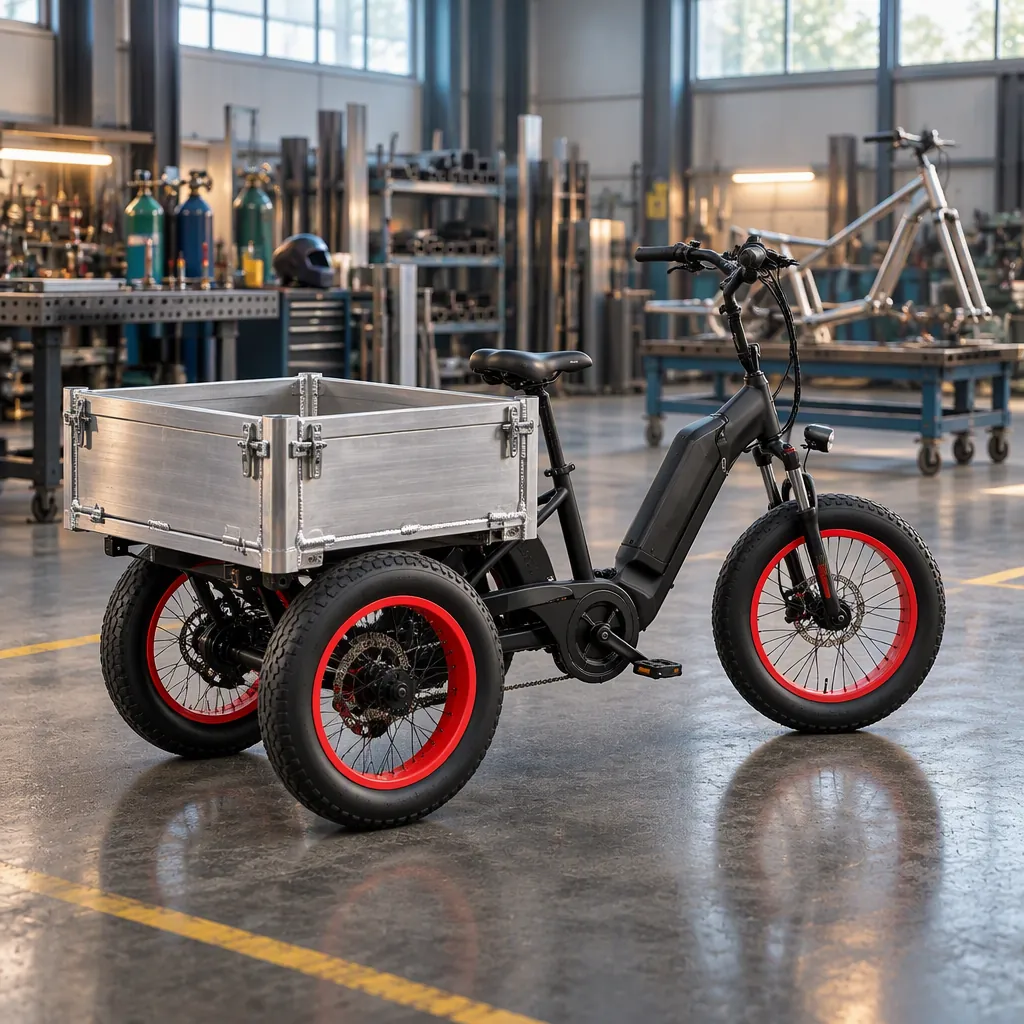
The Four MOQ Tiers and What Each One Unlocks
Chinese e-tricycle manufacturing settles into four practical tiers. The boundaries are set by the point at which a factory has to open new steel rather than by any policy document, and knowing where the line falls is what lets a buyer plan a phased entry instead of over-committing on a first container.
| Tier | Order quantity | What is customised | Tooling required |
|---|---|---|---|
| Catalog model | 50 units | Logo sticker on the down tube, branded manual | None |
| Custom colour and branding | 100 – 200 units | Your Pantone in the paint booth, decals or pad printing, saddle / grips / tyre swaps | Setup only |
| Custom frame or major component | 200 – 500 units | Modified geometry, different fork spec, bespoke battery enclosure shape | Welding jigs, possibly mould |
| Fully custom moulds | 500 – 1,000+ units | Proprietary frame, plastics, battery case | Full tooling package |
A 200–500 unit tier is not an arbitrary number either. It is the frame supplier's minimum batch for a new welding jig, and simultaneously the battery supplier's minimum for a custom enclosure. When both constraints land on the same order of magnitude, that is not coincidence: they are both amortising a fixed setup across units. This is why the tier boundaries look similar across suppliers and why arguing MOQ downward rarely produces a different number unless you change what is being built.
The Battery Tray Maths Nobody Puts in the Quote
The clearest window into MOQ logic is the cell pack, because the arithmetic is visible. A 21700-format cell ships from Samsung, LG or EVE in trays of roughly 200 cells. A 13S4P pack uses 52 cells, so four packs consume one tray. Below 50 packs, the factory is breaking trays and carrying orphaned inventory of a cell no other customer's order will absorb. That is the real reason the price premium appears under 50 units, and the reason a supplier who quotes you 20 custom packs without a premium has probably not costed the order properly.
On the tricycle platform, the pack spec that drives this is 60V 32Ah or 72V 40Ah lithium, with LFP available where cycle life matters more than energy density. Each pack configuration has its own case, BMS layout and connector set, and each of those is a place where a custom decision multiplies the tooling footprint. If you are weighing cell chemistry against fleet lifetime for a hot-climate market, the LFP versus NMC comparison covers the cycle-count trade-off, and the battery pack sourcing guide details the four standard mounting configurations that avoid custom tooling entirely.
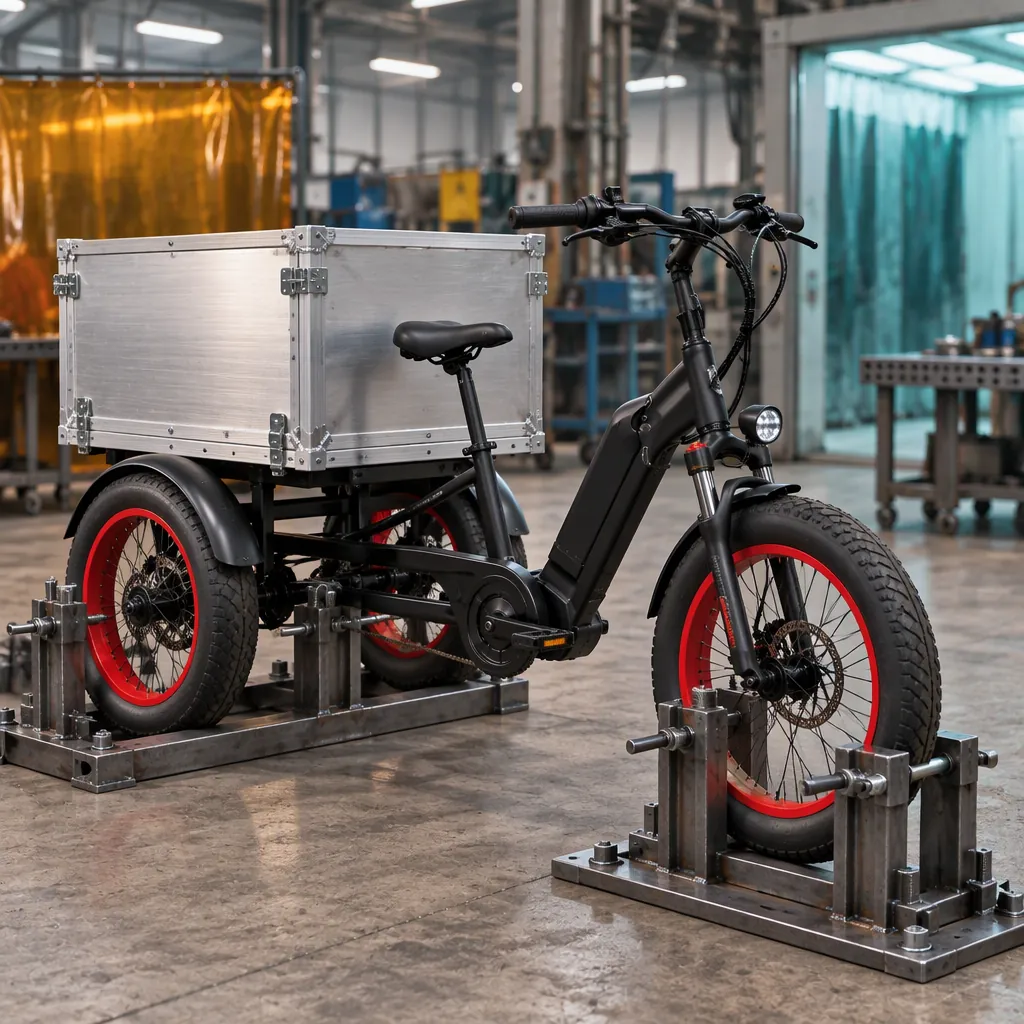
What Custom Tooling Really Costs in Lead Time
Tooling does not just gate quantity, it gates the calendar. A standard configuration leaves the factory in 15 to 30 days. A first custom-branded run typically needs 30 to 45 days, and the additional fortnight is almost entirely tooling and pre-production sample work rather than production itself. The sequence runs tooling, then samples, then approval, then production, then quality control, and every step before production is irreversible in the sense that a change after the jig is cut means cutting it again.
This is why the factory process walkthrough puts sample approval ahead of mass production, and why a buyer planning a spring selling season has to count backwards from the container date through tooling, not from the deposit date. If your target market runs on a seasonal cycle, the tooling decision has to be made a full quarter before the season, not six weeks before it.
Four Structures That Spread the Tooling Cost
None of this means a first-time importer must fund a mould in full. Four structures are used in practice, and the right one depends on how confident you are that the programme will continue past the first container.
Straight amortisation. The full tooling cost is quoted and absorbed into the unit price across the first production run. Simple, and the correct choice when the order is already large enough to carry it without distorting the landed cost per unit.
Shared mould cost. If a custom battery enclosure mould is quoted at USD 12,000, the buyer pays USD 6,000 up front and the factory absorbs the other half, on the condition that the tooling cost is refunded against future orders, for example USD 10 credit per unit across the next 600 units. Both parties then have a reason for the programme to succeed, because both are waiting to be made whole by volume.
Tooling as buyer property. The buyer pays for the jig outright and owns it. On paper this protects the investment if the relationship ends. In practice the tool is only useful at the factory that has the line set up to run it, so ownership without a take-back clause, or an escrow arrangement covering the drawings, is largely theoretical comfort.
Deferred customisation. Start at 50 catalog units, move to 100 units with custom colour once the first container sells through, and negotiate custom frame elements for a third order at 200-plus units. This is the option most importers should take first, because it converts an uncertain market into a tested one before the factory spends money on steel.
The Cargo Box Is Where Tooling Decisions Get Made
On a cargo platform the box is the component that most often triggers tooling, because it is the part every operator wants to change. Our OEM programme treats the box as a blank-slate engineering project on every order rather than a catalogue pick. Boxes are fabricated in welded aluminium sheet for corrosion resistance and weight, galvanised steel for impact-heavy duty, or insulated sandwich panel for cold-chain work, with body types running from a fixed flatbed with stake sides to a three-way drop-side body that converts to a flatbed, and a hydraulic tipper for construction material, agricultural produce or waste collection.
Each of those choices changes fixture requirements. A drop-side body with a different panel break needs different bending setups; a tipper needs a subframe and ram mounting geometry that a flatbed does not. The commercial consequence is that box customisation is what moves a first order out of the 15–30 day band and into the 30–45 day band, and it is the usual reason a branded first container costs more per unit than the second one. Buyers comparing a tipper build against a fixed body should read the hydraulic tipper specification guide before committing, because the subframe geometry is not interchangeable with a flatbed after the fact.
Where the Line's Rhythm Limits Your Options
The factory runs four parallel final assembly lines with a mixed-model schedule, meaning several models can run in the same week. That flexibility is what makes a 50-unit catalog order economic at all. But the line rhythm also sets limits on what customisation is cheap and what is not. Station cycles run from 75 seconds at battery install to 240 seconds at final test, and every station's torque and test data is logged against the unit's production record.
A change that fits inside an existing station's cycle is nearly free. A change that adds a station, or pushes one past the line rhythm, is not, regardless of how small it looks on a drawing. This is the practical argument for specifying a frame and box combination the line already knows how to run: the tooling saving is real, but the scheduling saving is often larger and less visible on a quote sheet. The full station-by-station breakdown is published on our factory page, and it is worth reading before you assume a small geometry change will be treated as small.
Auditing a Tooling Claim Before You Pay For It
Because tooling is paid up front and is not shipped with the container, it is the easiest line item on a quote to inflate or to leave vague. Three questions separate a real tooling charge from a padded one.
First, ask what the tooling consists of, in named parts: how many jigs, which fixtures, what the mould is for. A supplier who cannot enumerate it has not quoted it, and the amount is really a surcharge. Second, ask where it is stored and who holds the drawings. If the answer is vague, the tooling is not an asset to you in any practical sense. Third, ask what happens to the charge if you place a repeat order: whether it was amortised into the first unit price, whether any portion is credited back, and at what volume. A tooling charge that is amortised and then charged again on the repeat order is a margin line wearing a capex label.
These are the same verification instincts that apply to any supplier claim. The supplier selection guide sets out the quality documentation to demand alongside commercial terms, and the OEM buying guide covers sampling and deposit structure in full. For a first container specifically, the first-container shipment guide covers loading maths and pre-shipment inspection timing, both of which depend on when tooling completes.
Tooling and Compliance Run in Parallel, Not in Sequence
One planning error worth avoiding: treating certification as something that happens after tooling. On this platform the compliance package is quoted with the vehicle and rests on UN 38.3 for the pack, with EU and US requirements mapped per market. A single frame homologated against both EN 15194 and UL 2849 avoids duplicating tooling and certification spend across two separate chassis, which on a new programme is one of the largest avoidable costs there is.
If you are building for two markets, decide that before the frame jig is cut, not after. The EU versus US certification guide explains the test sequences and their timing, and the cargo trike OEM guide covers the per-market compliance map alongside the platform specification. Getting the market definition right at the tooling stage is worth more than any negotiation on unit price.
Frequently Asked Questions
Can I get a fully customised tricycle at 50 units?
Only in the branding sense. At 50 units you are buying a catalog model with your logo and manual. Colour comes in at 100–200 units, frame or component changes at 200–500, and full custom moulds at 500-plus. A supplier who offers full customisation at 50 units is either using an existing tool that happens to suit you or has not costed the tooling.
Who owns the mould after I pay for it?
Whoever the contract says, and the practical answer matters more than the legal one. A mould is only useful at the factory running the line it belongs to. If you are paying for tooling outright, pair it with a drawings escrow or take-back clause, otherwise treat the payment as an amortised order cost rather than an asset.
How much tooling should I expect to pay on a first branded run?
If you stay inside catalog specification plus branding, the answer is a paint and print setup fee, not capex. If the battery enclosure or frame geometry changes, expect the four-figure to low five-figure bands shown above, and expect the lead time to move from 15–30 days to 30–45.
Does tooling cost change the FOB price or sit on top of it?
Either, depending on structure. Amortised tooling is inside the unit price. Straight tooling paid up front sits outside the FOB figure. Ask which one you are being quoted, because the two produce very different first-order cash requirements for the same per-unit price.
Plan the Tooling Decision Before the Container
The right order of decisions is market definition, then frame and box specification, then tooling, then samples, then production. Buyers who invert it, ordering a container first and discovering the customisation question afterwards, pay for the privilege twice: once in a unit price that already carries someone else's tooling amortisation, and again when the change order arrives.
If you already know your market, your box type and your target volume, the tooling question resolves quickly. If any of those three is still open, the honest answer is to start at catalog specification and defer the steel until the first container has told you what the market actually wants.
Tell us what you want to change before you commit to steel
Send us the frame geometry or box specification you want to differ from catalogue, your target volume for the first three orders and your market, and we will tell you which MOQ tier the change actually falls into, what the tooling line will be and whether it can be amortised or shared. If the honest answer is that a catalog model plus branding gets you there, we will say so.
