
Flowers are a fragile, time-sensitive cargo. A florist's day is built around getting stems to a shop, a wedding or a hotel in condition that would not survive a bumpy van ride. An electric cargo tricycle changes the maths: it is stable, low-slung and gentle on a load, cheap enough to run on the many small trips a flower business makes, and nimble enough to deliver right to a doorway. This guide covers the crates, water and stands a flower trike carries, how a three-wheeler handles fragile loads, how to keep stems fresh and cool, and how to buy one as an OEM program.
Why Florists Are Switching to Three Wheels
A flower business makes dozens of short, fragile, time-sensitive runs a week, from wholesaler to shop, shop to wedding venue, shop to event. A van costs $9–$14 of fuel per 100 km, needs a commercial driver, and jolts the load with every bump. An e-tricycle runs on $0.30–$0.60 of electricity per 100 km, needs no commercial license at the low-speed class, and rides low and stable. The fleet economics that decide when this works are modelled in our cargo e-bike and e-tricycle fleet guide.
The three-wheel layout is the real selling point for stems. A single bicycle leans and tips in corners and braking; a cargo trike stays upright, so a vase or a stand of roses does not take the impact of a cornering bike.
What a Flower Trike Carries: Crates, Stands and Water
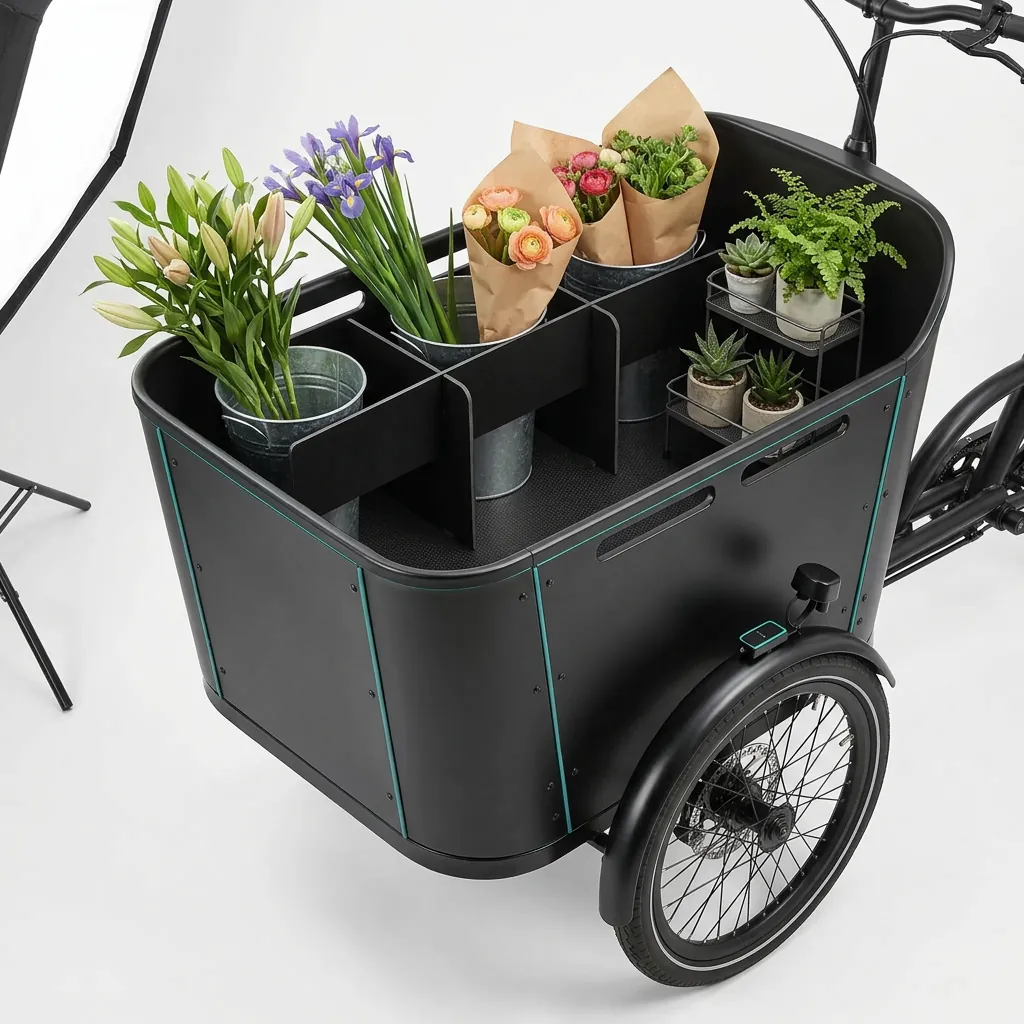
The box on a flower trike holds product the way a florist does. The standard build is a deep, non-skid crate box with dividers that keep buckets and pots upright, plus a rack or slots so tall stands and bouquets can be braced rather than laid flat. A sealed canopy or enclosed box keeps stems out of weather and out of sun, the box options are detailed in our canopy guide. If rounds include live plants, the deeper box with drainage is the build to spec.
Stability and Handling for Fragile Loads
Stems do not like being bumped, and the biggest difference between a trike and a bike for a florist is the ride. A three-wheeler stays level in corners and under braking because it cannot lean, so the load shifts far less. The suspension that softens the ride on rough streets, and the trade-offs between comfort and payload, are covered in our suspension guide, and the tires that soak up kerbs and setts are in our tires guide.
Payload Math: Stems, Arrangements and Vases
A flower route is limited by the number of stands, buckets and arrangements it can brace, but weight is the honest limit. A full bucket of water for stem-holding can be heavy, so the 300 kg (EU) or 500 kg (non-EU) payload rating is worth planning around when a round blends bucket deliveries with finished arrangements.
| Configuration | Payload | Typical Load per Round | Best Use |
|---|---|---|---|
| EU-class crate box | 300 kg | ∏ 10–15 venue stops | Shop and event rounds |
| Non-EU heavy build | 500 kg | Buckets + arrangements + stands | Wholesale and wedding runs |
| Deep box w/ drainage | 300–500 kg | Plants, pots and shrubs | Nursery and landscaping supply |
Range is the second constraint. A loaded trike rated for 50–80 km covers a full flower round, and the 60V vs 72V battery decision is covered in our 60V vs 72V comparison.
Cold and Hydration: Keeping Cut Flowers Fresh
Cut flowers stay freshest when they are kept cool and out of sun. On a trike this is a sealed, shaded box with an insulated compartment rather than a full cold-chamber, enough to hold a morning's stems at a stable temperature between the wholesaler and the venue. The passive vs active cooling trade-offs, the power budget, and route design are covered in our cold-chain guide, and the motor choice for a loaded, start-stop flower route is in our motor power guide.
Motor, Battery and Range on a Stop-Start Flower Round
A florist round is a tight pattern of stop-and-go hops, so the motor that matters is the one that pulls away cleanly with a full load rather than the one that wins a speed test. The cargo line runs a 800W, 1000W or 1200W brushless hub motor with a differential, and on a loaded, frequent-stop round the larger of the two is the safer spec. The standard build starts with a 60V 32Ah NMC pack, or a 72V 40Ah lithium iron phosphate (LFP) pack for hotter climates. LFP holds its capacity across more recharge cycles and shrugs off the afternoon heat that wilts a morning's stems if the trike is parked between rounds. Both feed through a heavy-duty BMS that protects the cells during the hard, high-current starts.
Real range is a payload-dependent figure. A trike carrying 200 kg on a flat route returns 50–80 km at a top speed of 25–35 km/h, which is enough for a full flower round and a second wedding return. The hidden constraint on a shop that runs both a morning wholesale loop and same-day event work is recharge time: a standard 5A charger refills a drained pack in 6–10 hours, so a second swappable battery is the cheapest way to cover two rounds without a midday charge stop. Charger ratios, swap economics and charge-station planning for exactly this dense, two-shift pattern are laid out in our fleet charging guide.
The Economics of a Florist Trike
A florist makes many small trips. Replacing a van with an electric trike removes the commercial-driver cost, cuts energy cost roughly twenty times, and lets a small shop run two or three deliveries a day with one vehicle, a job a van only did once. The suspension and tires are the main wear items on a fragile-load route, both covered in the suspension and tires guides.
Specify a Florist Trike as an OEM Program
Confirm the MOQ . Typically 50 assembled units or 100 with a custom divider and rack layout, then run a sample on a real round: load the buckets and arrangements you actually carry, run the actual route, and verify that stems arrive upright and dry, that the trike starts from a stop with a full load on the worst grade, and that the range survives a detour. The sample strategy, lead time and payment terms are in our OEM buying guide, and first-container planning is in the importing guide.
Spec a Flower Cargo Tricycle
Tell us your stops per day, bucket and stand layout, and whether you need a chilled compartment. We will quote the 800W–1200W cargo tricycle line with dividers, racks and canopy options, FOB China.
