
A vineyard manager does not need a truck that can cross a continent. They need a vehicle that can carry ninety kilos of fruit 400 metres from row 14 to the crush pad, eleven times, without rutting the inter-row, without burning diesel at walking pace, and without a second worker driving it back empty. That is a specific job, and it is the exact job a cargo tricycle is built for. This guide sets out how to specify one for vineyard and orchard work: which geometry constraints are non-negotiable, how harvest weight accumulates across a day, where the platform pays back and where it does not, and the OEM line items to settle before you order.
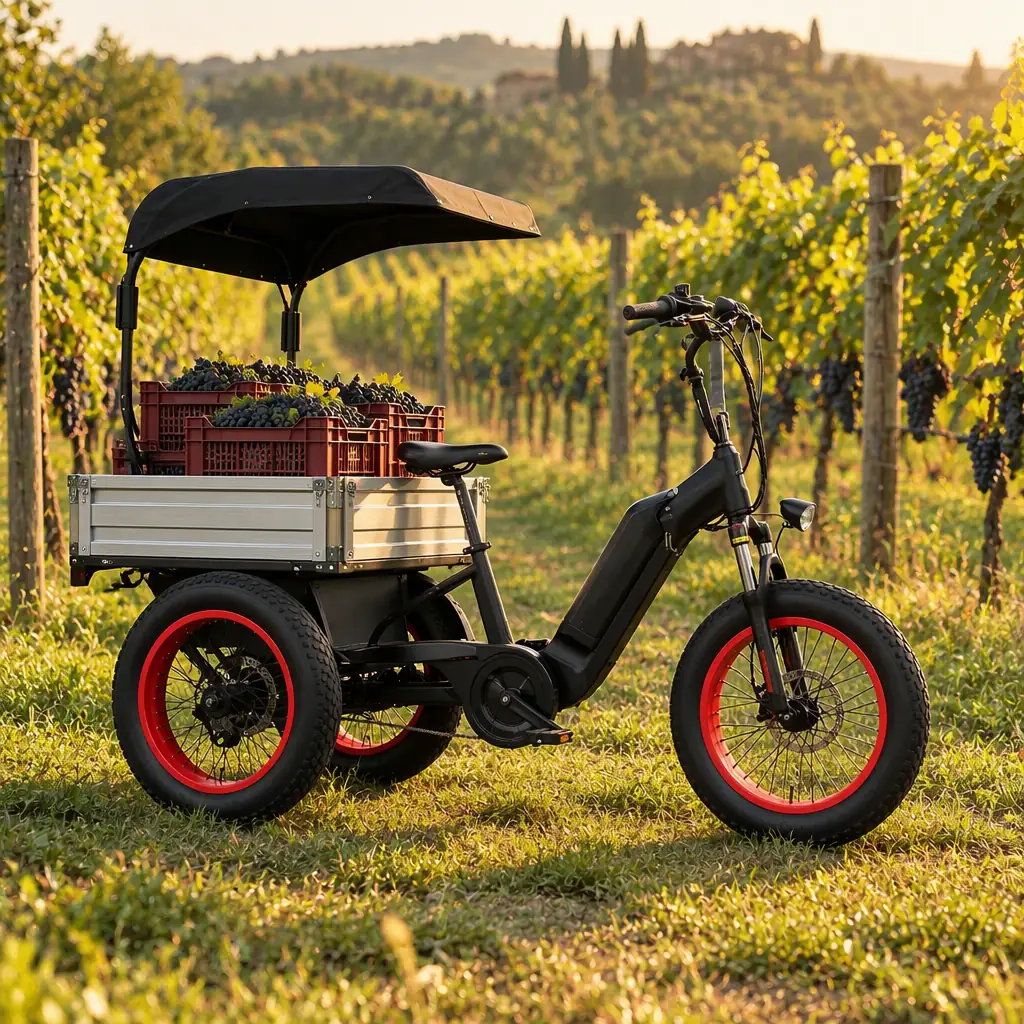
Row geometry comes before motor power
The first thing to measure is not your tonnage. It is your narrowest inter-row gap, your headland turning radius, and the height of your lowest trellis wire. A tricycle that cannot physically enter the row cannot help you, no matter what its payload rating says. Measure these three numbers before you look at a specification sheet.
| Constraint | What to measure | Why it decides the build |
|---|---|---|
| Inter-row clearance | Narrowest gap between vine rows or tree rows, at the trunk | Sets the maximum machine plus box width you can run without damaging cordons or trunks |
| Headland turning | Width of the headland at each row end | The trike must turn and re-enter without a multi-point shuffle; a differential rear axle is what makes this a one-move turn |
| Trellis height | Lowest wire or cross-arm over the row path | Determines whether a canopy clears or must be omitted in-row, which changes fruit protection and rider exposure |
| Ground surface | Cover crop, bare earth, gravel, or grassed headland | Sets tyre choice and whether you need the 1200W hill-climb gearing for a soft, sloping headland |
A standard cargo tricycle platform is built around a 3.00-12 front tyre and dual 3.75-12 rear tyres on a steel tube chassis. Its track is deliberately narrower than a pickup's, which is the whole point in a vineyard: it passes between rows that a utility vehicle would either refuse or damage. Where the headland is tight, the rear differential is not an upgrade you can skip. A dual-rear axle without a differential drags both rear wheels through every tight turn, scuffing the inter-row cover crop and putting a twisting load through the axle. Ask for the differential explicitly.
How harvest weight actually accumulates
Harvest is not a single heavy load. It is the same moderate load repeated for six to ten hours, and how you accumulate it decides which platform tier you need. A full 20 kg crate of fruit is easy to lift and easy to overload a machine with, because nobody stops at one crate.
| Task | Typical load per trip | Trips per shift | Platform tier that fits |
|---|---|---|---|
| Crate shuttle, row end to pad | 80–140 kg (4–7 crates) | 10–20 | Standard 1000W, 60V 32Ah |
| Bulk bin movement on flat ground | 200–300 kg | 3–6 | Heavy-duty 1200W, 72V 40Ah LFP |
| Pruning and canopy debris removal | 60–150 kg loose | 6–12 | Standard 1000W with drop-side body |
| Spray, fertiliser and tool resupply | 100–250 kg | 2–5 | Heavy-duty with flatbed and stake sides |
The platform carries 300 kg in EU configuration and 500 kg in non-EU configuration, with box volumes from 150 to 500 litres. Those numbers are engineering limits for the frame and axle group, not marketing figures, and they assume the load is distributed in the box rather than hanging off one side. The published range of 50–80 km is a loaded figure measured at 200 kg on flat terrain at 25 km/h average: treat it as an upper bound, not a plan. Vineyard work is stop-start at low speed on soft ground, which is a harder duty cycle than flat urban running.
Box configuration: drop-side, flatbed, or tipper
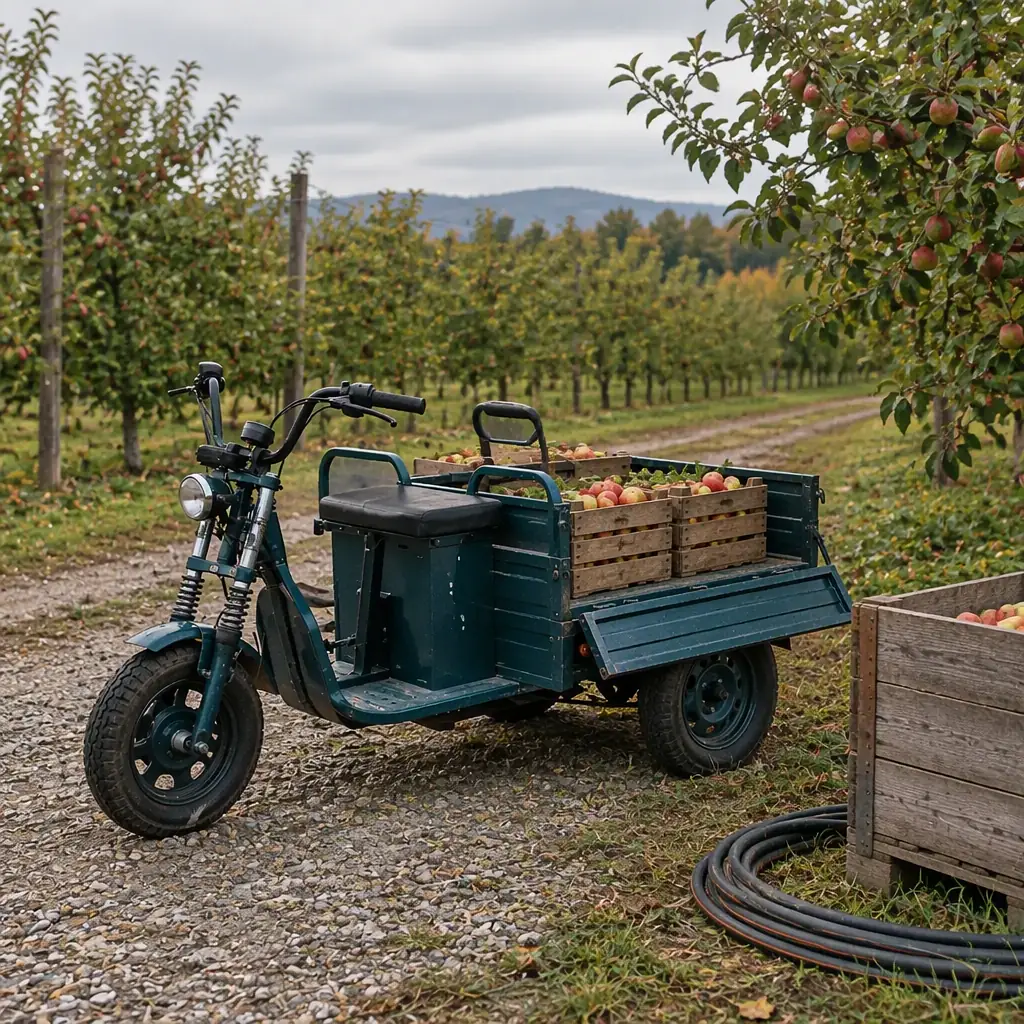
The cargo box is where the platform either fits your operation or does not, and the three factory configurations are genuinely different tools rather than price tiers of one product.
Three-way drop-side body
Drop-sides convert to a flatbed in seconds and let you unload from whichever side faces the pad, the bin or the trailer. For crate work this is the default choice: you load over the low side at row level and unload over the side that faces the collection point, without climbing into the box. If your harvest is handled in crates and trays rather than tipped in bulk, specify drop-sides.
Fixed flatbed with stake sides
The flatbed with stake sides is the right body for pruning debris, posts, wire spools and tool resupply, where the load is irregular and you want maximum usable platform area. It is the least mechanically complex option and the cheapest to repair.
Hydraulic tipper
The factory offers a hydraulic tipper mechanism for construction material, agricultural produce and waste collection. It earns its place where you tip loose produce or green waste at a single fixed point, such as a compost bay or a bulk trailer. It does not replace crates for premium fruit, because tipping crushes what you are trying to sell. Be honest about which of the two you are actually doing.
Charging arithmetic on a working vineyard
Charging is where agricultural buyers most often get caught, and the arithmetic is simple enough to do before you order. The platform charges in 6–10 hours on a 5A charger. That fits a single-shift operation perfectly: plug in at the end of the day at a barn or workshop outlet, unplug in the morning.
A two-shift harvest does not fit. If the same machine must run a morning and an afternoon block through picking, a single overnight charge is not enough, and no amount of additional battery capacity fixes it — the constraint is charge time, not stored energy. Your options are to buy a second machine, to keep a second charged pack and swap it, or to specify a higher-current charger. A vineyard with 300+ fleet units worth of harvest moving off a single pad is a genuine two-machine case during picking week and a one-machine case for the other fifty weeks, which is why the second unit is usually justified as peak cover rather than as additional capacity.
Two options matter more on a vineyard than on an urban route. A solar panel roof trickle-charges the auxiliary battery and adds 8–12 km of daily range, which is meaningful on a low-mileage stop-start circuit but should not be planned around. LFP battery chemistry is what we recommend wherever the machine sits in direct summer sun or works in a hot climate: it costs more energy density and pays it back in cycle life, which matters when the pack is charged every single day of a harvest.
Specification table for vineyard and orchard duty
| Specification | Value |
|---|---|
| Motor | 800W / 1000W / 1200W brushless hub with differential, 60V or 72V |
| Battery | 60V 32Ah / 72V 40Ah lithium, LFP available, heavy-duty BMS |
| Range (loaded) | 50–80 km at 200 kg on flat terrain |
| Payload | 300 kg (EU) / 500 kg (non-EU) |
| Box volume | 150–500 L, drop-side or fixed, insulated lining optional |
| Brakes | Hydraulic disc front, dual drum rear, parking brake |
| Tyres | 3.00-12 front, 3.75-12 rear dual, reinforced load-rated |
| Kerb weight | 150–220 kg without cargo box |
| Charging | 6–10 hours on 5A charger |
| Top speed | 25–35 km/h, governor adjustable |
| Compliance | CE, RoHS, UN 38.3, ECE R10 (EMC) |
| MOQ / lead time | 50 units, 15–30 days standard, 30–45 days first custom-branded run |
The brake specification deserves a note for any orchard on sloping ground, because it is not a fitment you can revisit later. Hydraulic disc braking at the front carries the majority of deceleration force, and the dual drum rear brakes are sealed against the dust and mud that a working vineyard throws up — which is exactly why they are used on this platform rather than a second disc. On a laden descent with a full crate load aboard, brakes are the constraint that decides whether the route is safe to plan. If your rows drain downhill to a public road, size the machine for that descent rather than for the flat. The brake system guide covers the full spec.
Slope handling: gearing, not battery capacity
A sloping headland or a terraced block does not call for a bigger battery. It calls for hill-climb gearing and more motor headroom. Motor power on this platform scales from 800W for flat urban routes to 1200W with hill-climb gearing, and on vineyard terrain the 1200W tier is the honest choice whether or not your tonnage seems to require it. Range estimates are quoted on flat terrain; a sustained gradient reduces them, and the correct fix is the gearing tier, not a pack you do not need.
Where the trike pays back, and where it does not
The one number to settle first: your narrowest inter-row gap at the trunk line. Payload tiers, motor power and box body are all negotiable against budget, but row clearance is not. A platform that cannot enter the row has no payload rating worth quoting, so measure the gap, the headland and the trellis height before you compare any specifications.
The economics of a vineyard tricycle are not about replacing a truck. They are about removing the single most wasteful movement in the day: the return trip. A pickup that carries crates from the row end to the pad makes the same journey back empty, every time, all season.
| Use case | Tricycle is the right answer | Keep the tractor or pickup |
|---|---|---|
| Crate shuttle, row end to pad | Yes — short, repeated, low-speed, narrow access | — |
| In-row picking platform | Yes if the machine fits the inter-row and trellis | — |
| Tool, wire and spray resupply | Yes — flatbed with stake sides | — |
| Bulk bin movement across open ground | — | Yes — tractor loader territory |
| Road haulage to the winery | — | Yes — a non-road-registered platform is not a road vehicle |
| Steep, soft, rutted blocks after rain | — | Yes — know your wet-weather limits |
Be clear about the boundary, because it keeps you out of trouble twice over. A cargo tricycle built on this platform is not a road-registered vehicle in most markets. It is a work machine for private land. Moving fruit down a public highway on it is a different legal question in every jurisdiction, and the honest answer is that it is what the pickup is for. Inside the gate, the reverse is true: the tricycle is cheaper to run, quieter at a 5 a.m. start, does not compact the inter-row the way a heavier machine does, and needs no second worker standing by to move it 200 metres.
Quiet operation and the early start
A vineyard tricycle runs without an engine note. For crews starting before neighbours are awake, or for blocks near a dwelling, that is not a comfort feature — it is what makes the early shift possible at all. The full LED lighting package, with an optional beacon light and reflectors, covers the dim end of the working day on both ends of a harvest shift.
OEM line items to settle before you order
The orderable options on this platform are the ones that decide whether the vehicle fits the job. Configure them at quotation, because retrofitting a cage, a partition or an interface costs more than specifying it.
- Cargo box dimensions and material — aluminium sheet, steel, or insulated sandwich panel; fixed, drop-side or tipper body.
- Canopy or rain cover — for produce protection and rider exposure; omit it in-row if your trellis height will not clear, and see the canopy guide for how roof type changes range and payload.
- Shelving and interior partition — separates crate tiers so a harvest load cannot shift and crush the lower layer.
- Motor power tier — 800W to 1200W with hill-climb gearing, chosen against your headland gradient rather than your flat-ground tonnage.
- Battery chemistry — LFP for hot, high-sun sites; the platform quotes 12 months or 2,000 charge cycles for LFP against 12 months or 800 cycles for NMC, whichever comes first.
- Tyre specification — 3.00-12 front and 3.75-12 rear dual, load-rated and reinforced; the tyre guide covers how tread choice interacts with grassed and gravel headlands.
- Solar panel roof — 8–12 km of additional daily range on low-mileage circuits.
- Box branding — vinyl wrap, paint, or silkscreen for estate identity.
Warranty coverage on this platform runs 24 months on frame and cargo box structure against manufacturing defects, weld failure and structural deformation under rated load; 18 months on the motor and differential axle; 18 months on the controller including water ingress; 18 months on hydraulic brake components; and 12 months or the cycle limit on the pack. Spare parts ship at 1% of order value, including brake pads, inner tubes, bulbs, fuses and one spare controller per 25 units, packed into the container. On a vineyard that is the difference between a machine that runs all harvest and one that waits two weeks for a part — confirm the spares list at order, not after a failure. The after-sales and spare parts guide sets out what to specify.
Frequently asked questions
Can a cargo tricycle replace a tractor on a vineyard?
No, and it should not be positioned that way. It replaces the repeated short-haul trips a pickup or tractor does inefficiently — crate shuttle, in-row picking runs, tool and wire resupply — while the tractor keeps the jobs it is actually good at, which is bulk bin movement, steep or rutted ground, and road haulage to the winery. Buying the tricycle as an additional machine for a defined duty is the framing that works; buying it as a tractor substitute is the framing that disappoints.
What payload do I need for harvesting?
Most harvesting shuttle work fits inside 80–140 kg per trip, which the standard 1000W tier handles comfortably. Move to the heavy-duty 1200W tier with 72V 40Ah LFP if you are also moving bulk bins or doing spray and fertiliser resupply at 200–300 kg. The platform's ceiling is 300 kg in EU configuration and 500 kg in non-EU configuration, measured as a frame and axle limit, not a suggestion.
Will it fit between my vine rows?
That depends on your inter-row gap, not on the model. Measure the narrowest gap between rows at the trunk line and the width of your headland turns before you specify anything. The platform's chassis is narrower than a utility vehicle by design, but there is no universal answer: an inter-row that clears a well-managed trellis in one block can be too tight in another. Send us your measurements and the engineering desk will confirm the build against them.
How do I charge it during harvest?
From any standard outlet at a barn or workshop, on the supplied 5A charger, in 6–10 hours. That covers a single-shift operation completely. If harvest runs two shifts of the same machine, plan for a second unit, a second charged pack to swap, or a higher-current charger, because the limiting factor is charge time rather than battery capacity. Where mains power is not available at the row end, the fleet charging guide covers depot and swap arrangements.
Spec a vineyard trike against your own rows
Every decision in this guide comes back to four measurements you already have access to: inter-row gap, headland width, trellis height and headland gradient. Get those numbers, decide the box configuration, choose the motor tier against the worst slope you will actually work, and the rest of the specification falls into place. Do that and the machine becomes a seasonal workhorse that pays for itself in removed return trips; skip it and you buy a narrow vehicle with the wrong body.
Send us your row measurements, headland condition and the loads you move per trip. The engineering desk will return a platform configuration with box body, motor tier, battery chemistry, tyre specification and the compliance package for your market. If you are still deciding whether the tricycle case holds on your property at all, start from the farm and ranch duty guide, the comparison against a golf cart, and the trailer towing guide for the harvest loads that need a towed bin.
Spec a Vineyard Trike Against Your Own Rows
Send us your inter-row gap, headland width, trellis height and the loads you move per trip. We will return the platform configuration, box body, motor tier and battery chemistry for your ground, with the compliance package for your market.
