
Ask three cargo tricycle factories for monthly capacity and you will get three round numbers: 2,000 units, 5,000 units, 10,000 units. None of them is a lie, and none of them is an answer. Capacity is not a figure a factory has. It is a figure a factory has for a given mix, at a given labour configuration, on a given week. A line that builds folding e-bikes at one rhythm builds a loaded cargo trike at quite another.
This article is the audit we would expect a serious buyer to run on us. It works from the inside of the process outward, because the numbers that matter are the ones a factory cannot restate without also restating its line layout, its sampling plan and its change-control rules. If a supplier cannot walk you through those three things, the capacity number it gave you is marketing. For the commercial and compliance layer of the same purchase, our cargo e-tricycle OEM guide covers moq, pricing and market certification; this article starts where that one stops, at the production line.

Why a Monthly Output Number Cannot Be Audited
A monthly figure is the product of four variables, and a buyer is only ever told the last one. The first is the number of parallel final assembly lines. The second is the takt time, the seconds each station is allowed per unit. The third is the number of shifts and working days assumed. The fourth is the model mix, because a cargo trike and a folding e-bike do not consume the same line time. Change any one of those and the output figure moves by multiples, not percentages.
That is why an audit question should never be "what is your capacity". It should be "walk me through station eight". A factory that has actually measured its line can give you the takt time for each station and the current unit mix behind the headline number. A factory that has not will answer in adjectives.
The Line Rhythm Test: Reverse-Engineering Output From Takt Time
The most reliable capacity check available to a buyer is arithmetic, because it does not depend on the supplier's honesty at all. Ask for the station list on a final assembly line, the takt time at each station, and the number of operators. Then check whether the numbers reconcile with the monthly output claim.
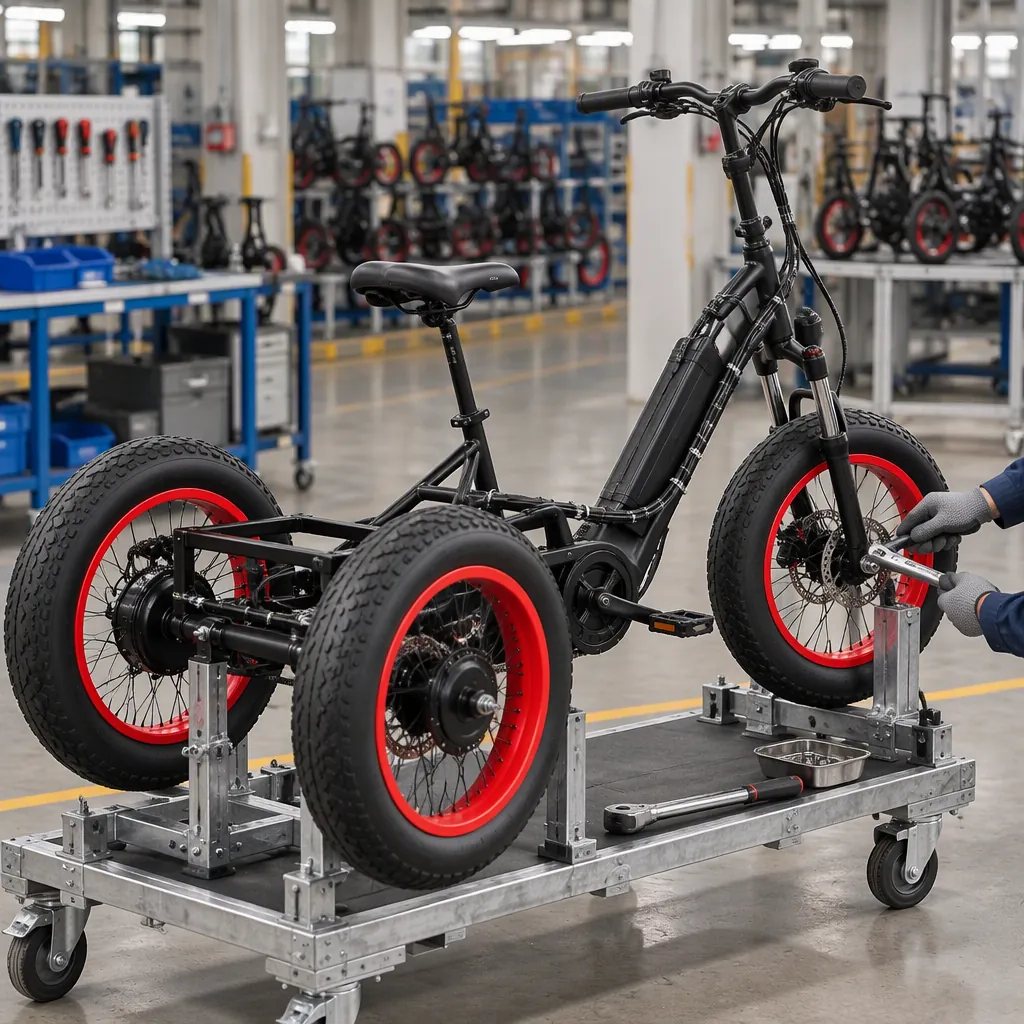
On a tricycle line, the rhythm is set by the slowest station, not the average. Final test is normally the bottleneck: a dynamometer roll with a load ramp, an IP54 spray pass and an insulation resistance check at 500V DC takes minutes, not seconds, and it is not a station you can rush by adding an operator. A useful audit exercise is to divide the claimed monthly output by the working days and shifts, convert it into seconds per unit, and compare that against the takt time the supplier has just told you. If the claim implies a shorter per-unit cycle than the bottleneck station physically takes, the claim has been built on an unstated assumption: a second line, a third shift, or a different product mix.
Any of those three may be true. None of them is a problem, provided the supplier says which one it is using. A supplier that cannot name the assumption is quoting you a number it has not modelled.
The secondary check is the model-mix sentence. Ask directly: "what share of that monthly figure is cargo tricycles, and what share is e-bikes and scooters?" A factory running mixed-model scheduling will answer precisely, because mix scheduling is a real constraint it manages weekly. Factories that build one model in one long campaign answer in campaign lengths, which is also a usable answer. The evasive answer, where mix is waved away as irrelevant, is the one to treat as a red flag.
What the IQC Gate Tells You About Whether Capacity Is Real
Capacity that has not been stress-tested upstream is capacity waiting to fail. The incoming quality gate is where you find out how much line time the factory actually spends absorbing supplier variability, and whether that cost has been built into the schedule it quoted you.
Three questions about incoming inspection are enough to separate a sampled gate from a decorative one:
- What sampling standard, and what level? An AQL 2.5 Level II incoming gate is a genuine statistical commitment. "We check every batch" without a standard usually means a visual once-over that is not recorded.
- What happens to a failing cell? Lithium cells that fall outside the internal resistance and open-circuit voltage windows should be rejected to quarantine with a written disposition, not quietly blended back into the next build.
- What triggers a supplier audit? A rule with a number and a clock in it, such as two incoming failures in a quarter triggering an on-site audit within fourteen days, tells you the gate has teeth. A general commitment to quality tells you nothing.
This matters for capacity specifically because a weak incoming gate does not reduce output. It moves defects downstream, where they consume rework hours at the final test station, which is the station that sets your takt time. A factory can therefore hit its monthly unit number and still ship late, because the units it counted included ones that came back off the line.
Outgoing Sampling: The Difference Between Counted and Shippable
The outgoing gate answers a different question: of the units counted, how many are actually release-quality. Sampling plans differ enormously between factories, and the difference is easy to quantify once you know the batch size and the standard.
Take a 200-unit batch. Under an AQL 1.0 Level II outgoing plan, the sample size is 50 units, with zero critical defects, zero major defects and at most one minor defect accepted. Under the more common AQL 2.5 plan, the same sample size tolerates several minor defects. Neither plan is dishonest; they are simply different promises about what "finished" means. Ask which one applies to your order, in writing, and ask what the critical defect list contains. It should name electrical system failure, brake failure at any wheel, structural weld or frame defects, battery swelling or voltage anomalies, and any condition that creates a risk to the end user.
A factory that can recite its critical defect list without looking it up is a factory that has argued about it internally. That is the behaviour you want, because a critical defect list that has never been contested is usually a list nobody is using.
BOM Freeze and the Cost of a Late Change
The single most useful process question in a capacity audit is not about machines. It is: "when does my bill of materials freeze, and what happens if I change something after that?"
In a properly controlled programme, the purchase order is entered with a frozen bill of materials, and cell, motor, frame and component suppliers are booked against the confirmed delivery date. A specification change after that freeze does not adjust the existing order. It moves the order to the next production slot. That is the correct behaviour, because a change that rides along inside a running build is how a container arrives with two incompatible batches of a part that was supposed to be one specification.
For a buyer, the practical consequence is scheduling. If the freeze date is real and enforced, then every brand decision has a deadline, and the deadline is roughly the lead time for the longest component. Buyers who learn this early negotiate calmly and change little. Buyers who learn it late discover that their "small colour change" costs them a month. Our private-label tricycle programme guide covers the brand asset decisions that must be settled before that freeze.
Sample Turnaround as a Leading Indicator
Sample lead time is a small, cheap, honest proxy for the production system behind it, and it is worth measuring because it is observable before you commit to a container.
The numbers to ask for are the three that a programme normally publishes separately: stock samples, custom-branded samples, and samples requiring new tooling. Those three turnarounds diverge sharply, and the gap between them tells you where the real constraint sits. If custom-branded samples take dramatically longer than stock samples, the factory's decal and colour-change process is the weak link, and that same process will slow every reorder. If tooling-dependent samples take far longer again, the limitation is tooling capacity, which matters to you only if you intend to change the frame or the box.
An audit that skips this step tends to over-weight the factory tour, which shows you the best line in its best hour, and under-weight the change process, which is what you will actually experience for the next three years.
Six Questions to Ask on the Video Walk
A factory tour is useful if it is treated as an inspection rather than a presentation. Ask to walk the line on a live call and steer the camera rather than accepting a pre-recorded segment. These six questions produce answers that are hard to prepare in advance:
- "Which station is my bottleneck right now, and what is its takt time?" A credible answer names a station and a number of seconds, and usually sounds slightly defensive because bottlenecks are unfashionable.
- "How many final lines are running this week, and what models are on them?" This tests the parallel-line claim and the mixed-model scheduling claim in the same breath.
- "Show me the quarantine bin and the rejection record from this month." Every real incoming gate has a bin that fills. An empty bin with a perfect record is a signal, not a compliment.
- "Show me the torque record for the last unit off this line." Safety-critical fastener records tied to a unit serial number are the single clearest difference between a line that is instrumented and a line that is merely busy.
- "What was the last line stop, why, and how long did it take to clear?" A factory that answers in minutes is managing the line. A factory that cannot remember is not collecting the data.
- "If I need to add thirty per cent volume in the fourth quarter, what specifically changes?" The answer should be a combination of a shift, a line allocation and a component booking, not a reassurance.
Reading the Certificate Set Without Over-Reading It
Certification is necessary and frequently misread. The point of a certificate audit is not to collect logos; it is to establish which standard applies to which market, and which party is the certification holder of record.
For a cargo tricycle programme, the relevant set usually includes CE machinery and EMC documentation for the European Union, RoHS declarations maintained per component revision, UL 2849 and UL 2271 for the North American electrical system and battery, FCC for controller and telemetry emissions, the EN 15194 and EN 50604 standards alongside eMark ECE R136 where the vehicle is being placed in a regulated lane, and UN 38.3 for battery transport. Ask to see the actual test reports for the product family you are buying, not a marketing page listing standards. Ask too who holds the declaration and whether re-verification is needed for your specific market.
Two practical notes. First, RoHS and REACH declarations have to be maintained per component revision, so a declaration set that has not moved since an earlier component change is stale. Second, UN 38.3 is a transport document, and it is the single most common reason a booking slips, so confirm it is compiled with the order rather than produced on request. Our EU versus US certification comparison covers which documents each market actually checks.
Putting Numbers to the Schedule
Once you have the process answers, the commercial schedule becomes checkable rather than aspirational. The structure that a controlled programme should be able to publish is a chain, not a promise: a documented sample stage with distinct turnarounds for stock, branded and tooling- dependent units; a defined point after which the bill of materials is frozen; a production window that begins once the deposit is confirmed; and an inspection window placed close enough to shipment that the findings are still actionable.
Ask the supplier to state each link with its own duration and, critically, to name what invalidates it. A schedule where nothing can be invalidated is not a schedule. A schedule where the invalidation triggers are explicit, such as a specification change after freeze or a component substitution, is one you can plan a launch against.
| Audit Dimension | Question That Produces a Checkable Answer | What a Weak Answer Looks Like |
|---|---|---|
| Line capacity | Bottleneck station and its takt time, lines running this week, model mix share of the claimed figure | A single rounded monthly number with no station detail |
| Incoming gate | Sampling standard and level, cell rejection criteria, supplier audit trigger with a number and a clock | "We inspect everything" with no standard, no records |
| Outgoing gate | Sampling plan for your batch size, written critical defect list | Sample size quoted without a standard |
| Change control | Bill of materials freeze point and what a late change does to the slot | Changes accepted at any stage, unspecified consequences |
| Traceability | Torque and test record retrievable against a unit serial number | Records kept per batch, not per unit |
| Documentation | Test reports for your product family held on file, UN 38.3 compiled with the order | Certificate logos without reports, documents on request |
Planning Loads Around the Real Number
Capacity auditing has an immediate commercial application that buyers often miss: it tells you how to structure your first and second orders rather than just which factory to choose.
Once you know the bottleneck and the freeze point, the sensible first order is the one that fits inside a single production slot with a generous inspection window, sized to fill a container cleanly. Volume spread across several small orders stresses the change process repeatedly; a single consolidated order stresses it once. The second order is then where you test the ramp, using the volume question above to see whether the factory's answer matched what actually happened. Our first container loading and shipping guide covers the container arithmetic, and our heavy-duty cargo tricycle OEM guide covers how the specification side of the order is settled.
The audit conclusions worth writing down are short: the bottleneck station and its takt, the monthly figure with its assumptions named, the sampling standards at both gates, the freeze point, and the two or three answers that felt rehearsed. That document is what you compare a supplier against in year two, and it is considerably more useful than the quote.
For a wider view of how platform choice interacts with sourcing, our payload and capacity engineering guide covers the vehicle side, and the manufacturing process walkthrough covers the build sequence station by station. Buyers running a competitive tender can use both alongside the audit questions above to compare submissions on the same footing, and the China to US tricycle market analysis is useful context for why so many programmes are sourcing from the same region in the first place.
Audit our line before you audit our quote
Send us your target model, annual volume and destination market. We will return the station list and takt times for the line your order would run on, the sampling standards at both quality gates, the bill-of-materials freeze date for your slot, and the certificate set for your market, usually within one business day. Video walk of the line available on request.
