
A tool hire counter sells availability, not vehicles. The customer who walks in on a Saturday morning does not want to hear that the cargo trike is excellent; they want to hear that it is on the trailer in ten minutes and that it will still be working when they get to the job. Those are fleet-management promises, and a trike either supports them or quietly breaks them.
That distinction is why hire fleets specify differently from the businesses that own and operate their own trikes. An operator buys a vehicle for its own duty cycle and amortises it over years of predictable use. A hire desk buys a vehicle that has to survive unpredictable use by dozens of different customers, be turned around in minutes between them, and still be worth something when it is sold at three years old. This guide works through the specification decisions that follow from that difference, in the order a hire manager actually meets them.
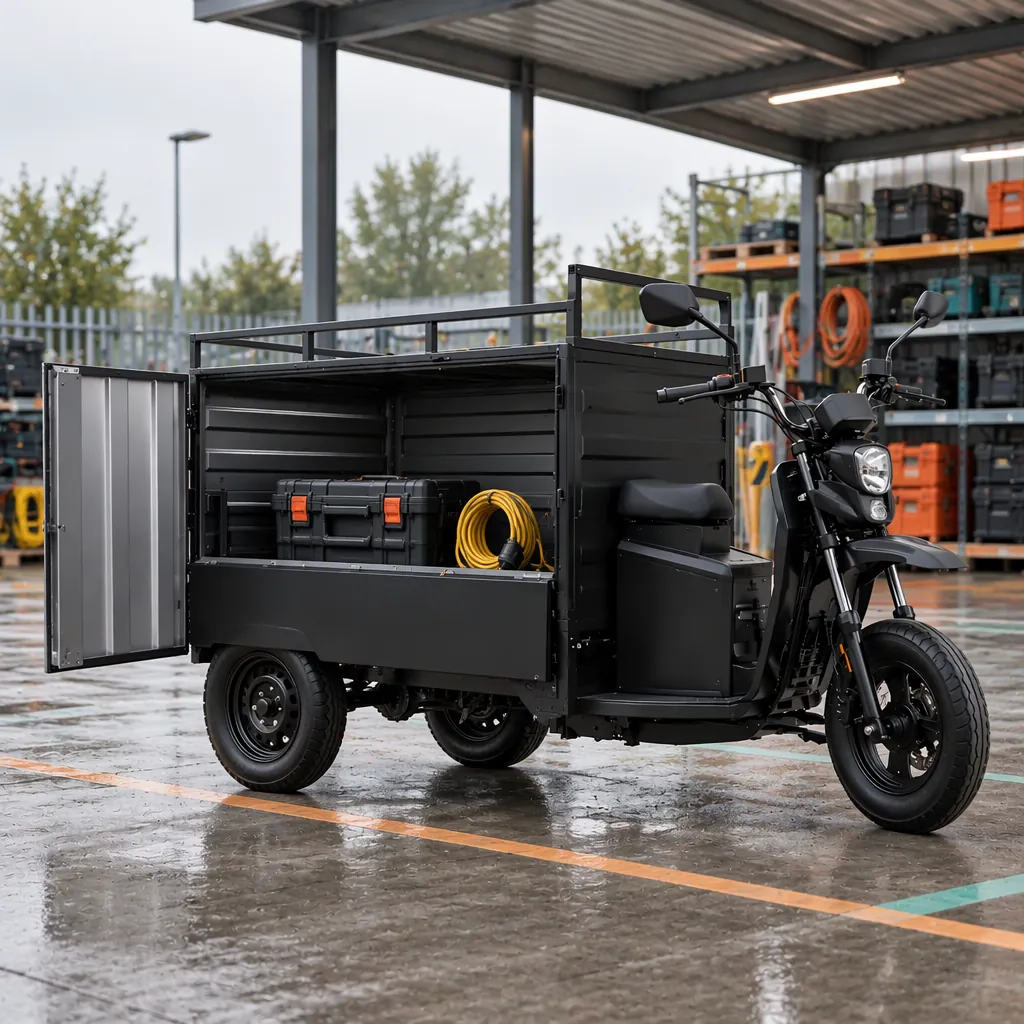
Why Hire Duty Is Not Operator Duty
The first thing a hire fleet discovers is that the vehicle's own duty cycle is the smallest part of the problem. The trike spends far more time being checked, cleaned, charged and moved between customers than it spends working. What wears it out is not distance, it is handling by people who have no reason to be careful.
Four properties of hire use drive every specification decision downstream:
- The user changes every hire. A machine that leaves on Monday with an experienced landscaper may come back on Wednesday having been loaded by someone who has never driven a three-wheeler. Controls have to be legible and forgiving to a first-time operator, not tuned for a skilled one.
- Nobody reports the small damage. An operator's own driver mentions the bent bracket. A hire customer does not, because mentioning it invites a charge. Faults are therefore discovered at the counter, not at the point of failure, and the counter inspection has to be fast and repeatable.
- The asset has a resale date. Hire fleets turn over vehicles on a schedule, and residual value depends on condition at disposal. Cosmetic robustness is a financial parameter in hire in a way it rarely is for an owner-operator.
- Utilisation is the revenue line. Every hour a vehicle spends waiting for a part or an approval is revenue that cannot be recovered. The specification decisions that matter most are the ones that keep units in the available pool.
An operator optimising for these four properties will end up with a different vehicle from one optimising for a single known duty cycle, even at the same payload class. The rest of this guide is about which differences actually change the order.
The Handover Turns the Vehicle Into a Service
A hire counter's real product is a handover that takes minutes. Everything about how the vehicle is configured either shortens that handover or lengthens it, and the difference compounds across every hire in the year.
Three physical properties determine how fast a unit can go back out:
| Property | What it changes at the counter | Specification that helps |
|---|---|---|
| Charge state at return | Whether the unit is available today or tomorrow | A charger sized so a partial top-up completes inside the turnaround window, not one that needs a full cycle |
| Access to the working parts | Whether a brake or cable adjustment is a five-minute job or a docked half-day | Panels and covers that come off with common tools; brake and cable adjusters reachable without removing the cargo box |
| Condition visibility | Whether damage is recorded at handover or discovered by the next customer | Wheels, tyres and box corners visible on a walk-around without kneeling or opening anything |
The charge-state line is the one hire managers underestimate. A vehicle returned at 30 percent is not available this afternoon, and the counter has to either refuse the next booking or substitute a different unit. Sizing a charger to refill a realistic partial discharge inside the turnaround window does more for availability than buying a larger battery, because the larger battery mostly delays the moment the unit enters the charge queue.
The access line is where an owner-operator specification actively hurts a hire fleet. Cargo box designs that enclose and protect the drivetrain are right for a single operator who values protection, and wrong for a hire desk that needs a brake cable changed between hires. Ask suppliers how long a routine brake adjustment takes with the box fitted, and treat a vague answer as a no.
What to Record on Every Hire
Hire businesses already record who has the vehicle. The record that protects the fleet is the condition record, and its value depends entirely on it being fast enough that staff actually complete it when the queue is long.
A useful condition record for a cargo trike covers a short list of items, each of which fails visibly before it fails functionally:
- Tyres in four places rather than one, because a hire machine is loaded unevenly by users who do not think about weight distribution. Check tread at each wheel and record pressure, not just a pass or fail.
- Box and drop-sides: hinge play, latch engagement, and the lower edges where loading damage shows up first. Photograph the box interior empty on handover, so the next customer's damage claim has a baseline.
- Brake lever travel and parking brake hold, tested at the counter rather than described. A parking brake that no longer holds on a slope is the most common unreported fault on a hire trike and the one most likely to cause an incident.
- Battery state of charge and charge port condition. Record the percentage rather than a colour, and inspect the port for bent pins, which is a direct consequence of connectors being mated by unfamiliar users.
- Lights, beacon and any warning equipment, because these are the items a customer notices last and the regulator notices first.
Two of these items, brake hold and charge port condition, are worth more than the rest combined. Both fail silently, both are caused by user behaviour rather than by mileage, and both produce expensive consequences: a rollaway on a slope, or a burnt connector that takes the unit out of the pool for a week. A condition record that captures them at every handover is cheaper than any telematics package.
The Wear Items That Actually Break in Hire
Hire fleets accumulate maintenance data faster than owner-operators, and the pattern is consistent across mixed-customer use: the failures cluster around the interfaces between the vehicle and the person, not around the drivetrain.
In practice the recurring items are tyres and tubes, brake pads and cables, charge ports and connector pins, box latches and hinges, and the fixings that hold the box and any racking to the chassis. Drivetrain failures are comparatively rare, which is worth stating plainly because it inverts the usual specification conversation. Buyers who optimise motor power and battery capacity for a hire fleet are usually optimising the part that least often fails.
The exception is the chassis fasteners. A hire vehicle is loaded and unloaded by people who do not know its limits, and the loads arrive as impacts rather than as gradual weight. Fasteners that loosen under that treatment are the earliest warning sign, and a scheduled torque check at a fixed interval costs less than the panel damage that follows a loosened box mounting.
The corrective action is not to over-specify the drivetrain but to standardise the consumables. A hire fleet that can hold one tyre size, one brake pad shape and one charge connector across the whole cargo trike pool carries less stock, trains staff once, and can swap a wheel between units when a customer is waiting. Tyre and brake specifications are covered in more detail in our guide to cargo tricycle tyres and the brake system guide, both of which matter more to hire utilisation than they do to a single operator.
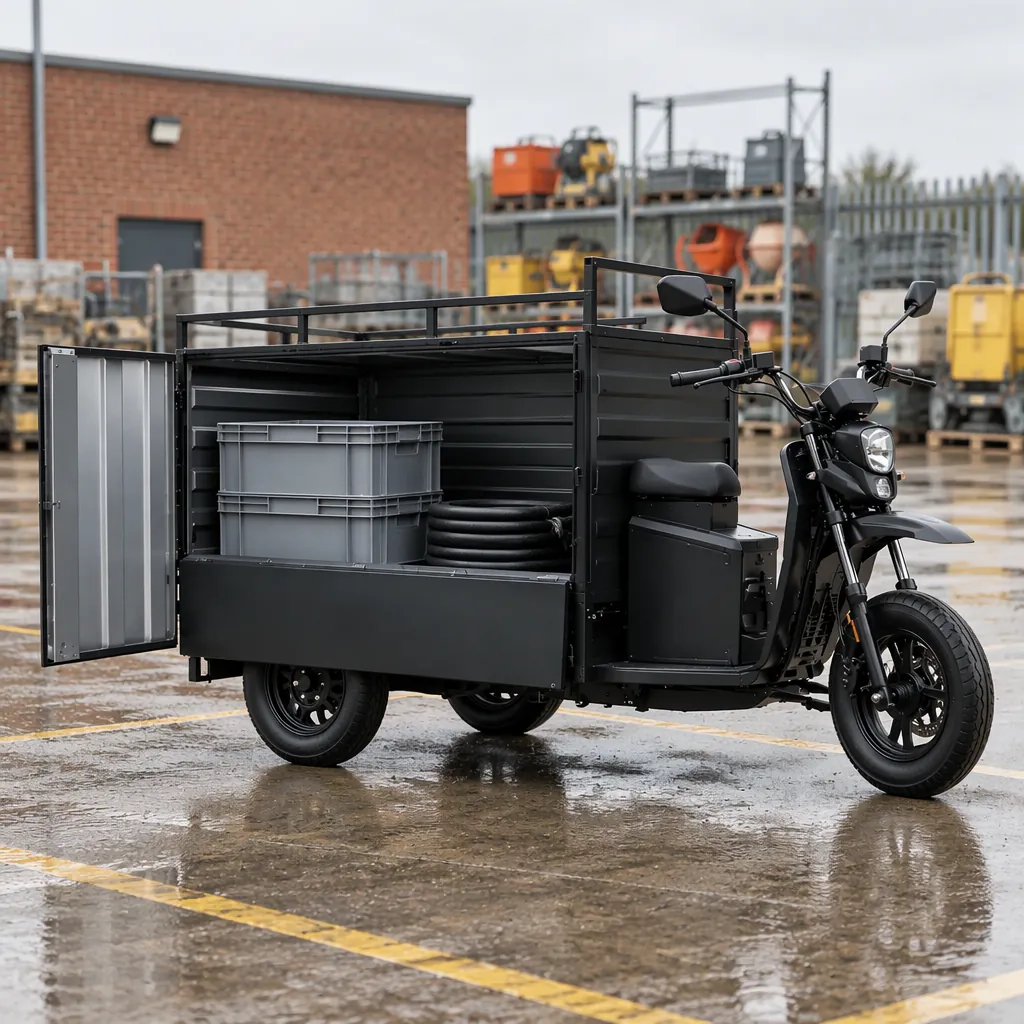
Pricing Structure Before Vehicle Choice
The hire rate structure usually decides the platform before any specification question is asked. A fleet priced by the day with unlimited mileage has different needs from one priced by the week with a delivery charge, and the two will not want the same battery.
Day-rate hire rewards vehicles that are quick to return to service, because the revenue unit is short and a unit in the workshop loses a whole booking. Week-rate hire rewards vehicles that can complete a job on a single charge, because the customer's complaint is about returning to swap batteries mid-job. A hybrid structure, common in tool hire generally, ends up wanting both properties and should be quoted against the stricter of the two.
Two further commercial decisions belong in this stage rather than later. The first is whether the fleet offers a delivery and collection service, which turns the vehicle into a transported asset and makes weight and tie-down points a specification item rather than a logistics detail. The second is whether damage is charged back, which determines how good the condition record has to be. A fleet that never charges for damage does not need a photographic record and will not maintain one, so the specification should not assume it exists.
Fleet Sizing: The Arithmetic That Decides Unit Count
Hire fleet size is not a marketing decision, it is a queueing calculation, and it is the calculation most often done wrong. The number of vehicles needed depends on the utilisation target and the turnaround time, not on how many customers the business would like to serve.
The relationship is straightforward. If a unit is booked for an average of six hours a day and needs two hours of turnaround for charging, cleaning and inspection, it can support at most one hire per day and only if the turnaround happens outside the booking window. Reducing turnaround to one hour by charging during the hire, or by having a second charged battery available, adds meaningful capacity to a fleet without buying another vehicle.
Two conclusions follow for the order. First, spare batteries or a second charger are usually cheaper than an additional vehicle per unit of added availability, and they should be quoted alongside the order rather than treated as accessories. Second, the turnaround figure should be measured rather than assumed during a pilot, because it is the parameter that moves fleet size most and the one a supplier cannot tell you. Our guide to fleet charging dock stations covers the bay layout side of this arithmetic, and the fleet financing guide covers how the same numbers feed a lease or hire-purchase decision.
What the Order Should Specify for a Hire Pool
A hire order differs from an operator order less in the vehicle than in what surrounds it. The following items belong in the enquiry, and a supplier who cannot quote them is selling a one-off vehicle rather than a fleet.
| Item | Why it matters in hire | What to ask for |
|---|---|---|
| Standardised consumables | Shared stock across the pool | Written list of tyre, tube, pad and connector part numbers used across the platform |
| Key and access control | One key per hire, no master key loss | Keyed-alike option within the fleet, plus a stated policy on replacement keys |
| Spare parts commitment | Units stay in the available pool | Availability period and lead time for the five wear items listed earlier |
| Battery handling | Charging happens at the depot, often indoors | Removable pack with a documented charge procedure and a stated cycle life |
| Documentation per unit | Resale and compliance at disposal | Serial-numbered documentation pack per vehicle, not one pack per order |
The spare parts commitment is the item that separates a viable hire fleet from an expensive one, and it is the item most often left vague. A hire business can tolerate a vehicle that needs a part occasionally; it cannot tolerate waiting weeks for one, because the booking is lost and the customer does not come back. Our guide to after-sales and spare parts sets out what a workable commitment looks like, and the OEM ordering guide covers how to write it into the order rather than leaving it verbal.
Keying is a small item with an outsized effect on administration. Keyed-alike units mean a customer can be handed any available vehicle, which is what makes a pool behave like a pool. Individual keys mean every booking is tied to a specific unit, and the first lost key removes that vehicle from availability until it is re-keyed.
The Pilot That Proves the Numbers
A hire pilot is not a test of whether the trike works. It is a measurement of the parameters the business plan depends on, and those parameters are nearly all internal to the hire operation rather than to the vehicle.
Four measurements justify a pilot before a full order, and each one maps directly to a decision:
- Turnaround time, measured from return to available. Stopwatch it across at least twenty hires, including charge time. This figure sets fleet size more than any other.
- Damage rate per hire, by item. Record which parts take damage and how often. A pattern in one item means a specification change, not a training problem.
- Hire duration distribution. The mean is less useful than the spread, because the fleet has to cover the long hires, and a small number of multi-day bookings determines peak demand for units.
- Charge behaviour in practice. What state vehicles actually come back in, which is almost never the state a supplier assumes. This decides whether a second battery or a faster charger is the right purchase.
A supplier can support this stage by providing pre-production samples with the exact configuration being considered, which is standard practice for fleet orders and the only way to measure turnaround on the real vehicle rather than a demonstrator. The field service fleet guide covers a related problem, sizing a fleet around call territory rather than bookings, and the same discipline of measuring before committing applies to both.
Where a Hire Trike Stops Making Sense
Hire fleets have failure modes that owner-operators do not, and they are worth stating plainly because they eliminate some businesses from the model before any vehicle is bought.
The first is a customer base that expects a van. If most hires involve moving material that needs a weatherproof enclosed load bay at road speed, a cargo trike will be substituted for a van on most bookings and the fleet will be under-utilised. The second is a depot without a covered charging area, because charging is the operation's bottleneck and doing it outdoors in winter extends turnaround at exactly the season when hire demand for outdoor work is lowest. The third is a hire duration distribution weighted heavily toward multi-week rentals, where the customer's own transport becomes viable and a trike is rarely the first choice.
Where these conditions do not apply, the model works well: short-duration, local, load-carrying hires where the customer has no van and does not want to rent one. That describes a large share of the tool hire, garden machinery and small contractor market, which is why the format has been spreading through it. Related hire models are covered in the e-bike rental fleet guide, which addresses consumer rental rather than tool hire and has a different utilisation profile, and in the fleet financing guide for businesses buying the pool on terms rather than outright.
Building the Fleet Around Utilisation
The specification decisions in this guide converge on a single principle: a hire fleet is bought for the hours it is available, not for the hours it works. Every choice that shortens turnaround, standardises consumables or makes a fault visible at the counter adds availability, and availability is what the customer is paying for.
That principle points to a platform rather than a model. A cargo trike with a documented consumables list, accessible service points, a removable pack and a chassis whose fixings tolerate impact loading will support a hire operation for its whole service life. The same vehicle specified for a single operator's known route will look cheaper on the quotation and cost more per available hour, because the first time it waits a fortnight for a part the difference is settled. Buyers comparing platforms should read the cost breakdown guide alongside the utility work trike guide, since both address how a lower headline price is usually paid for elsewhere in the fleet's life.
If you are building a hire pool and want the specification written around turnaround and consumable standardisation rather than around a single route, send us the hire duration profile and the depot's charging arrangement. We will return a configuration with the consumables list, the turnaround arithmetic for your booking pattern, and a quotation that prices the fleet rather than one vehicle.
Spec a Hire Pool Around Turnaround, Not Just Payload
Tell us your hire duration profile and how your depot handles charging. We will send a configuration with the consumables list, the turnaround arithmetic for your booking pattern and a quotation for the fleet rather than a single vehicle.
