
A stadium is not one venue. On any given Saturday it is a catering kitchen, a bar network, a waste operation, a grounds team, a cleaning crew and a logistics dock, all sharing the same perimeter and all working to the same kick-off deadline. The question venue operations managers keep arriving at is not whether a small electric vehicle belongs on site, but which duty it should carry first, and what specification that duty actually demands.
Why a Venue Operations Round Is Not a Delivery Route
A last-mile delivery trike optimises for a route that starts at a depot and ends at customers. A venue operations round is a closed circuit inside one property: it starts at a back-of-house store, visits fixed points, and returns to the same store, often several times per shift. That single difference changes what the platform has to do well.
| Duty dimension | Last-mile delivery route | Stadium operations round |
|---|---|---|
| Route shape | Linear, outward from depot | Closed loop inside one perimeter |
| Stops per shift | 30–80 addresses | 8–25 fixed points |
| Ground surface | Public roads and footways | Concourse paving, service tunnels, turf edges, ramps |
| Load profile | Monotonic — picks up at depot, empties out | Multi-leg — loads and empties repeatedly per round |
| Peak constraint | Daily parcel volume | A fixed kick-off or event time that cannot move |
| Spectator exposure | Low | High — the vehicle works in crowds on event days |
The multi-leg load profile is the one that most often catches buyers out. A venue trike that carries catering stock out to a kiosk usually comes back with empty crates, returnable kegs or waste. If the platform is specified only around the outbound load, the return leg is either unsafe or wastes a trip. Sizing has to cover the heavier of the two legs, not the average.
Five Duties on One Perimeter, and What Each Demands
Venue operations managers rarely need five vehicles. They need to know which of the five routine duties their first trike will absorb, because the answer decides the box, the tyres and the motor rating. These are the five we see in practice, drawn from the platform specification for our cargo tricycles and the utility configuration used by public fleet buyers.
1. Concourse catering and drinks resupply
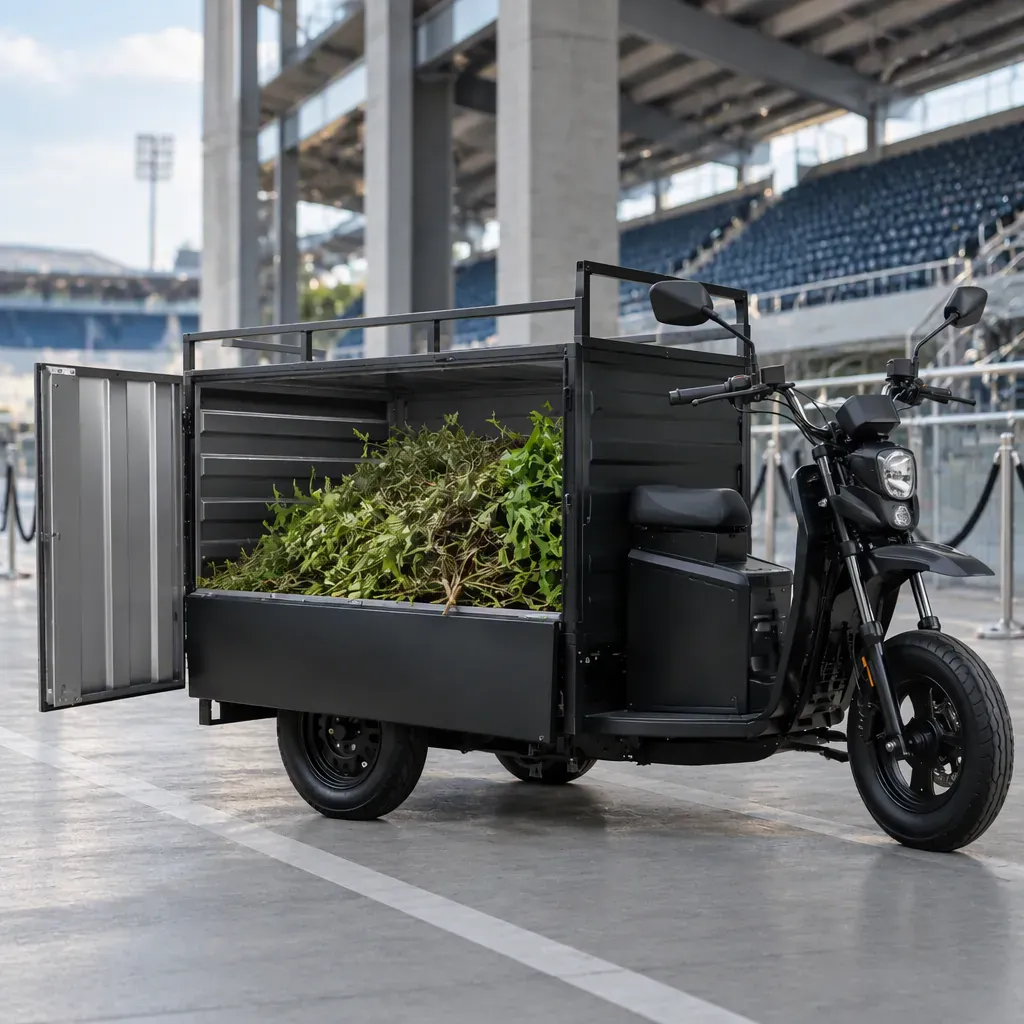
Kiosks and bars run out mid-event — the same holding-load problem covered in our event and venue catering trike guide, and the resupply run is the single most time-critical duty on site because the service window is measured in minutes. Loads are dense and awkward: crates of bottles, stacked cups, kegs, CO2 cylinders and chilled trays. This duty needs the drop-side box for fast side loading, a flat floor with no wheel arches intruding, and enough volume that a single trip clears three or four kiosks rather than one.
2. Waste and recycling between service points
Waste volumes at a sports venue arrive in waves: pre-event, half-time and post-event. The half-time wave is the problem, because it lands in a twenty-minute window. The waste duty needs the heaviest payload rating and the most robust box, because glass, food waste and liquid residue are all denser than they look and often wet — the same reasoning that governs waste-collection trike specification. This is the duty where the 300 kg EU / 500 kg non-EU payload envelope earns its place.
3. Grounds and pitch-surround maintenance
Mowers, line-marking kit, tools, seed and top-dressing all move around the perimeter on a maintenance round, often several times a week and almost never on an event day. This duty tolerates a slower circuit and rewards a low deck for easy loading by hand at ground level. Operators running both a pitches round and a grounds-clearance round often end up with a two-vehicle configuration, as set out in our grounds crew fleet guide.
4. Equipment and furniture moves
Tables, barriers, PA kit, signage, medical stations and hospitality furniture move constantly between storage and position. This duty is the most varied in shape and the least predictable in weight, so it rewards the widest box and the easiest change of load configuration rather than the deepest payload.
5. Internal shuttle of staff and contractors
On a large site with a service road, moving stewards, contractors and kit between gates is itself a duty. It is the one case where a passenger-configured platform does the work instead of a cargo box, and where the walking-pace governor and seated capacity matter more than payload.
Measure Four Things Before Choosing a Platform
Every mismatch we have seen at venue sites traced back to a dimension nobody measured. These four are the ones that eliminate platforms rather than merely rank them.
- Narrowest service passage. Concourse service corridors and back-of-house access routes are often 1.6–1.9 m wide once temporary barriers, bins and signage are in place. A trike that cannot pass a loaded refuse trolley in a corridor will be parked where it blocks an evacuation route. Measure the passage with the worst-case obstruction in position, not the empty corridor.
- Door and gateway width and height. Back-of-house doors are frequently narrower than the site assumes, and roller shutters often have a lower clear height than the frame suggests. A box that fits the corridor may still not fit the door it has to pass through to reach the corridor.
- Ramp and level-change gradient. Stadium sites are full of ramps between concourse levels and service decks. Above roughly an 8 % gradient under a full load, the correct answer is a higher motor rating, not a larger battery. Adding battery capacity does nothing for gradeability; it only extends range.
- Point loading on elevated decks. Where a trike travels on a suspended concourse or a lightweight service deck, the structural question is the load under one wheel contact patch, not the total vehicle mass. A three-wheeled platform concentrates more weight per wheel than a four-wheeled utility vehicle of the same mass, and that has to be checked against the deck rating before the vehicle is bought.
The Load Envelope That Covers All Five Duties
Rather than specify five vehicles, most venues converge on a single envelope that covers four of the five duties and add a passenger configuration only if the internal shuttle duty is real. The table below maps the routine venue loads against the cargo platform we build, using the published specification rather than an estimate.
| Venue duty | Typical single-trip load | Box volume needed | Binding constraint |
|---|---|---|---|
| Catering and drinks resupply | 3–4 kiosk restocks, mixed crates and kegs | 200–400 L | Side access speed, not payload |
| Waste and recycling | Wet glass and food waste, half-time wave | 300–500 L | Payload rating (300 kg EU / 500 kg non-EU) |
| Grounds maintenance | Tools, seed, top-dressing, line-marking kit | 150–300 L | Deck height for hand loading |
| Equipment and furniture | Barriers, tables, signage, PA kit | 400–500 L | Volume and configuration flexibility |
| Staff and contractor shuttle | 2–3 seated plus kit | Passenger configuration | Seated capacity and ramp access |
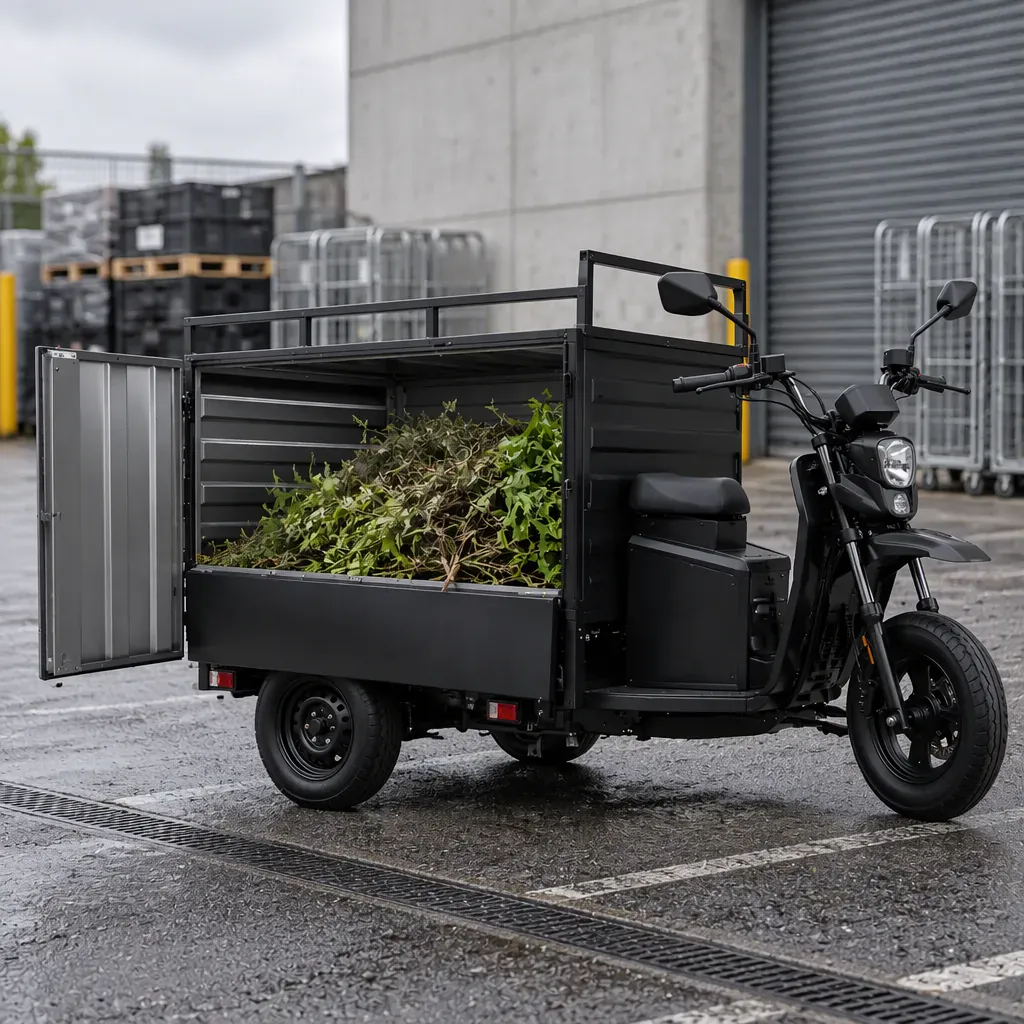
The platform data behind that table: 800 W / 1000 W / 1200 W brushless hub motor with differential running 60 V or 72 V; a 60 V 32 Ah or 72 V 40 Ah lithium pack with LFP available; 50–80 km of range when loaded to 200 kg on flat terrain; 25–35 km/h top speed; hydraulic disc front with dual drum rear and a parking brake; 150–220 kg kerb weight; 3.00-12 front and 3.75-12 rear dual load-rated tyres; and a steel tube chassis finished in heavy-duty e-coat and powder coat. Box volume runs from 150 L up to 500 L with drop-sides and optional insulated lining.
Two specification points matter more at a venue than they do on a delivery route. The first is the tyre load rating: concourse and service-deck surfaces are unforgiving of overloaded sidewalls, and the 3.00-12 and 3.75-12 load-rated tyres exist precisely to carry rated payload without the sidewall deflection that damages both tyre and deck. The second is the differential. On a closed circuit with tight turns around stanchions, kiosk corners and service-door thresholds (see our payload capacity guide), a driven axle without a differential scrubs the inner rear tyre on every manoeuvre, and the tyre wear over a season at a busy venue is measurable.
Charging Around a Match-Day Calendar
The charging arithmetic at a venue is driven by the calendar, not by the energy budget. A standard 5 A charger on the 60 V 32 Ah pack needs 6–10 hours to refill, which is a good fit for an overnight cycle between event days and a poor fit for anything that has to be charged between two events on the same day.
That produces a simple rule. If a venue runs one event day followed by at least one non-event day, a single trike charged overnight from a standard 230 V outlet covers the routine round with no infrastructure at all. If the venue runs consecutive event days, or a match followed by a concert the next evening, then a single vehicle cannot rely on charging to cover both, and the buyer has three options: a second vehicle, a swap battery on a higher-capacity pack, or higher-current charging installed at the service store. Weighing those three options against the calendar is a more honest exercise than picking a bigger battery, because a bigger battery only changes the number, not the gap between events.
One further practical point: the charging point should sit at the back-of-house store where the vehicle is parked between rounds, not at a distant plant room. Every metre between the parking position and the outlet is a metre of cable run that someone has to manage, and a trike parked away from its charger is a trike that does not get charged.
Working Safely in a Crowd
A venue is the one environment where a quiet electric vehicle operating in a dense crowd creates a risk that a delivery route never does. Spectators do not hear a small electric platform approaching, particularly in a noisy concourse.
- Speed governance. Our cargo platform supports a governor that can be set to 25, 35 or 40 km/h. At a venue it should be set low, and it should be set centrally so that individual vehicles are not running different limits.
- Visibility. High-visibility bodywork, full LED lighting and an optional beacon matter more here than anywhere else. A platform working the concourse on an event day should be visible through a crowd, not discoverable by it.
- Route discipline. Service movement should follow a defined route with defined crossing points, on the same closed-perimeter logic as our campus and closed-perimeter shuttle guide, and it should stop entirely during the periods of peak spectator movement. This is a site rule rather than a vehicle feature, but the vehicle has to be able to comply with it, which means being able to move at walking pace under full load. The duty-cycle charging trade-offs are the same ones we set out in the fleet charging guide.
- Non-road registration status. These are non-road-registered vehicles. They belong on private land, and any route that crosses a public road requires checking against local rules before it is used. At a venue, that usually means working out in advance which gates the vehicle may use.
Page Not for Full Loads, but for the Store to Concourse Run
There is one more geometric question specific to stadium sites. The distance between the back-of-house store and the nearest concourse service point is often 150–400 m, partly under cover and partly outdoors. It is short enough that walking feels reasonable and long enough that a loaded hand trolley costs real time on every round, and it adds up across five or six rounds per event day. That run, not the theoretical maximum payload, is usually what justifies the first vehicle.
A trailer becomes worth considering only where the store-to-concourse run is long and the loads are palletised, because a trailer lets one trip carry what would otherwise take two. Below a few hundred metres, a box that loads fast from the side beats a trailer that has to be coupled and uncoupled at each end.
Specifying Your First Venue Operations Trike
- Pick one duty, not five. Start with the concourse catering round or the waste round. Both are daily, both are measurable, and either one alone will justify the vehicle within a season.
- Measure the four dimensions above — narrowest passage, door width and height, worst ramp gradient, and deck point loading — with the site in its normal operating state.
- Size to the heavier leg. If the return leg carries returnables or waste, size the box and payload to the return leg, not the outbound one.
- Match the configuration to the duty. Drop-side box for catering and waste; wide flat floor for equipment; passenger configuration only where the shuttle duty is genuinely daily.
- Check the charging window against the calendar, not against the battery capacity. Consecutive event days change the answer entirely.
- Confirm the procurement terms. MOQ is 50 units, lead time is 15–30 days, and first-order branding or custom box work extends that to roughly 30–45 days. Spare parts continuity for the 3.00-12 and 3.75-12 tyres should be agreed up front (tyre options are covered in our cargo tricycle tyre guide), because they are a consumable at a busy venue.
- Run a pilot on the hardest duty. Two or three units on the toughest round for one full event cycle will surface every routing, charging and loading problem before a fleet decision is made.
Handled that way, the first venue trike usually pays for itself on the catering and waste rounds alone, and the remaining duties are added as separate, evidence-backed steps. For sites that also run a public or institutional fleet, the procurement framing in our public fleet procurement guide transfers directly. rather than as an assumption about what a small electric vehicle can do.
Size a Cargo Trike Around Your Concourse and Service Rounds
Tell us your narrowest service passage, your heaviest routine load and your event calendar. We will send the platform configuration, tyre and brake specification, and FOB pricing for a build that fits your site.
