
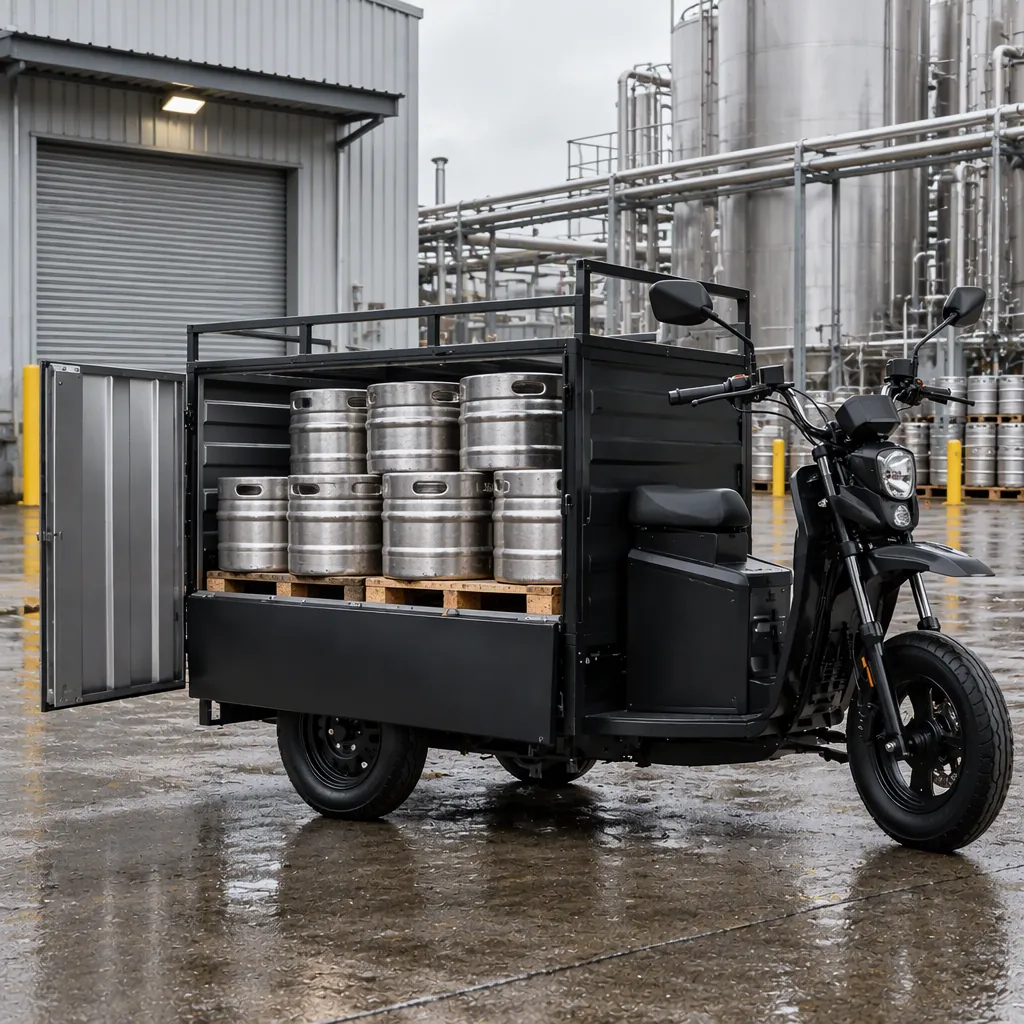
A brewery, distillery or bottling line is a cargo problem before it is a vehicle problem. The liquid itself is not the load: the liquid plus the vessel is. A full 50-litre keg weighs about 60 kg, and a standard pallet holds four of them, so a single pallet of finished beer is roughly 240 kg before you add the pallet itself. That number, 240 kg, is the one that decides whether a three-wheeled platform works inside your plant walls — and it lands almost exactly on the EU payload rating of a heavy-duty cargo e-tricycle, which is why beverage plants have started replacing ride-on pallet trucks and pickups on the short internal legs of their operations. This guide is the specification walkthrough we give plant engineers: the duty cycles that actually break a vehicle, the tyre and brake choices that follow from keg weights, the washdown reality of a food-grade facility, and the charging arithmetic that tells you how many units a two-shift plant really needs.
Why a Bottling Plant Is Not a Delivery Route
The instinct is to treat an internal plant shuttle like last-mile delivery. It is not, and the mismatch is where most specification errors come from. Five differences matter:
- Loads are monotonic and repeating, not varied. A courier vehicle sees mixed parcels of unpredictable weight. A plant shuttle moves the same keg, the same pallet, the same crate hundreds of times a shift. That means you can specify the vehicle against one worst-case load instead of a distribution.
- The vehicle shares floor space with people. Warehouses and bottling halls have pedestrian aisles, forklift traffic and wet floors. A silent electric platform moving at 25 km/h next to staff is a different safety problem from a delivery bike on a road.
- Washdown is daily, not seasonal. Brewing and bottling floors are hosed down with caustic and acid cleaning agents. Anything not sealed corrodes at a rate road vehicles never see. This is the single most common failure mode in beverage-plant trike deployments.
- The routes are short but the hours are long. A shuttle may travel only 2 km per hour of operation, but it must do so for a full eight-hour shift. Range is easy; continuous duty is not.
- Crossing a public road is usually prohibited. An internal plant vehicle is not registered for road use in most markets, so any route that leaves the site perimeter must be handled differently.
The duty-cycle comparison that follows from this is the same framework we use in our industrial and warehouse tricycle guide, with one addition that is unique to beverage operations: the drum, keg and crate weights are heavy enough that tyre load rating, not frame strength, becomes the binding constraint.
Start With the Four Dimensions, Not With the Motor
Before discussing power, measure four things. Each one can eliminate a platform regardless of how good the drivetrain is.
- Aisle width. A cargo e-tricycle with a 150–500 L drop-side box needs roughly 1.6–1.9 m of clear aisle to pass a pedestrian or an opposing pallet truck comfortably. Measure your narrowest aisle between racking uprights, not your widest.
- Door openings. Both width and height. A filled keg on a box floor sits higher than a parcel, and a trike that fits an aisle may still not clear a roll-up door lintel or a fire door with the box side dropped.
- Thresholds and ramps. Any grade above 8% should be solved with a higher motor rating, not a larger battery. Torque climbs a ramp; amp-hours do not.
- Floor loading where the vehicle parks. A laden trike concentrates its mass on three contact patches. Mezzanine and upper-floor storage areas are assessed per wheel load, not per vehicle weight — check with whoever owns the structural drawings before parking a loaded unit upstairs.
Kegs, Pallets and Crates: Sizing the Load Envelope
The cargo platform we build is rated 300 kg payload in EU configuration and 500 kg in non-EU configuration, with a 150–500 L box volume and drop-sides that let the box open on three sides. That rating is the engineering limit of the combined chassis rail, axle set, braking system, motor and tyre specification — it is not an arbitrary marketing number, and it must be read together with the supporting components.
| Beverage load | Unit weight | Typical move | Platform fit |
|---|---|---|---|
| Full 50 L keg | ~60 kg | 2–4 at a time, short haul | Drop-side box, 300 kg EU rating covers 4 kegs (240 kg) |
| Standard pallet, 4 kegs | ~240–260 kg | Bulk transfer, dock to cold room | Needs non-EU 500 kg rating or split into two runs |
| 24 × 500 ml case (bottles) | ~13–16 kg | Palletised, 60–80 cases | Volume-limited before weight-limited; box volume decides |
| Empty kegs / casks (return leg) | ~10–12 kg each | Backhaul collection | Low weight, high volume — the reason drop-sides matter |
| Cleaning chemical drums | 25–30 kg | Weekly, locked transport | Requires enclosed box; open flatbed is not acceptable |
Three practical rules come out of that table. First, most plants should specify in the 300 kg EU band and simply make two runs rather than buying a 500 kg platform they do not legally need, because a heavier-rated vehicle costs more in tyres and brakes over its life. Second, if you genuinely move full pallets, the configuration that matters is the reinforced load-rated tyre set — 3.00-12 front and 3.75-12 dual rear — not the motor. Third, the return leg of empties is the load nobody budgets for: empty kegs and casks are bulky and light, so the box configuration, not the payload rating, governs how many you can carry per trip. A fixed flatbed wastes the return leg; drop-sides let you stack and strap it.
Tyres, Brakes and the Part of the Spec That Fails First
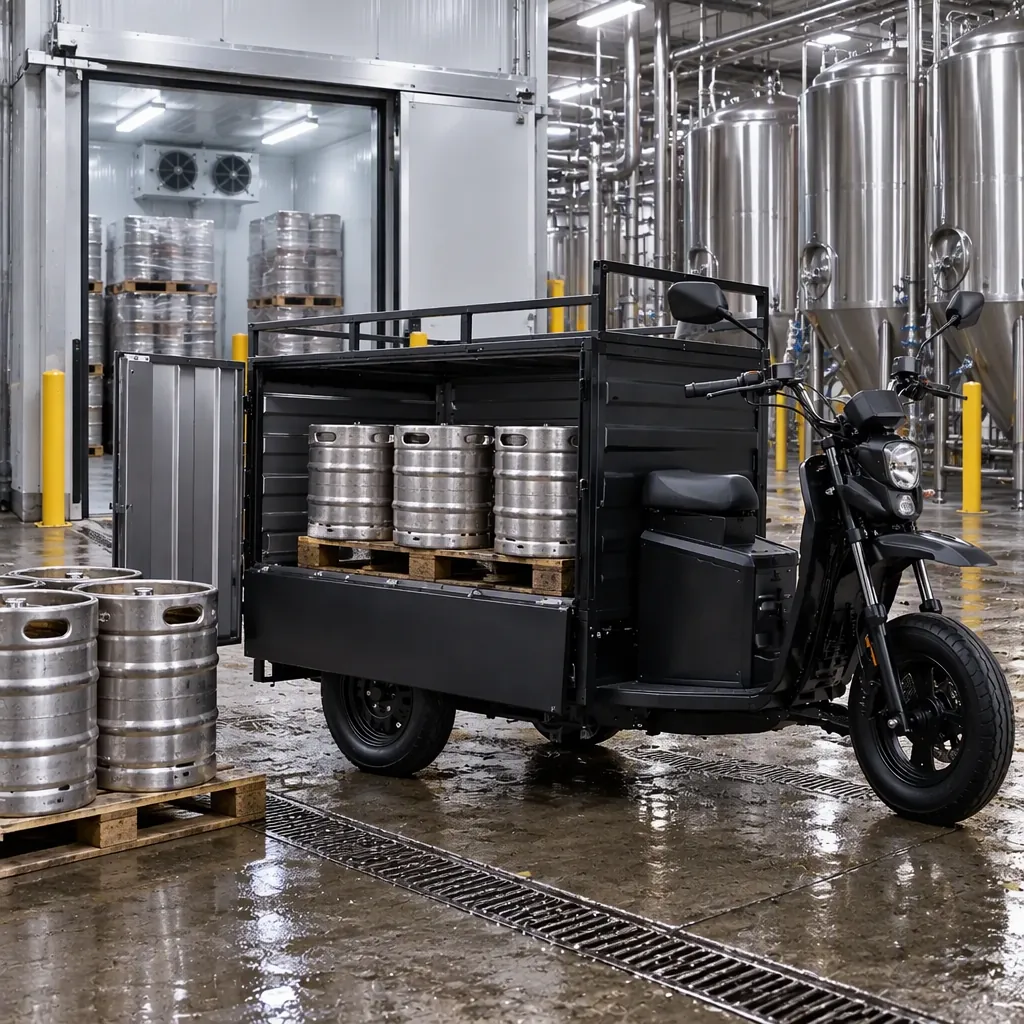
On a beverage plant route the tyres are the highest-wear component, and they are the first place a cheap build shows itself. A keg-run trike does loaded start-stop cycles all shift on possibly wet concrete, which is a far harder duty than the same tyre sees on the road.
- Load-rated tyres, not cosmetic ones. The platform ships with reinforced load-rated 3.00-12 front and 3.75-12 rear dual tyres. When you reorder, the specification must remain identical. Substituting a softer, cheaper tyre on a 250 kg keg run is how fleets end up with sidewall failures at month four.
- Wet-floor braking. Standard configuration is hydraulic disc braking at the front with dual drum brakes at the rear and a parking brake. The parking brake is the item beverage plants underestimate: a loaded trike left on a washdown slope, or on a wet ramp outside a cold room, must be held by something more than the motor.
- Differential, not a solid axle. The drive platform uses a brushless hub motor with a differential. Inside a plant this matters more than on a road: a dual-rear-wheel vehicle without a differential scrubs its tyres and drags its line every time it turns tightly around racking or a door frame. Over a season of tight internal turns that scrub is measurable tyre cost.
- Continuous duty rating. A motor rated for 800W, 1000W or 1200W with 60V or 72V battery is specified for the load, but a plant shuttle runs near-continuously. Confirm the duty rating rather than assuming, and plan the cooling and inspection interval around actual hours, not kilometres.
Washdown: The Specification Item That Decides Longevity
This is the point where beverage operations diverge from every other trike application. A brewing floor is cleaned with water, caustic and acid-based agents on a daily cycle. An unsealed vehicle on that floor will lose connectors, bearings and display units within a season.
The specification response has four parts. Electronics must be sealed to an appropriate ingress rating for the environment, and the connectors at the headset and battery bay are the weak points — they are the ones a washdown jet reaches. The frame finish must be e-coat plus powder coat rather than a single-layer cosmetic paint, because chipped paint on a caustic-washed frame is where rust begins. The display should be positioned where it is less exposed to direct spray, and the battery bay must have a gasketed closure with a drain path so water does not pool. Finally, the cleaning procedure itself should be adapted: pressure-washing directly at electrical enclosures is the most common cause of a failed unit, and a plant that specifies a sealed vehicle should also specify that staff do not jet-wash the connectors.
If your operation also moves temperature-sensitive product, the box can be specified with insulated lining, and the same insulated-box reasoning we cover in our refrigerated trike cold chain guide applies to a beverage plant moving pre-chilled stock from cold room to dock in hot weather.
Charging Arithmetic That Decides Fleet Size
This is the calculation that most plants get wrong, and it is the same trap as in any two-shift operation: the battery is specified in amp-hours, but the constraint is downtime minutes.
The platform charges at 5A and takes 6–10 hours for a full cycle on a 60V 32Ah pack, or roughly the same order for a 72V 40Ah pack. That is an overnight charge, not a shift-break charge. The consequence is arithmetic, not opinion:
- Single-shift plant. One unit per route, charged overnight, works. This is the clean case and where most trials should start.
- Two-shift plant. The vehicle is in use for both shifts, so it cannot also be charging. A 6–10 hour charge window does not fit inside a 90-minute shift changeover. You have exactly three options: buy a second unit, specify swappable batteries so a charged pack goes in while the depleted one charges, or install higher-current charging.
- The worked example. A two-shift bottling hall running three internal shuttle routes needs three vehicles plus either a fourth as a rotation unit or a swap-battery program. Buying three and hoping the shift break covers it is the deployment pattern that shows up as a trike parked at a charger mid-shift while staff walk kegs by hand.
The relevant comparison is not trike versus truck; it is trike plus charging infrastructure versus the ride-on pallet trucks and pickups the plant already runs. The power architecture behind the pack — cell grades, BMS behaviour and cycle life under a duty cycle this regular — is covered in our battery pack specification guide, and it is worth reading before you choose between a 60V 32Ah pack and a 72V 40Ah LFP pack for a vehicle that will cycle every working day.
Safety in a Shared Floor Space
An electric platform is quiet, and quiet is the risk. Three measures address it.
First, visibility: the platform carries a full LED lighting system with optional beacon, and high-visibility frame colours are worth specifying for a vehicle that operates where forklifts and pedestrians mix. Second, speed governance: the platform supports a selectable governor at 25 km/h, 35 km/h or 40 km/h, and 25 km/h is the correct setting for indoor plant use regardless of what the vehicle can do. Third, procedural: define the routes, mark the crossings at aisle ends and doorways, and hold the same right-of-way rules you already apply to pallet trucks.
One boundary must be stated plainly in the operating procedure. A plant-internal vehicle is not a road-registered vehicle. Any route that crosses a public highway needs a compliant, registered configuration — the distinction between EPAC and L-category configurations, and what each market requires, is set out in our e-tricycle laws in the US and EU guide. Do not assume your internal shuttle can legally make a short public-road hop.
What to Specify, and What It Costs to Get Wrong
A beverage-plant trike specification that survives a real facility looks like this: heavy-duty cargo platform with differential hub motor at 800W–1200W, 60V or 72V battery depending on shift pattern, drop-side box of 150–500 L with the option of insulated lining, hydraulic disc front with dual drum rear and a parking brake, reinforced load-rated 3.00-12 / 3.75-12 tyres, e-coat plus powder-coat frame, LED lighting with optional beacon, LCD display with load indicator and reverse gear, and the three-position forward/neutral/reverse selector.
Commercial terms for a beverage-plant fleet program are the same as our other OEM builds: minimum order of 50 units, 15–30 days production lead time, and 30–45 days for first orders that involve custom body work or branding. Sample units before volume is the right sequence, and it is the sequence we recommend for any plant that has not run an electric shuttle before. The specification table on the cargo e-tricycle platform page carries the current component-level detail, and the fleet-side economics of replacing vans and pallet trucks with electric platforms are set out in our cargo and last-mile logistics overview.
Two procurement notes close this out. Ask for the tyre specification and the spare-part identification in writing, because a plant that cannot reorder the exact 3.00-12 and 3.75-12 load-rated tyres will eventually fit something wrong. And ask for the duty-supporting test records rather than a brochure figure: dynamometer efficiency, brake performance and battery-cell acceptance testing are the items that tell you whether a supplier builds for continuous industrial duty or for a consumer shelf. Our cargo trike supplier selection guide walks through the documents to request, and our spare parts and after-sales guide covers the service framework a fleet should contract for before the first unit arrives.
Specified this way, a three-wheeled electric platform does the work that ride-on pallet trucks were never designed for: it carries a keg run, a crate run and a chemical run on the same chassis, inside the same building, on a fraction of the running cost. The plants that get it wrong are the ones that buy on price and discover at month four that the tyres, the connectors and the charging window were the three things that actually mattered.
Size a Cargo Trike Around Your Keg and Pallet Loads
Tell us your heaviest routine load, your narrowest aisle and your shift pattern. We will send the platform configuration, tyre and brake specification, and FOB pricing for a build that fits your actual plant floor.
