
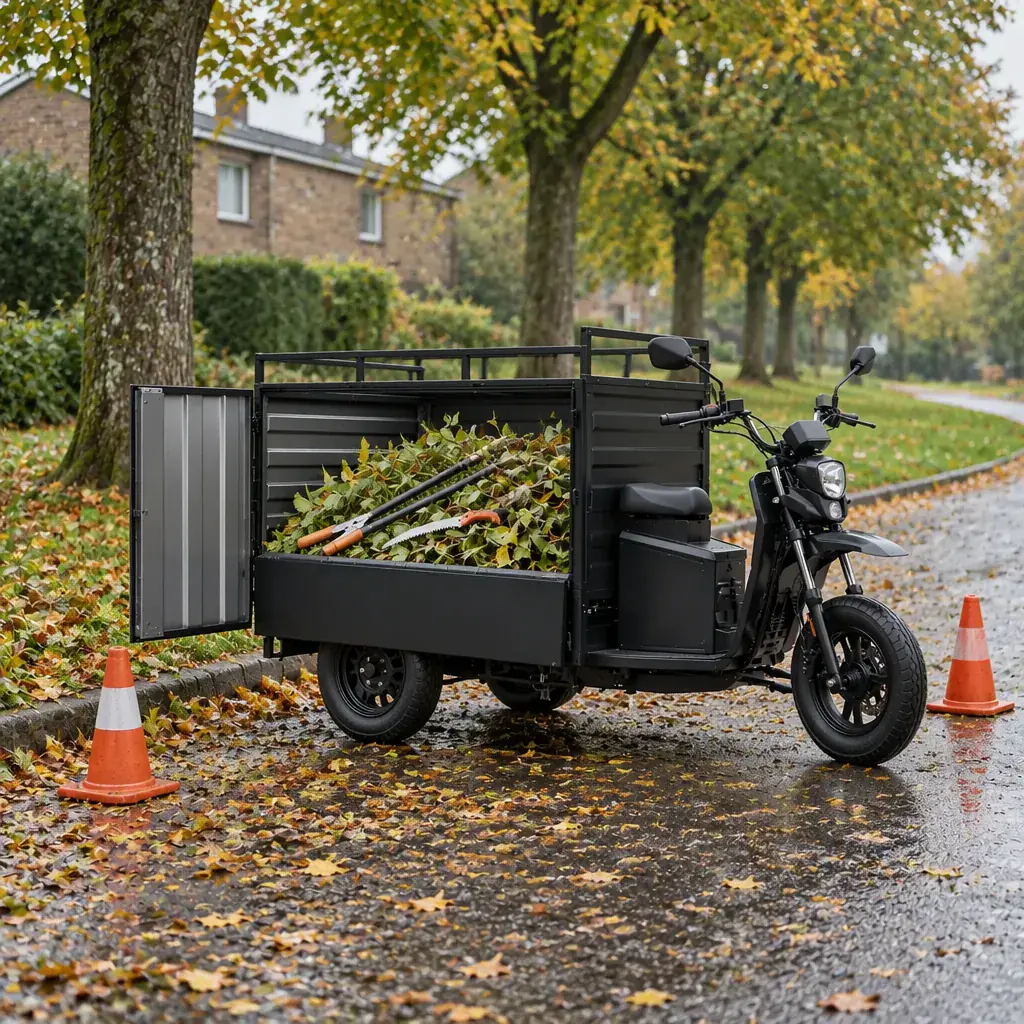
A municipal tree crew’s day looks nothing like a delivery round. A typical residential street-tree contract runs 4 to 9 stops across 9 to 14 km, and each stop adds 60 to 180 kg of cut material to the vehicle. The trike leaves the depot empty in the morning and gets heavier all day. By late morning it is sitting at its rated payload with three or four stops still on the sheet.
That difference in shape, not size, is what breaks most electric tricycle specifications written for arboriculture. Procurement documents are usually copied from a parcel template, where the vehicle starts full and ends empty, so the payload figure is treated as a peak that happens once. In tree work the peak arrives at the end of the shift, after the crew has committed to finishing the route. Weight is an ascending problem here, not a descending one, and every specification decision should be tested at the end of that curve rather than the start.
Why green waste is a different weight problem
A delivery trike is loaded once, at a dock, with goods weighed before they left. An arboriculture trike is loaded by hand at eight different kerbsides by a crew holding loppers in the other hand. Three properties follow. The load is unmeasured, because nobody weighs a pile of prunings and crews underestimate cut material. It is high-volume and low-density early (raked brush over the drop-sides) and dense by late morning (saw logs and compacted brush at the bottom of the bed). And it does not leave until the depot or chipper, so every stop compounds the last.
The sizing rule that beats any headline number: sum the estimated green waste for the full route, add 15 to 20% for estimate error, and compare that total to payload. A route averaging 7 stops at 110 kg is 770 kg over a shift. No trike in this class moves that in one load, which is why route design and unload strategy matter as much as the specification sheet.
The four circuits a tree and grounds fleet actually runs
Fleets rarely have one duty. They have four, and each places different demands on the same platform. A fuller treatment of how public-works departments divide their daily routes is in the municipal public-works tricycle guide.
1. Street tree maintenance
Short hops, stop-dense, 60 to 120 kg of prunings and rakings per tree. The bed carries branches, tool bags, cones and signage and is emptied frequently. Stop density favours a drop-side flatbed over an enclosed box, because folding sides let the crew toss brush in from the kerb. Narrow verges dominate the width calculation, and reversing 15 m along a footway matters more than top speed.
2. Park and cemetery grounds
Mixed surfaces: tarmac paths, gravel, grass and compaction-prone lawn edges. Widest payload spread of the four — a morning of 300 L of mulch at 150 kg, an afternoon of 400 kg of felled branches and old benches. Because the vehicle often reaches path-end tip points nothing else can, it gets loaded to the ceiling. Ground point loading dominates here, not width.
3. Linear verge and boulevard work
Long roadside runs of 9 to 14 km with constant lateral movement along the verge. Payload per stop is moderate but distance and exposure dominate, and the vehicle sits in or beside the carriageway for long stretches, so full LED lighting and an optional beacon are operational requirements. It is also where a governed 25 km/h setting costs least, because the crew works from the verge.
4. Tree nursery and holding yard
Bulk, dense loads over 200 to 800 m internal loops: root balls, bagged compost, containerised stock. The bed is emptied and refilled many times a day. Payload ceiling and unload speed matter; road speed and noise barely register. A hydraulic tipper pays for itself faster here than anywhere else, turning a three-minute manual unload into a 25-second tip.
The four measurements that eliminate a site before you specify anything
Most failed deployments are geometry failures, not payload failures. Measure these four at the actual site, with a tape. Each has a threshold that changes the answer rather than adjusting it.
Clear width between tree pits and street furniture
Take the clear width between a tree pit guard and the nearest parked wing mirror, then repeat between a lamp column and a low wall. If the narrowest realistic passage is under about 1.6 m, a trike cannot pass a crew working on foot with a barrow — it blocks the footway or the crew abandons it 40 m back. A 1.1 m body needs roughly 0.5 m of working clearance either side. Below 1.6 m clear, use a walk-behind.
Gate and yard clear width and height at loaded height
Measure the depot gate and every park service gate on the route, and measure clear height with the vehicle loaded. A load of brush sitting 300 mm above the drop-sides changes the effective height, and a 2.1 m crossbar that clears an empty trike will rake off the top of the load. Set the survey against the tallest realistic profile, typically 1.2 to 1.4 m above the bed floor.
Ramp and camber gradient
Measure the steepest sustained upgrade on the route at the loaded end of the shift. Above roughly 8% upgrade with a 300 kg payload, a larger battery does not solve it — it adds mass to the vehicle being pushed uphill. Move up the motor class instead: 800 W where the route is flat and the ceiling is rarely reached, 1000 W or 1200 W where the loaded climb is sustained. The hub motor with differential matters too, because a loaded trike on a camber will spin one wheel without torque distribution.
Ground point loading on lawns and soft verges
Check wheel load, not total vehicle weight. A loaded trike at 300 kg payload plus 190 kg of vehicle is 490 kg over three contact patches, with roughly 60% on the rear pair. On a wet verge that cuts ruts a lawn contractor will bill for. Ask for the rear axle load and compare it with the ground pressure a ride-on mower already leaves on the same turf; if it exceeds that, restrict the circuit to paths.
Payload versus configuration: matching the bed to the duty
The payload rating is one number; usable payload depends on the bed carrying it. A 300 L enclosed box handles clippings well but bulks out on brush long before it weighs out. The table ties duty to typical load and configuration. Load figures are operational estimates for route planning, not manufacturer specifications or site-measured figures.
| Duty | Typical estimated load | Binding constraint | Recommended configuration |
|---|---|---|---|
| Street tree maintenance, 6–8 stops | Est. 550–750 kg over the route | Box volume; unload frequency | Drop-side flatbed, 800 W, mid-route transfer |
| Park and cemetery grounds | Est. 150–450 kg per load | Payload ceiling on the dense end | Flatbed with hydraulic tipper, 1000 W |
| Linear verge and boulevard | Est. 200–400 kg per load | Visibility and verge width | Flatbed, LED plus beacon, 1000 W |
| Tree nursery and holding yard | Est. 400–500 kg per loop | Payload ceiling; unload speed | Tipper or enclosed box, 1200 W |
| Tool and signage transport | Est. 80–150 kg | Overnight tool security | Locking tool box plus small flatbed |
| Leaf collection, autumn peak | Est. 300–450 kg, high volume | Box volume; washdown access | Enclosed box with tipper, 1000 W |
Two things matter more than the numbers. The EU payload is 300 kg regardless of what the platform can physically carry, and configuration changes usable capacity far more than the rating does. How the platform is engineered around that ceiling, including frame, axle and brake sizing, is covered in the cargo tricycle payload capacity guide.
The towing distinction: when the problem stops being payload
Grounded green waste has high bulk density. Compacted into the bottom of a bed, 300 kg of brush occupies far less volume than 300 kg of rakings, so the second half of the route fills the bed before it reaches the rating. The constraint has moved from payload to volume, and the answer is a second load path, not a bigger bed.
A single trike cannot both fill to the payload ceiling and tow a trailer: the two compete for the same mass allowance, braking capacity and motor headroom. A trike at 300 kg pulling a 200 kg trailer asks the front hydraulic disc and dual rear drums to stop roughly 700 kg on a cambered footway, and the motor to lift it up the same 8% ramp.
For a mid-size contract the right answer is usually two vehicles rather than one bigger one: a trike for stop-dense street work plus a tipper or trailer on a fixed collection loop. The trade-off is honest — two sets of insurance, two charging points, two drivers, and on a narrow footway circuit the second vehicle may not fit. One larger vehicle has a lower headline cost but a higher peak-hour failure rate, because a unit at its ceiling has no recovery margin. The green waste and grounds crew tricycle guide works through the two-vehicle configuration, and the electric tricycle trailer guide covers the towing envelope and hitch requirements.
Corrosion, sap and the washdown habit
Green waste is wet, acidic and abrasive in a way road salt is not. Leaf tannin and sap cling to warm surfaces and hold moisture against metal for days. They attack the same places salt does: fastener threads, exposed caliper sections, box hinges and latches, any non-stainless hopper, and the under-bed connectors running to the rear lights.
The platform’s protection is heavy-duty e-coat plus powder coat at 40 to 60 micrometres on the chassis, an IP54 electrical enclosure and stainless fasteners. That assumes the material is removed rather than left. A low-pressure fresh-water washdown at the end of every shift — bed, drop-sides, hinges, arches and frame rails — is the highest-value maintenance action on a tree fleet. Two things must not be done: never pressure-wash the controller bay, because IP54 is a splash and not a jet rating, and never leave the bed loaded overnight, because a night of sap on powder coat is a week of ordinary exposure. Service intervals and fast-wearing parts are in the electric tricycle maintenance guide.
Noise and the permission to start earlier
The advantage most underestimated in tenders is the start time. No combustion noise, no idle, no exhaust means a crew can begin in a residential park margin or cemetery at the hour the contract allows people on site, rather than the hour a petrol saw or diesel chipper may run. On a spring contract with 40 booked visits a fortnight, an extra 45 minutes of usable morning per crew is several additional stops a week.
Two details belong alongside it. The governor can be set at 25, 35 or 40 km/h to match local regulation, so a fleet working both footway circuits and depot runs needs one vehicle type. And the lighting is full LED with an optional beacon, which is what makes an early start on a live verge safe as well as quiet.
The charging window is the real constraint, not the range
A tree circuit is 9 to 14 km a day. Range is 50 to 80 km at 200 kg on flat terrain, four to five times what the duty needs. Range is not the constraint; charging time is.
A full charge from empty takes 6 to 10 hours at 5 A — plug in at 18:00, unplug at 06:00. A single shift therefore needs no infrastructure beyond a standard outlet. Two shifts changes the arithmetic: the second returns at 14:00 and needs a usable pack by 13:30 while the same charger is still working on the first vehicle’s pack. With 6 to 10 hours, the single charger becomes the hard constraint on the fleet.
Three responses work: a second vehicle, a higher-current charger, or a swap pack that lets a depleted pack charge while the vehicle leaves on a fresh one. The one that does not is a bigger battery. A larger pack takes longer at the same 5 A, extending the between-shifts window rather than shortening it. Cold-season charging limits are covered in the electric tricycle winter guide.
What a tree-care tricycle does not replace
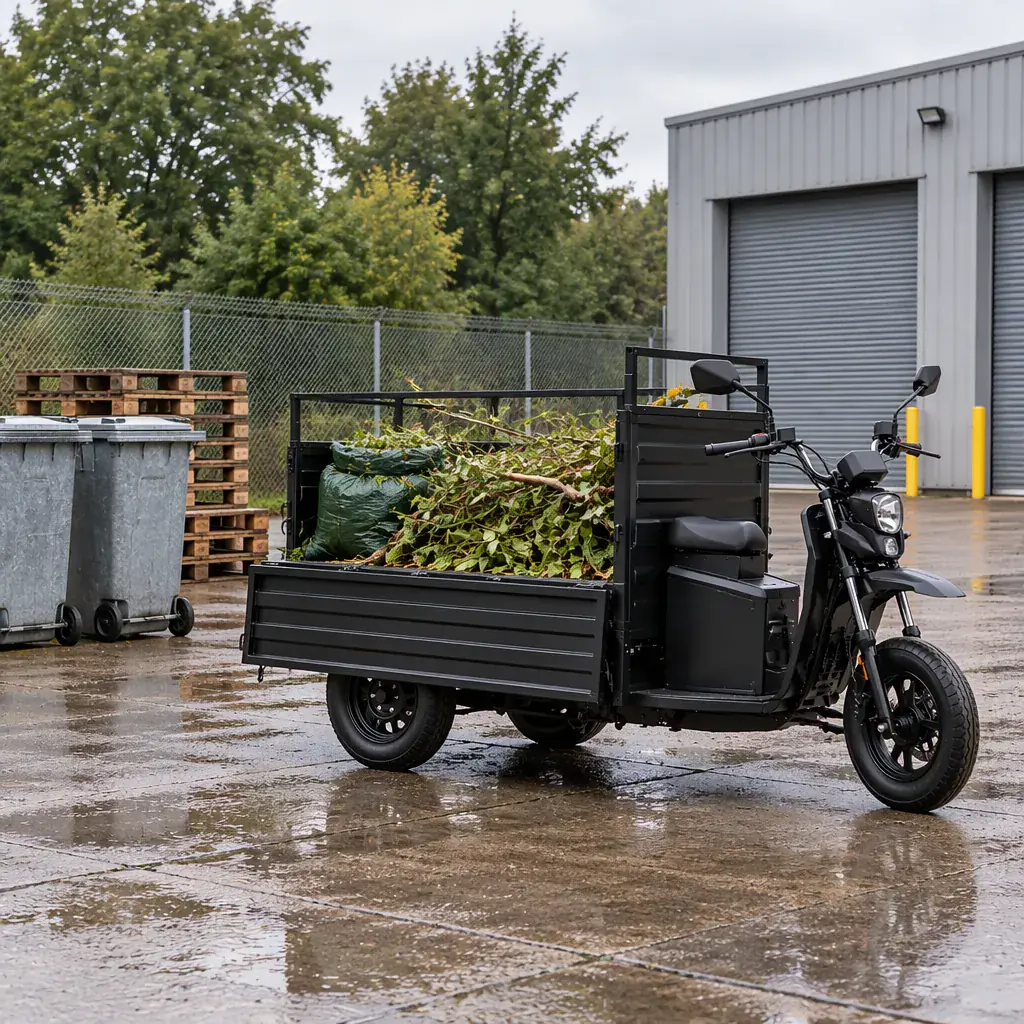
Honesty about the envelope is worth more than a longer feature list, because the alternative is a vehicle specified for work it was never designed to do. It is not a road-going chip truck: no chipper body, no hopper volume, no road speed between distant sites. It cannot replace a chipper or a crane. In some jurisdictions it cannot legally run on a carriageway as a road-registered vehicle, making it a footway, verge, park-path and depot vehicle. And it cannot substitute for a statutory emergency response vehicle — a fallen tree blocking a highway at 02:00 is a duty unit call-out. Where it earns its place is planned, stop-dense, short-distance work, and the private-contract version of that route economics is in the cargo tricycle landscaping guide.
RFQ specification table
These rows decide whether a quotation is comparable. Put all of them in the document and require a stated figure or a stated “not applicable”.
| Parameter | Requirement to specify |
|---|---|
| Platform | Three-wheeled cargo tricycle, differential drive, single front and dual rear wheels |
| Payload | 300 kg EU / 500 kg non-EU; state which classification applies |
| Box volume | 150–500 L usable; drop-side flatbed, enclosed box, or flatbed with locking tool box |
| Body configuration | Drop-sides standard; hydraulic tipper for yard or dense bulk work |
| Motor | Hub motor 800 W / 1000 W / 1200 W with differential, chosen against measured gradient |
| Battery | 60 V 32 Ah NMC or 72 V 40 Ah LFP; state whether a swap pack is offered |
| Charging | 5 A charger, 6–10 h full charge; state higher-current option and its charge time |
| Braking | Hydraulic disc front, dual drum rear, parking brake; state trailer brake provision |
| Tyres | 3.00-12 front, 3.75-12 rear dual; state tread for gravel and grass circuits |
| Corrosion protection | Heavy-duty e-coat plus powder coat 40–60 micrometres, IP54 enclosure, stainless fasteners |
| Lighting and governor | Full LED, optional beacon, governor settable at 25 / 35 / 40 km/h |
The payload row is a classification question, not a physical one, and naming the wrong figure creates a compliance problem at delivery. The motor row should reference the gradient survey, so the class is chosen against a measured climb. A 1000 W, 60 V 30 Ah municipal utility variant also exists with an 80 km range at 200 kg, suiting fleets that want one standard unit across public-works duties; the platform specification is on the cargo tricycle product page.
Procurement, lead time and the seasonal deadline
MOQ is 50 units. Production runs 15 to 30 days for a standard build, extending to 30 to 45 days for a first order with customisation — body configuration, livery, governor setting, beacon, tipper or tool box. Sea freight to Europe adds roughly 28 to 35 days, so a first customised order is 58 to 80 days order-to-depot before port handling, customs and inland delivery.
That drives a seasonal decision. Most municipal tree contracts start in spring, and the crew needs vehicles delivered, charged, liveried and trained on before the first pruning visit. Working back from an April start with the 80-day worst case plus two to three weeks for delivery and commissioning, the order belongs in the third quarter of the previous year. A January order arrives mid-season and gets measured against a partial season.
Two documents make the lead time hold: a pre-tender survey of the four geometry measurements, so the specification does not change after quotation, and a stated charger and swap-pack position, so depot electrical work is scoped in the same quarter as the order. The tender documentation set, including the survey sheet and specification template, is at government and municipal fleet procurement.
Frequently asked questions
What payload should we specify for a European tender?
300 kg. That is the EU figure for this platform class and applies whether or not a 500 kg non-EU variant exists. Design the route so estimated green waste over a shift does not require more than one unload.
Can one trike run two shifts a day?
Only if the charging window is solved separately. A 6 to 10 hour charge at 5 A does not fit between shifts, so a two-shift operation needs a second vehicle, a higher-current charger, or a swap pack.
Should we fit an enclosed box or a drop-side flatbed?
Drop-side flatbed for street tree work, because brush is tossed in from the kerb and the sides fold down for unloading. Enclosed box or tipper for leaf collection and yard work, where the load is loose and dense and needs tipping rather than forking out.
How often should a tree crew wash the vehicle down?
Every shift. Sap and leaf tannin are acidic and hold moisture against hinges, fasteners and calipers. Use low-pressure fresh water on the bed, drop-sides, arches and frame rails, and keep the jet away from the controller bay.
Designing the route around the weight curve
The most useful change a tree department can make is not a vehicle specification, it is recognising that the weight curve of an arboriculture route rises through the day, and testing every decision against the end of that curve. A delivery specification asks what the vehicle carries when it leaves. An arboriculture specification has to ask what it is carrying at 11:30, with four stops left, on a cambered verge, with the bed full of compacted brush and the driver still needing to reverse 20 m to the gate.
That reframing changes the numbers in the tender. Payload is sized against the sum of estimated green waste across the route with a 15 to 20% error allowance, which is why a 300 kg EU rating paired with a good unload strategy usually beats a larger vehicle with no unload point. Box volume is sized for brush rather than weight, which is why drop-sides and a mid-route transfer outperform a bigger enclosed box on street tree work. Unload rate becomes a specification item in its own right, because a tipper clearing the bed in 25 seconds instead of three minutes is worth more on a stop-dense route than 50 kg of rating the crew never reaches before the bed is full. And the charging window is scoped alongside the vehicle order, since the between-shifts interval is the one constraint a bigger battery makes worse rather than better. A fleet built on those four decisions, tested against a measured depot and a measured route, holds its route length through the spring peak without a second vehicle and without a mid-morning return to the yard, which is the only outcome that keeps the business case intact through its first full season in service and its first autumn leaf peak, when the weight arrives four hours earlier than the crew expects and the bed fills before the rating is reached.
Spec an Arboriculture Tricycle for Your Crews
Send us the four circuit types you actually run, the clear width between your tree pits and street furniture, the gradient at your depot, your mean green-waste weight per stop and how many stops a crew makes each day. We will size the payload ceiling and the bed volume against the end of the shift rather than the start, then quote the flatbed, drop-side, locking tool box or tipper variant that fits, with the corrosion protection schedule in writing. FOB China, MOQ 50 units, 15–30 day lead time.
