
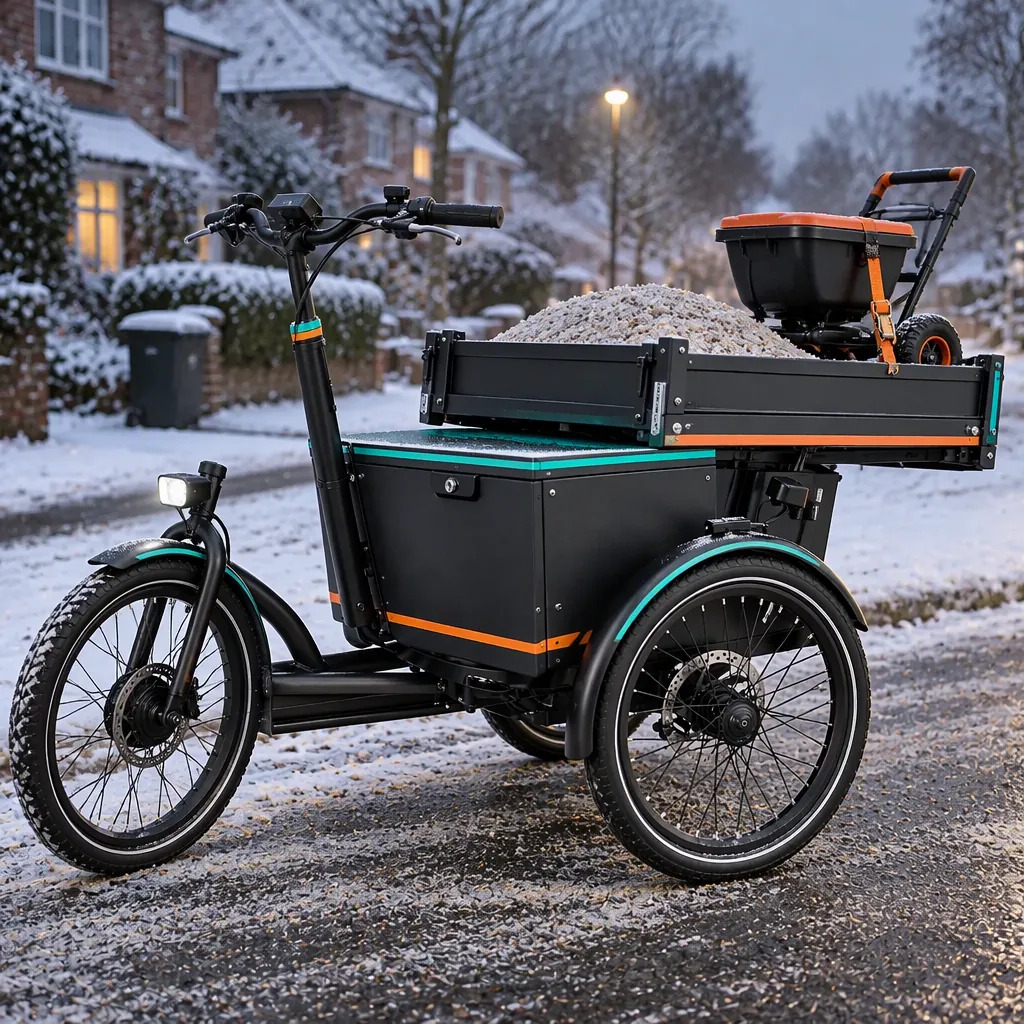
Winter maintenance is the one service contract where the vehicle decision is made entirely by the worst four days of the year, not the average of the other 361. A grounds or facilities contractor signs a gritting and snow clearance agreement with a response window written into it — typically a call-out within two to four hours of a forecast trigger — and then has to move salt onto footpaths, car park aisles, school entrances, hospital walkways and residential cul-de-sacs faster than the frost forms. A tipper truck is the reflex answer, and for arterial roads it is the right one. For everything else it is a fifteen-tonne vehicle doing a two-hundred-metre job, and it is the reason winter service margins are so thin.
This guide is about the other end of that problem: the routes that are too narrow, too pedestrian, too stop-start or too infrequent for a truck, and where an electric cargo tricycle carrying a spreader and a few hundred kilos of rock salt is the correct platform. The arithmetic below is deliberately unglamorous — spreader load, pass count, salt rate, battery temperature, corrosion intervals — because that is where these decisions are actually won or lost.
Why a Winter Service Circuit Is Not a Delivery Route
Delivery work rewards a vehicle that carries a large single load over a long distance and unloads in a few places. Winter service does the opposite on every axis. The table below is the clearest way to see why a platform specified for parcels will fail a gritting contract.
| Dimension | Parcel / delivery route | Winter service circuit |
|---|---|---|
| Call pattern | Continuous, planned, weather-independent | Seasonal and trigger-driven — idle for weeks, then intense for 48 hours |
| Stops per shift | 20–80 addresses | Continuous pass-and-spread; almost no static stops |
| Surface | Road and kerb, mostly dry | Wet, salted, slush-covered, refreezing |
| Payload profile | Volume-limited, light | Mass-limited and consumable — the load depletes as you work |
| Operating temperature | Ambient, rarely below freezing | −10°C or lower, with wind chill |
| Critical failure mode | Late delivery | Missed response window and a liability claim |
Two of those rows change the specification more than the others. The first is the depleting load: a delivery trike is dimensioned for the weight it leaves the depot with, while a gritting trike has to be dimensioned for the weight it starts with and the fact that the load is being thrown onto the ground for the whole circuit. The second is idle time. A winter unit sits unused for most of the year, which makes battery care, tyre flat-spotting and corrosion protection a storage problem as much as a driving problem.
The Spread Rate × Pass Count Arithmetic That Sizes the Load
Almost every winter service specification argument reduces to one question that nobody writes into the tender document: how many passes does a full load buy at the contractual spread rate. Once you have that number, the vehicle size and the depot refill logistics follow from it.
Rock salt is normally applied by mass per unit area, and the rate depends on the surface and the forecast. De-icing contractor practice generally follows a band of roughly 10–20 g/m² for light preventative treatment on footpaths, rising to around 20–40 g/m² for heavier post-fall clearance on vehicle surfaces carrying slush and compacted snow. Working an example is the fastest way to see why the numbers matter:
| Circuit | Pass width | Circuit length | Rate | Salt per full circuit |
|---|---|---|---|---|
| School footpath loop | 1.5 m | 1,200 m | 15 g/m² | 27 kg |
| Retail car park aisles | 1.5 m | 2,400 m | 20 g/m² | 72 kg |
| Business park spine + footways | 1.8 m | 3,500 m | 25 g/m² | 158 kg |
| Residential estate, two passes | 1.5 m | 6,000 m | 20 g/m² | 360 kg |
Read that table against the platform and the contract conversation changes. The first three circuits are comfortably inside a single-trip load on a standard cargo platform. The fourth — a residential estate worked twice in one night — needs either a refill at the depot halfway round or a second unit, because the 300 kg EU payload rating on the standard cargo tricycle is the whole vehicle's allowance, not the salt allowance. Accessory weight has to come out of that first.
The practical budget on a standard platform is therefore roughly 180–230 kg of salt once the spreader, a towable or walk-behind hand tool, a shovel and the driver are accounted for. That is enough for a very large number of footpath passes and not enough for a wide-area carriageway. Which is exactly the correct division of labour: the trike owns the pedestrian and perimeter circuits, and the truck owns the roads.
The Spreader Question: Walk-Behind, Rear-Mounted or Towable
Three configurations cover almost all real winter contracts, and they are not interchangeable. The choice is driven by whether the operator is riding or walking, and whether the treated surface is narrower or wider than the vehicle.
Walk-behind spreader carried on the bed
The simplest and by far the most common arrangement for grounds teams. A hand-pushed broadcast spreader rides on the flatbed with its hopper loaded, and the operator deploys it at footpath chokepoints — a school gate, a ramp, a set of steps — where driving the vehicle itself is impossible or unsafe. The trike is a transport and refill platform, not the spreading implement. This configuration keeps the vehicle completely unmodified, which matters when the unit is bought on a lease and must be returned in factory condition.
Rear-mounted broadcast spreader
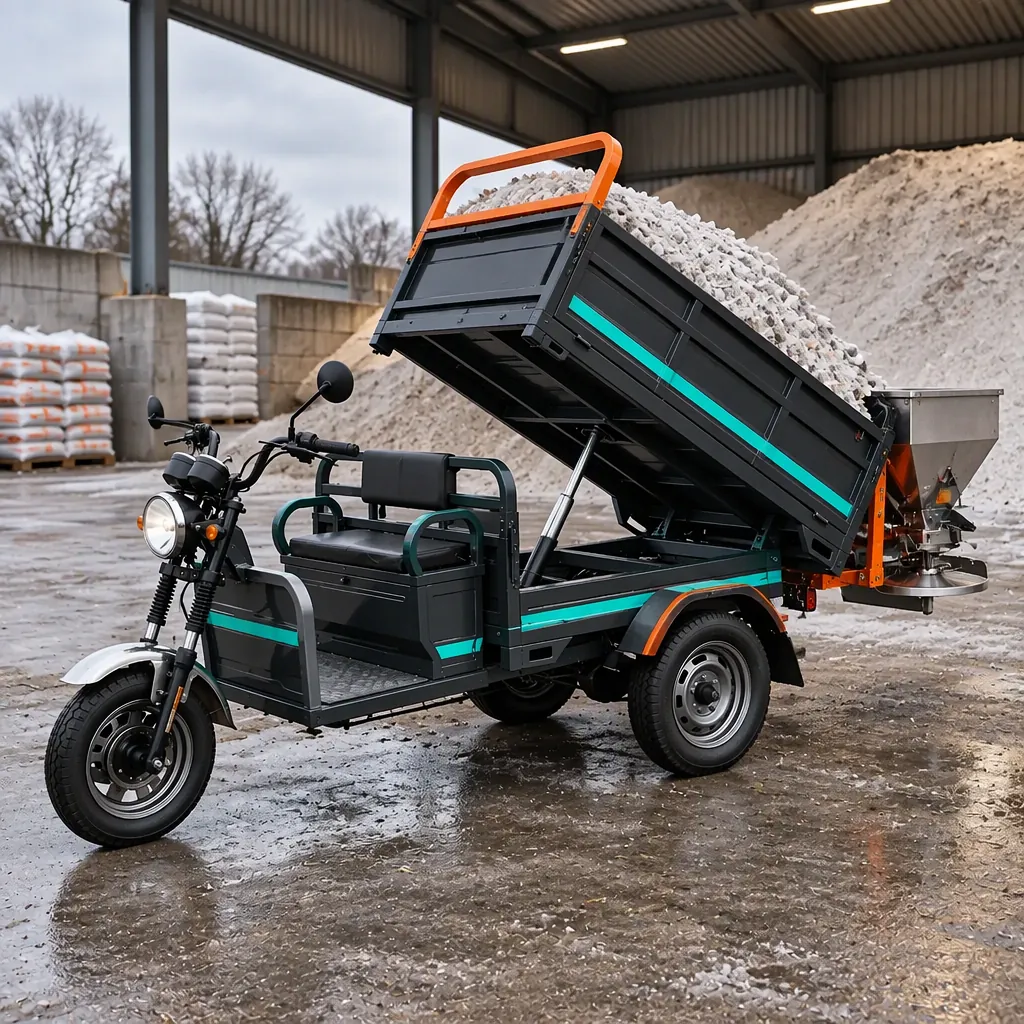
A stainless hopper with a spinner disc mounted over the rear axle, fed from the tipping bed or carrying its own charge. This is the configuration for continuous pass-and-spread work on car park aisles, business park spine roads and estate roads. Two design details decide whether it works in practice. The spreader must be mounted low and forward of the rear wheel line, or the salt pattern will be thrown onto the tyres and up the back of the operator. And the spinner must have a guard, because an unguarded disc throwing rock salt at 300 rpm at pedestrian height is a genuine hazard on a shared surface.
Trailer-mounted spreader
The highest-capacity option and the one that most changes the vehicle's duty. A single-axle trailer spreader behind a cargo tricycle buys load capacity cheaply, but it also adds a towed mass, a reversing problem and a second set of braking assumptions. On a winter circuit with tight turning circles and parked cars, the trailer is usually the wrong trade — the manoeuvring cost outweighs the capacity gain. Where it earns its place is a long linear frontage, such as a country estate drive or an industrial perimeter road, where the vehicle runs straight for hundreds of metres between turns.
Cold, Salt and Steel: What Actually Fails First
Winter service is the most aggressive duty cycle this class of vehicle will ever see, and the failures are predictable. They are also the part of the specification most often left to chance.
Road salt attacks everything the factory did not think about
The frame itself is normally protected by a heavy-duty e-coat followed by powder coat, which handles salt spray well. The exposure risk sits in the parts that are not painted: fastener threads, the exposed portion of the brake caliper, the cargo bed hinges and latches, the spreader hopper if it is mild steel, and any wiring connector under the bed. A stainless hopper and stainless or zinc-flake fasteners are not a luxury on a winter unit; they are the difference between a four-season vehicle and a two-season one. Our own pre-delivery quality process already runs every unit through a 360-degree water spray test at 10 L/min for three minutes with the electrical system live, which catches sealing faults — but spray testing at the factory is not the same as a hundred cycles of wet salt and freeze-thaw, so the maintenance interval has to carry the rest.
The corrosion wash is a scheduled task, not an occasional one
A winter unit needs a freshwater rinse of the underside, bed, hinges and wheel arches at the end of every salting shift, not weekly. Salt that is allowed to dry on a surface re-crystallises and holds moisture against the steel. The practical routine is a low-pressure fresh water rinse — high pressure drives water past seals — followed by a walk-round inspection of the spreader mount, the bed latch and the brake line. Building that into the shift handover, rather than hoping someone remembers, is the single cheapest reliability intervention available.
Cold reduces range, and the effect is not linear
Lithium packs lose usable capacity as they cool, and the discharge voltage sags under load at low temperature. A realistic planning assumption for a winter circuit is that usable range falls by roughly a quarter to a third against the published figure, on top of whatever the cold-weather load itself adds. Our cargo platform publishes 50–80 km loaded at 200 kg on flat terrain; for winter planning, treat the usable working figure as meaningfully lower and size the circuit accordingly. If a shift needs 30 km of working travel, plan against the derated number, not the headline one.
Charging below freezing is the one thing you cannot improvise
Charging a lithium pack below 0°C causes lithium plating on the anode, which is permanent capacity loss and, in the worst case, a safety event. No amount of "it was only slightly below zero" makes this safe. A winter fleet needs a charging location that is above freezing — a heated bay, a workshop corner or an insulated cabinet — and a rule that a cold vehicle is brought in and allowed to reach ambient temperature before it is plugged in. This is a procedural control, not a product feature, and it is the most commonly skipped step in a new winter operation.
Route Time, Refill Logistics and the Two-Unit Threshold
Once the load per circuit and the range derating are known, the rest of the fleet decision is arithmetic. The variables that matter are the average working speed on a winter surface, the refill turnaround at the depot and the number of circuits in the contract.
Working speed on salted or slush-covered pedestrian and car park surfaces is far below road speed. A realistic average for a loaded trike spreading and manoeuvring is in the region of 8–14 km/h, not the platform's 25–35 km/h top speed. At 10 km/h average, a 3,500 m circuit takes around 21 minutes of travel — and the spread rate calculation above says it consumes about 158 kg of salt. That combination produces the number that decides the fleet: how many times the vehicle must return to the salt pile in a single night.
Where a contract requires a full estate treated twice before a 07:00 deadline, the honest conclusion is often that one unit cannot do it on one charge and one load. The options are a second unit, a depot refill point placed inside the estate, or a trailer. Of the three, a second unit is usually the best answer because it also provides the redundancy that a winter contract effectively requires: a single vehicle that fails on the night of a forecast freeze is a breach, and no amount of maintenance scheduling removes that risk entirely.
The Snow Clearance Role: Where the Trike Genuinely Adds Value
Gritting is preventive; snow clearance is reactive. The tricycle is not a plough platform and should not be sold as one — the drawbar pull and the traction available from a 150–220 kg vehicle with a 300 kg payload will not move a snow blade through deep, compacted snow on any sustained basis. But there are three reactive tasks where it is clearly the right tool:
- Choked access routes. Narrow footpaths, alleyways, courtyard passages and steps where no truck can reach. The trike carries the hand tools, the salt and the operator to the point of work, and removes the waste.
- Clearance debris removal. Cleared snow and slush has to go somewhere. A tipping-bed platform is well suited to removing piles from entrances, loading bays and bin stores before they refreeze overnight into ice.
- Post-clearance spot treatment. The pass that follows a clearance to stop the meltwater refreezing at dusk, on the ramps and thresholds that matter most.
Anyone specifying a plough for this platform should test the drawbar assumption against their actual snow depth and grade before committing. The trailer and towing guide covers the towing arithmetic in detail, and it is the honest reference for what this platform will and will not pull.
Specifying the Winter Unit: What Goes in the RFQ
The specification below is written to be pasted into a request for quotation. Each line is there because it has a measurable effect on winter performance, not because it is conventional.
| Requirement | Why it matters in winter service |
|---|---|
| Payload allowance after accessories | Salt tonnage per circuit is the binding constraint; spreader and tools come out of the same 300 kg (EU) / 500 kg (non-EU) allowance |
| Stainless spreader hopper and fixings | Mild steel hoppers fail within two or three seasons of salt contact |
| Sealed, potted controller and IP-rated connectors | Wet salt bridges exposed terminals; the spray test proves sealing at build, not at year three |
| Reinforced load-rated tyres, correct pressures | Traction and steering authority on slush; under-inflation is the usual winter traction failure |
| Hydraulic disc front brake with drum rears | Drums are more tolerant of wet grit than exposed rotors on the rear axle |
| Full LED lighting plus optional beacon | Winter circuits run in darkness and in low visibility; a hazard beacon is often a contract requirement |
| Reverse gear and parking brake | Tight turning in cul-de-sacs and safe parking on a gradient while the operator works on foot |
| LFP battery option | Better cold tolerance and cycle life than NMC for a vehicle that sits idle for months |
| Heated or insulated charging location plan | Charging below 0°C damages the pack; the site must be able to support the protocol |
The LFP option deserves a note of its own. A winter service unit is a low-annual-mileage, long-idle vehicle, and that is exactly the duty profile where LFP's higher cycle life and greater tolerance of being stored part-charged pay back the price premium. The Heavy-Duty tier on our cargo platform pairs a 1200W motor with a 72V 40Ah LFP pack and a 70–80 km loaded range; the 60V versus 72V comparison sets out when that step up is worth the money.
Buying Terms and the Seasonality Trap
Winter equipment is procured in summer and needed in winter, which creates a procurement risk that is easy to overlook. Two dates matter. The first is the lead time from order to delivery, which on this platform runs 15–30 days for a standard build and longer for a first order with custom spreader mounting or bespoke livery. The second is the shipping transit time, which for Europe runs 28–35 days to Rotterdam, Hamburg or Antwerp. Read together, an order placed in October for European delivery will not be in service until December at the earliest — possibly after the first freeze. Winter fleets need to be ordered in the second or third quarter. The first container shipment guide covers the paperwork and inspection sequence for a first order.
The commercial terms are consistent across the range: MOQ 50 units, FOB bands of $1,250–1,550 for the Light 800W tier, $1,580–1,880 for the Standard 1000W tier and $1,880–2,250 for the Heavy-Duty 1200W LFP tier. For a winter operation buying a mixed fleet, the sensible split is Standard units for pedestrian and car park circuits and Heavy-Duty units for the longer estate and perimeter work where LFP and the 72V pack earn their keep.
Two contract clauses are worth pressing on before signing. Ask for the spreader mounting interface as a dimensioned drawing, so a locally sourced spreader can be fitted without drilling the bed. And ask for the corrosion protection specification in writing, including the e-coat and powder coat stages, because "rust-resistant" appears in every brochure and means very different things.
Where the Trike Does Not Belong
A credible specification has to say what the platform is not for. It is not a carriageway gritter, it is not a snow plough, it is not a substitute for a truck on an arterial route with a statutory response time, and it is not suitable for treating a surface it cannot physically reach at a safe speed. What it is, is the vehicle that makes the pedestrian and perimeter half of a winter contract economic — the half that a truck operator either over-serves with a fifteen-tonne vehicle or under-serves with a hand-pushed barrow.
The municipal public works guide covers the adjacent local-authority circuits, and the grounds crew two-trike configuration explains how the same platform is paired for year-round work when winter is only one of four seasons in the contract. Most operators who buy a winter unit discover the second application within a season: the same flatbed with drop-sides is a perfectly good year-round grounds and clearance platform, and that dual use is what makes the payback work.
For the vehicles that feed a winter circuit — the fleet charging arrangement, the depot layout, the spare parts holding — the fleet charging guide and the spare parts planning note cover the operating layer around the vehicle itself. What decides whether a winter contract is profitable is not the vehicle alone but whether the whole circuit — load, spreader, refill, charge and wash-down — was designed as one system before the first forecast of the season.
Spec a Snow and Ice Control Trike
Tell us your circuit lengths, pass widths, contractual spread rates, the number of passes per night and your coldest operating temperature, and whether you need a walk-behind, rear-mounted or trailer spreader. We will spec the platform and the salt budget together, with the LFP option and the corrosion protection schedule written into the quotation. FOB China, MOQ 50 units, 15–30 day lead time.
