
A school kitchen in term time sells exactly one thing: every pupil fed inside a single forty-minute window, with the allergy child's tray kept apart from every other. Miss the window and lunch is eaten in a classroom; miss the segregation and the consequence is an ambulance. No other catering duty compresses so much risk into so little time.
That is why a school meal round is not a delivery route. A restaurant round rewards covering distance efficiently. A school round starts and ends at one building, has no distance to optimise, and is instead governed by how fast trays can leave a pass, how quickly sealed containers can be moved from one building to the next, and whether the meal that arrives at building three is still above the temperature the food safety plan assumes.
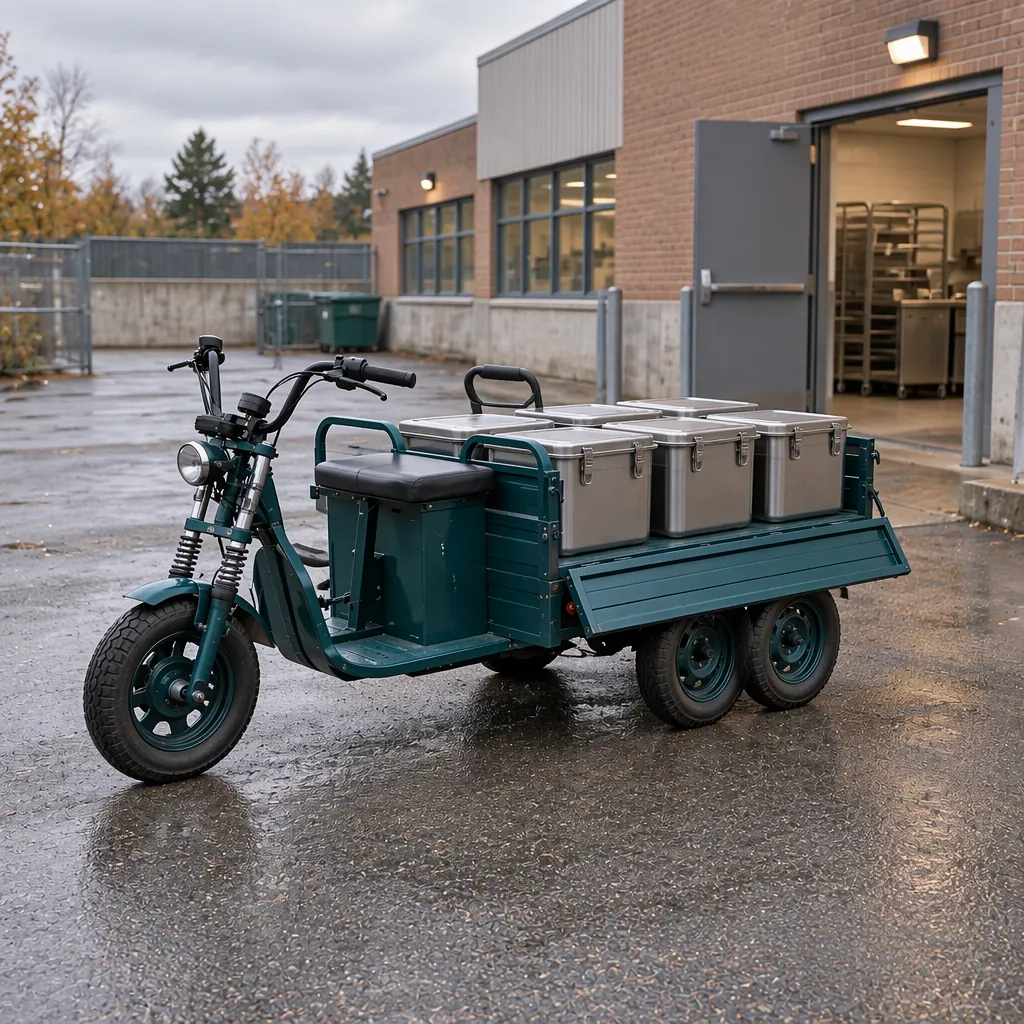
Why a school meal round is not a delivery route
A delivery route is judged on cost per drop. A school meal round is judged on a single binary outcome per day: all meals served, all within their window, all still compliant. That difference changes what the vehicle has to be good at, and it changes it in four specific ways.
- One origin, several destinations, one deadline. Unlike a courier round where drops spread across a day, a school round has all its drops falling inside the same short interval. The vehicle is either back at the service door before the queue starts or it is not.
- The load is fragile in a way parcels are not. Sealed containers of hot sauce and cold salad cannot be stacked on each other, cannot be tilted, and cannot share airspace with an allergen-bearing dish.
- The customer is regulated, not just commercial. A school carries a written food safety plan and an allergy register. The vehicle becomes part of that plan on the day it is first used, and anything the vehicle cannot demonstrate becomes the kitchen's problem at inspection.
- The asset works ten weeks and rests about six. School years and holidays mean the battery and the brakes see concentrated wear, then sit. That idle period is where unmaintained packs fail.
If you are still deciding whether the round is worth a vehicle at all, the arithmetic that settles it sits in event and venue catering duty, where the same fixed-window logic is applied to marquees. The school case adds the allergen dimension and the multi-building dimension on top.
Measure four numbers before you choose a platform
Every school catering specification we have quoted has been settled by four numbers, all of which the kitchen or the site manager already knows. Collect them before looking at any vehicle, because they eliminate most of the range immediately.
| Number | What to measure | Why it decides the platform |
|---|---|---|
| Pupils served per sitting | Not roll count, but meals actually plated in the busiest sitting | Sets container count, which sets deck area, which sets box volume |
| Service window length | Minutes between first and last pupil served | Sets how many round trips are possible, and therefore whether one vehicle is enough |
| Buildings and door widths | Number of serving points, plus the narrowest door the containers pass through | Sets container module size and rules out some trolley and drop-side approaches |
| Distance kitchen to furthest building | One-way metres, plus gradient and surface | Sets the holding time a container must survive without opening |
A school with 400 meals in one hall and a kitchen door onto the same corridor needs almost no vehicle at all. A school with 900 meals split across a main hall, a sixth-form block and an infant block across a 300 metre campus needs a vehicle precisely because a trolley cannot make the trip fast enough and a van cannot get through the bollards. Those are genuinely different specifications, and they come from the same four numbers.
Allergen segregation is a container problem, not a label problem
The most common specification mistake in this duty is to treat allergen control as something that happens on a printed label. In practice, the control that survives an inspection and a busy service is physical: the allergen meal never shares airspace, never shares a container, and never shares a shelf with anything else.
That has a direct vehicle consequence. The sensible configuration is a small number of sealed, individually closable compartments dedicated to allergen-bearing meals, sized for the number of allergy pupils on the register rather than for a share of the total. In most schools we quote, that is one compartment of roughly 20 to 30 litres with a latch and a gasket, positioned so it can be lifted out without disturbing anything else on the deck.
What the segregation has to survive
- A substitution mid-service. A pupil arrives who was not on the register count. The kitchen has to add one container after the vehicle is already loaded. If that means unloading the deck, the round loses minutes it does not have.
- A cross-contamination wash-down. A compartment that held an allergen meal must be cleanable to a standard the kitchen accepts, which means smooth internal surfaces and no exposed fasteners.
- An audit at short notice. An inspector will ask to see how the vehicle prevents contact. A vehicle that answers with a container specification answers it in one sentence.
The temperature handling for these containers follows the same logic as any cold-chain load, and the arithmetic for holding times is set out in our guide to cold chain delivery configurations. The allergen case is harder only because the container count is small and the consequence of a failure is severe, not because the physics differs.
Tray throughput: the number that decides how many vehicles you need
Almost every school that asks about a second vehicle is really asking a throughput question, and throughput is not measured in meals. It is measured in minutes per trip, because the round is a repeating loop inside a fixed window.
The arithmetic runs like this. Suppose the furthest building is 180 metres away, the vehicle averages 10 km/h across campus including stops, and loading and unloading takes 4 minutes at each end. That is roughly 1.1 minutes each way plus 8 minutes of handling, so about 10 minutes per round trip. Inside a 40-minute window, with 5 minutes of buffer at each end, that is three full trips.
| Round trip time | Trips inside a 40 min window | What it means |
|---|---|---|
| 10 minutes | 3 | One vehicle covers a campus of up to three serving points |
| 14 minutes | 2 | One vehicle covers two points; a third point arrives late |
| 20 minutes | 1 | Window is too tight; either shorten handling or split the fleet |
Note what dominates: the 8 minutes of loading and unloading, not the 2.2 minutes of travel. That is the single most useful insight in this duty. Buyers instinctively try to make the vehicle faster, but the vehicle is already faster than the handling. What actually buys capacity is making the load unit smaller and the deck easier to reach, so handling drops from four minutes to two at each end. That single change turns a two-trip campus into a three-trip campus without buying anything.
Thermal holding: what the container has to do while the vehicle is moving
A school meal is out of the kitchen for somewhere between two and fifteen minutes depending on the campus. The container, not the vehicle, is what holds the temperature during that time. This matters because buyers often ask for a refrigerated box on the vehicle when the honest answer is that the load is never on the vehicle long enough to need active cooling.
Passive insulated construction is the right answer for most school rounds. Our standard insulated box uses 40 mm PU foam sandwich panel, which is specified for passive cold chain work and adds 10 to 15 days to lead time. For a school round carrying hot meals in insulated containers, the box does something slightly different: it stops the deck from becoming a heat source or a heat sink, so the containers are not fighting the vehicle as well as the air.
Hot and cold in the same trip
- Separate the two thermally, not just physically. A cold salad container sitting against a hot sauce container will stratify within minutes. Place the cold module over the rear axle where it is shaded, and keep hot containers forward.
- Do not use one large compartment. A single large volume equilibrates, which is exactly what you do not want when half the load is meant to stay cold.
- Open the box as few times as possible. Every opening dumps the air that is doing the holding. A drop-side configuration that lets a whole shelf be reached at once is better than a rear door that requires unloading to reach the front.
If your round carries genuinely frozen items, or if the kitchen is producing cook-chill for the next day, the requirement changes and the vehicle needs active temperature control. That case is covered in the cold chain guide rather than here.
Compartments, deck and container layout
The cargo platform we build for this duty runs 150 to 500 litres of box volume with 300 kg payload in the EU configuration and 500 kg outside it. Those numbers sound generous for school meals, and they are, which is why the deck matters more than the volume. A 500 litre box that can only be loaded from the rear is slower to work than a 300 litre box with drop sides on three faces.
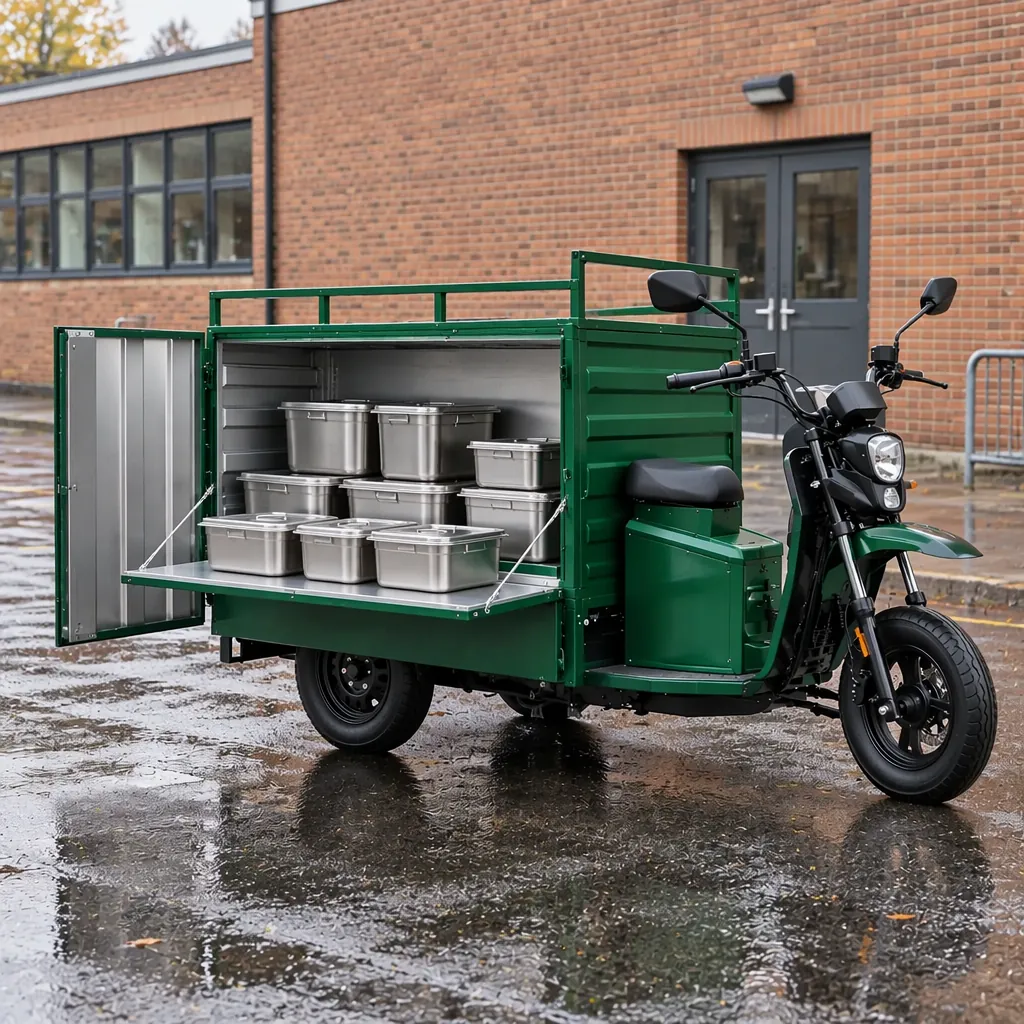
Three layout decisions that come up on every quote
Drop sides versus fixed box. Drop sides win wherever the serving point has no raised dock. The panel folds down and becomes a shelf at working height, which means the person unloading does not lift from the deck floor. For a service where the same two people unload every day, this saves the most time of anything on the vehicle.
Shelf or no shelf. A single intermediate shelf doubles the number of containers reachable without moving another container, at the cost of stacking height. For school meals, where the container count is moderate and the container height is modest, one shelf is almost always right.
Where the allergen compartment sits. It should be reachable first, without disturbing anything, and ideally on the side that faces the serving door. If it is buried, it will be treated as an exception and the segregation discipline will erode.
Charging around a school day, not around a route
School catering duty is unusual because the vehicle does a concentrated morning and midday, then idles for the afternoon and the holidays. That shape suits battery care rather than punishing it, but only if the charging plan matches it. Our platform carries 60V 32Ah or 72V 40Ah packs with 6 to 10 hour charging on a 5A charger, which fits an overnight charge comfortably.
| Situation | Charging approach | Reason |
|---|---|---|
| Single morning round, back by 13:00 | Overnight charge only, pack rarely below 50% | Long shallow cycles extend pack life; no mid-day charging needed |
| Breakfast club plus lunch round | Overnight plus a short top-up between services | Two rounds with a gap is the cheapest case for a second charger, not a second battery |
| Multiple buildings, three or more trips | Size the pack on trips, and keep a spare pack charged | A spare pack costs less than a second vehicle and removes the queue |
| Holiday periods | Store at mid charge, top up monthly | Leaving a pack flat for six weeks is the main cause of avoidable capacity loss |
The general pattern, including the arithmetic for sizing charger capacity against shift overlap, is in our fleet charging guide. For a single school the practical version is simpler: charge overnight, keep the charger indoors, and never leave the pack flat across a holiday.
What the specification table should say
The table below is the configuration we would put in front of a school or a contract caterer for a single-building or two-building round. It is deliberately modest, because the duty does not reward a heavy specification.
| Item | Specification for school catering duty | Why |
|---|---|---|
| Platform | Cargo e-tricycle, 800W hub motor with differential | Torque for kerbs and ramps at low speed; differential for tight service yards |
| Battery | 60V 32Ah, LFP where ambient temperatures are high | Round is short; cycle life matters more than range |
| Box volume | 150–300 L with drop sides on three faces | Working access beats capacity for a fixed-window round |
| Insulation | 40 mm PU sandwich panel, insulated lid | Stops the deck acting as a heat path; passive is enough for a short round |
| Allergen compartment | 1–2 sealed compartments, 20–30 L, latch and gasket, removable | Turns allergen control into a physical guarantee |
| Brakes | Hydraulic disc front, dual drum rear, parking brake | Loaded stop on a school yard with children present |
| Speed | Governed to 25 km/h or lower on campus | Campus traffic and pedestrian density, not road speed |
| Documents | UN 38.3, cell and BMS test reports in the export file | The vehicle becomes part of the kitchen's food safety plan |
Everything above is drawn from the standard build rather than a special project. OEM orders start at 50 units per model with 15 to 30 days standard lead time, and 30 to 45 days for the first custom-branded run. A single school buying one vehicle to test the round does not fit that model, which is why the practical route for a single site is usually through a contract caterer or a local authority fleet that is already ordering.
Where the platform pays back, and where it does not
A cargo tricycle is the right answer when the campus is long, the doors are narrow, and the round is one kitchen to several buildings. The saving is not fuel, because the trips are short. The saving is the second pair of hands that a van requires, and the access a van cannot achieve at all.
It is the wrong answer in three situations, and being honest about them saves buyers a wasted purchase. If the round is a single hall served from an adjoining kitchen, a trolley is cheaper and always will be. If the campus is flat, short and has no vehicle access at all, a pedestrian trolley train is the correct tool. And if the requirement includes delivering to pupils' homes rather than to school buildings, the duty is a home delivery route and belongs with the models in our charity redistribution circuit guide, which deals with multi-drop rounds rather than a single-window loop.
Running it as a term-time operation
The vehicle itself is the simple part. The operation around it is where school rounds succeed or quietly degrade. Three things carry most of the weight.
A loading sheet that matches the register
The container count must match the allergy register before the vehicle leaves, and the sheet must record what went into which compartment. This is a two-minute discipline that removes the entire class of failure where a substitution is made in good faith and the wrong container is opened later.
A daily walk-around that takes ninety seconds
Tyres, brake feel, compartment latches, and the insulated lid seal. School rounds fail on latches more often than on motors, because a latch that does not close is a segregation failure that nobody notices until it matters.
A holiday routine
Charge to about half, park indoors, and check the pack monthly. Six weeks of a flat pack is worse for the battery than a full year of daily short rounds. This is the one maintenance item that is almost always skipped and almost always expensive.
Driver safety equipment deserves a mention too, because campus rounds involve pedestrians in a way that road delivery does not. The minimum we would specify for any school round is covered in safety features that matter on a loaded tricycle, and the licensing question, including the fact that many jurisdictions class these vehicles below the threshold requiring a full licence, is set out in electric tricycle law in the US and EU.
Frequently asked questions
Can one tricycle serve a school with two buildings?
Yes, provided the round trip including handling stays near ten minutes. Two buildings 200 metres apart, with four minutes of handling at each end, gives roughly two to three trips inside a forty-minute window, which is normally enough. The binding constraint is handling time, not travel time.
Do we need a refrigerated box for hot meals?
No. A hot meal is held above its safe temperature by the insulated container it travels in, and the vehicle only needs to stop the deck from pulling heat out of it. Passive 40 mm insulation is sufficient for rounds under about fifteen minutes. Active cooling is for frozen and cook-chill loads.
How do we handle a pupil who is added to the register on the day?
Keep one spare sealed compartment empty and reachable. The correct response to a late substitution is to load one container into that compartment without touching the rest of the deck. If the layout makes that impossible, the layout is wrong, regardless of how much capacity it has.
Is a cargo tricycle allowed on a school campus?
In most jurisdictions a governed cargo tricycle at or below 25 km/h with pedals or type approval falls into a class that does not require a full driving licence, but the position differs between the EU, the UK and US states. The classification test and the questions to put to a local authority are in our guide to tricycle law and registration.
What breaks first on a school round?
Latches, lid seals, and tyres. All three are cheap and all three are exactly the items that a segregation and temperature plan depends on. This is the reverse of a heavy cargo duty, where the drivetrain is the limiting item. The maintenance budget should reflect that.
If the round is part of a wider district programme rather than a single school, the operator model, including how a small operator takes on several kitchens, is covered in micro-franchise and district operator programmes. For a kitchen that is also supplying retail or events alongside the school round, the equipment overlap is discussed in bakery and café delivery, which deals with the same morning-product timing problem in a commercial setting.
Spec a Trike Around Your Serving Window
Tell us how many pupils, how many buildings and how long your window is. We will come back with a compartment layout, a holding plan and a unit spec built for term-time duty.
