
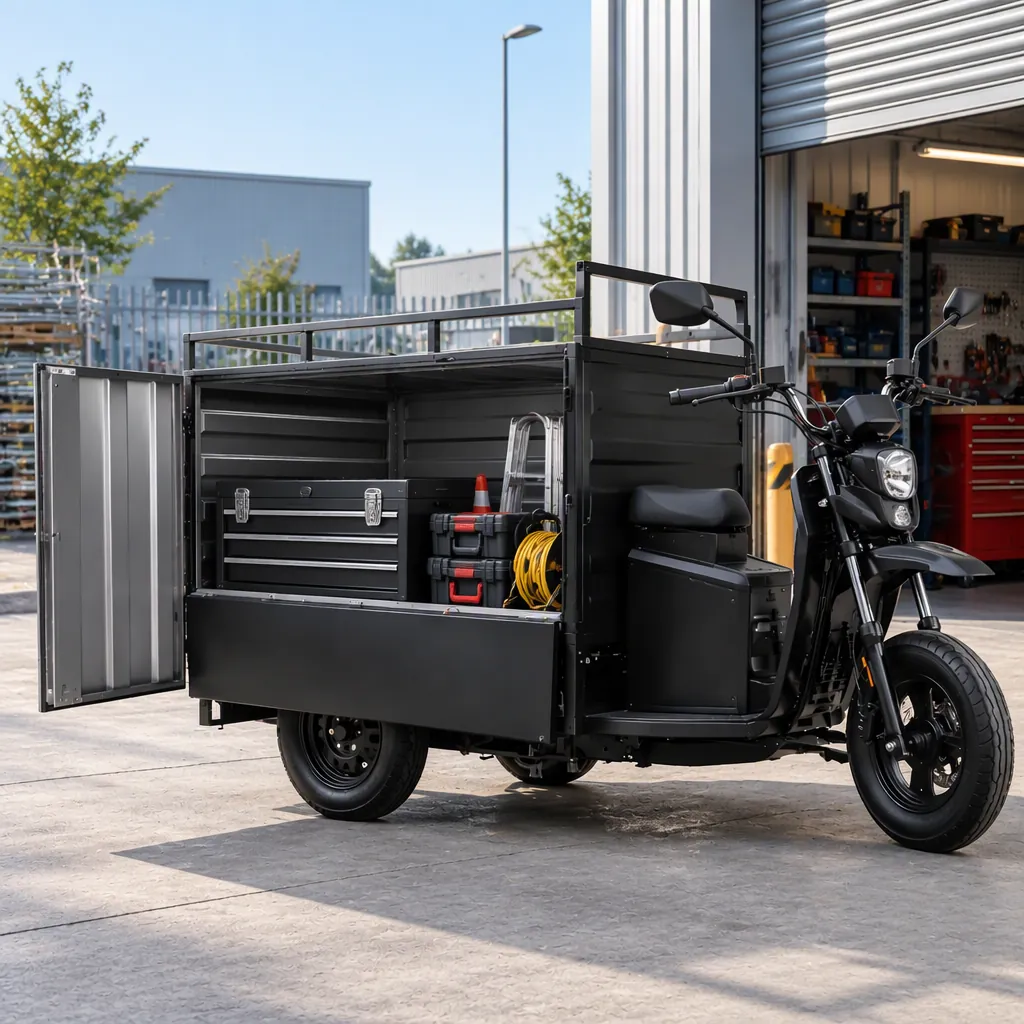
Most fleets that add electric cargo tricycles buy them as delivery vehicles: leave full, finish empty, stops measured in seconds. A mobile tyre service or roadside assistance unit is the opposite animal. It leaves the depot carrying its heaviest load, works out of that load for an hour or more at a time, and comes back to base with the same kit plus whatever it removed. Specifying one on a delivery-trike template is the single most common and most expensive planning mistake in this category.
This guide works through what actually changes when the job is fitting tyres and responding to breakdowns rather than dropping parcels: the load profile, the workshop you have to carry, the electrical demand of powered equipment, and the arithmetic that decides whether one trike or two will cover your call territory. All platform figures below come from our own cargo tricycle platform data and the government and municipal fleet specification set.
Why a tyre-service round is not a delivery round
A delivery route has one property that makes it easy to plan: the vehicle gets lighter all day. A tyre-service round has the opposite property — it carries its full payload on the outbound leg and keeps carrying almost all of it all shift, because the tool set, the compressor, the jacking gear and the spares must be on board whether or not a given call needs them. That difference cascades into every downstream decision.
| Duty dimension | Parcel delivery | Mobile tyre / roadside service |
|---|---|---|
| Payload profile | Parcel volume, unloads to zero | Fixed workshop kit, stays on board all shift |
| Stop duration | 30–120 seconds | 20–60 minutes per roadside call |
| Load at end of shift | Empty | Full, plus removed tyres and scrap |
| Critical constraint | Volume and route density | Ground clearance, kerbside access, low-speed ballast |
| Powered equipment | None | Compressor, impact wrench, lighting |
| Failure cost | Late parcel | Second trip for a missing socket or a flat air tank |
| Charging window | Overnight | Overnight, plus opportunistic top-up between calls |
Two rows in that table decide the platform. The payload never clears, which means the trike has to be specified around its worst-case static load rather than its average; and the powered equipment draws on the traction battery or on a separate supply, which most delivery-oriented builds never consider at all. A fleet that buys on the delivery template discovers both problems in the same month.
The workshop you have to carry, in kilograms
The load envelope for a tyre-service trike is dominated by equipment, not by stock. Before picking a motor or a box, list the kit that is genuinely non-negotiable on every call. A realistic two-technician roadside specification looks like this:
| Kit item | Typical mass | Handling note |
|---|---|---|
| Portable air compressor (with receiver) | 18–35 kg | Should be tank-mounted, never loose |
| Trolley jack + axle stands | 20–40 kg | Heaviest single item; low mount point |
| Impact wrench + torque wrench set | 8–14 kg | Torque control is a compliance issue |
| Socket and adaptor case | 10–20 kg | Dense; keep over the rear axle group |
| Replacement tyres (2–4 units) | 30–80 kg | Volume driver more than mass |
| Wheel-balancing and valve kit | 6–12 kg | Small parts; needs lockable storage |
| Consumables, sealant, PPE | 10–20 kg | Replenished per shift |
| Work lighting and beacons | 4–8 kg | Draws on the electrical budget |
That totals roughly 105–230 kg of kit before a single replacement tyre for the customer's vehicle is loaded, and before the technician. Against a platform rated for 300 kg (EU) / 500 kg (non-EU) with a box volume of 150–500L, that leaves a genuinely workable margin — but only if the weight is placed correctly. Kit density, not total mass, is what makes a service trike feel unstable.
Three measurements that eliminate a platform before you discuss motor rating
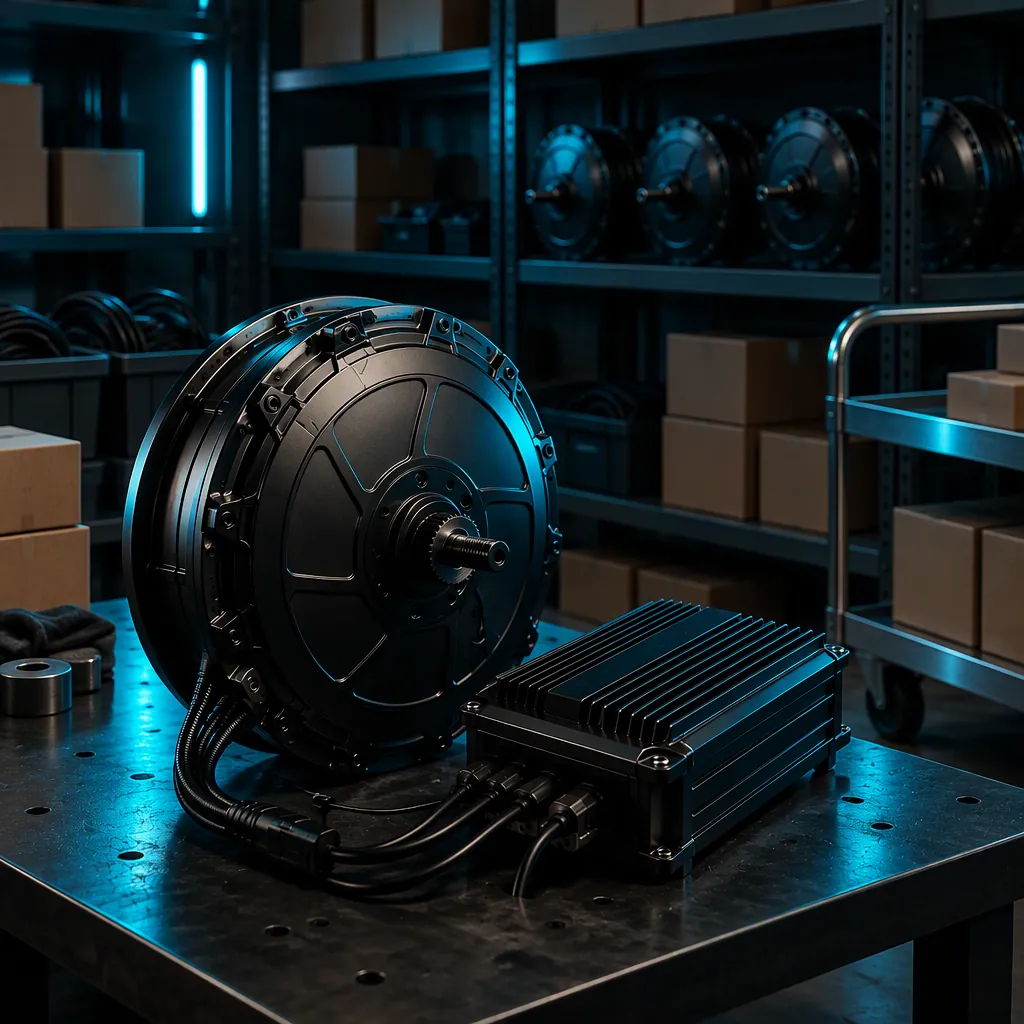
Motor size is the last question, not the first. Three physical measurements on your actual call territory will disqualify more platforms than any specification sheet. Take them before you request a quote.
1. Kerb height and approach angle at your typical call
Roadside work happens at the edge of a carriageway, which means the trike is parked with one side against a kerb, often on a camber or in a drainage gully. Measure the kerb height where you actually work. A platform running 3.00-12 front and 3.75-12 dual rear tyres clears a normal urban kerb comfortably; anything that needs a ramp or a second person to reposition is a platform that will get left at the depot. If your territory includes a lot of rural verges and soft shoulders, that is an argument for load-rated tyres and the heavier specification, not for a bigger motor.
2. Doorway and yard access at the depot
A trike-based service unit still has to get in and out of wherever it lives overnight, and it has to be chargeable there. Measure the narrowest gate, the doorway width and the threshold height. If the access is under about 1.6 m clear, the vehicle belongs elsewhere and the kit should be hand-trucked to it — a trike that cannot reach its own charging point is a trike that does not get charged, and the charging window is already the tightest constraint in this entire duty cycle.
3. Gradient on the loaded outbound leg
The outbound leg carries the full kit. If the depot exits uphill, that climb defines the motor requirement far more than flat-terrain range does. Our platform range figures — 50–80 km loaded at 200 kg on flat terrain — are quoted on the flat. The correct response to a steep loaded exit is to step up the motor class (800W / 1000W / 1200W hub with differential, 60V or 72V) rather than to add battery capacity, because a larger pack simply feeds a motor that is already at its thermal limit.
Electrical demand: the part no delivery build accounts for
A tyre-service trike carries powered equipment, and that equipment has to come off something. There are three ways to do it, and the decision has to be frozen before the bill of materials is locked, because retrofitting a circuit into a finished, powder-coated frame means drilling it.
| Option | How it works | Best for |
|---|---|---|
| Independent 12V service battery | Separate battery runs the compressor, lighting and inverter; isolated from the traction pack | Heavy electrical draw, minimal risk to drive range |
| DC-DC converter from the traction pack | Steps the 60V/72V pack down to 12V for auxiliary loads | Light draw; simplest BOM; adds a parasitic drain |
| Dedicated auxiliary circuit from the factory | An additional fused circuit terminated at a service panel in the box | Fleets that want one standard build across many units |
The practical guideline is to keep the auxiliary load modest relative to the traction pack. The platform ships with a 60V 32Ah NMC pack on the standard build, rising to 72V 40Ah LFP on the heavy-duty configuration. A compressor that cycles for a few minutes per call and an LED work light are within reach; heavy continuous inverter loads are not, and belong on the independent battery. Getting this wrong is how a fleet ends up with a trike whose quoted range halves the moment it actually starts working.
The charging arithmetic that decides one trike or two
This is the calculation that most tyre-service operators get wrong, and it is the reason a fleet that looked fine on paper ends up hiring a second van. A tyre-service round is not distance-limited — it is time-limited, and the limit is how long the vehicle spends unavailable.
Charging the standard platform takes 6–10 hours at 5A. That is a full overnight cycle, which fits a single-shift operation perfectly. It does not fit a two-shift or extended-hours operation. If your service window runs longer than one charging cycle, you have exactly three options: run a second trike, install higher-current charging, or move to a battery-swap arrangement. Adding a bigger battery does not help — it makes the charge take longer, which is precisely the wrong direction. The trade-offs are set out in our fleet charging guide.
The other half of the arithmetic is the duty cycle itself. Roadside calls run 20–60 minutes, and the trike sits parked with the workshop open for that entire time. A trike covering a call territory of 10–25 km per shift with 6–10 calls will typically finish well inside its range, which means the real question is not "how far can it go" but "how many calls fit in a shift before the battery is the limiting factor for the next shift". Answer that honestly and the one-or-two-trike decision makes itself.
Ballast, stability and the low-speed problem
A service trike spends much of its life at walking pace or stationary, and that is a harder stability problem than cruising. The dual rear wheels with a differential provide the standstill stability that lets one technician work without a second person steadying the vehicle — but only when the load is correctly distributed. Heavy dense items (socket cases, jacking gear, the compressor) belong over or slightly forward of the rear axle group, not cantilevered at the back of the box and not packed against the front bulkhead. Our payload capacity guide works through the load-rating arithmetic behind this in detail.
The triple disc-and-drum arrangement — hydraulic disc front with dual drum rear and a parking brake — matters more here than on a road-going delivery route. A loaded tyre-service trike is frequently parked on a camber while the technician works underneath a customer vehicle, and the parking brake is the only thing holding it there. Confirm it as a specification item rather than assuming it, and confirm the motor has a reverse gear for repositioning in tight laybys; both are standard on this platform and both are frequently omitted on cheaper builds.
The evidence pack a fleet procurement office will ask for
Tyre-service and roadside operators are increasingly commercial fleets buying through a procurement process, which means the specification has to survive more than a test drive. Ask any supplier for these items in writing, and treat a supplier who cannot produce them as a supplier who has not built for fleets before.
- Sampled quality documentation. Incoming material sampled to AQL 2.5 Level II, cells sorted for internal resistance within 3 mΩ and open-circuit voltage within 0.02V, frame tubing verified by ultrasonic thickness gauge — the three gates that determine whether a fleet's units behave the same as each other.
- Test evidence rather than a datasheet. A dynamometer curve across the operating range, a thermal chamber cycling result, and an IP-rated spray test on the motor and controller enclosure.
- Certification matched to your market. EN 15194 and EN 50604 for EU supply, UL 2849 for US, UN 38.3 for the pack, plus CE and RoHS declarations maintained at component version level rather than issued once and forgotten — the same framework our EU versus US certification guide sets out.
- A priced spare-parts list with a service-level commitment. Tyres in the 3.00-12 and 3.75-12 sizes, brake pads, controllers, displays and battery cells — each with a part number and a lead time. A fleet that cannot reorder the exact tyre size is a fleet that goes off the road for a fortnight.
- Serial-number traceability. A single serial number should resolve to the cell batch, the measured internal resistance, and the point-weld station that built the pack.
Order terms and how a first batch should run
| Item | Terms |
|---|---|
| Minimum order quantity | 50 units |
| Standard lead time | 15–30 days |
| First order with custom box or branding | 30–45 days |
| Sample unit | Before serial production, always |
| Box customisation | Adds approximately 10 days |
For a tyre-service fleet, the sensible first move is not fifty units. Order one sample configured as closely as possible to your final specification, run it on your hardest shift pattern for a full month, and measure four numbers: calls completed per charge, actual kit mass as loaded, average charge time from your own supply, and every item that had to be fetched from the depot because it was not on board. Those four numbers will tell you more about whether the platform fits than any demonstration day, and they will tell you whether what you actually need is a different configuration, a second vehicle, or a larger motor class.
If the answer is a work-rated trike with a lockable, organised service bay, the utility work tricycle OEM guide covers the bed, attachment and electrical-load specification in more depth. If your work involves fluids rather than tyres, the same duty logic is worked through for mobile wash and detailing fleets, and for field calls generally in the field-service fleet guide. When the calls are frequent and short, the platform sizing in our municipal public works guide applies directly, and for operators deciding between body styles the cargo versus passenger platform comparison sets out where the two diverge.
Send Us Your Call Territory, We Will Spec the Workshop
Tell us your call radius, the kit you have to carry and how long your service window runs. Our engineering desk will come back with a platform configuration, the electrical-load breakdown and volume pricing.
