
The garden retail yard is a route, not a delivery job.
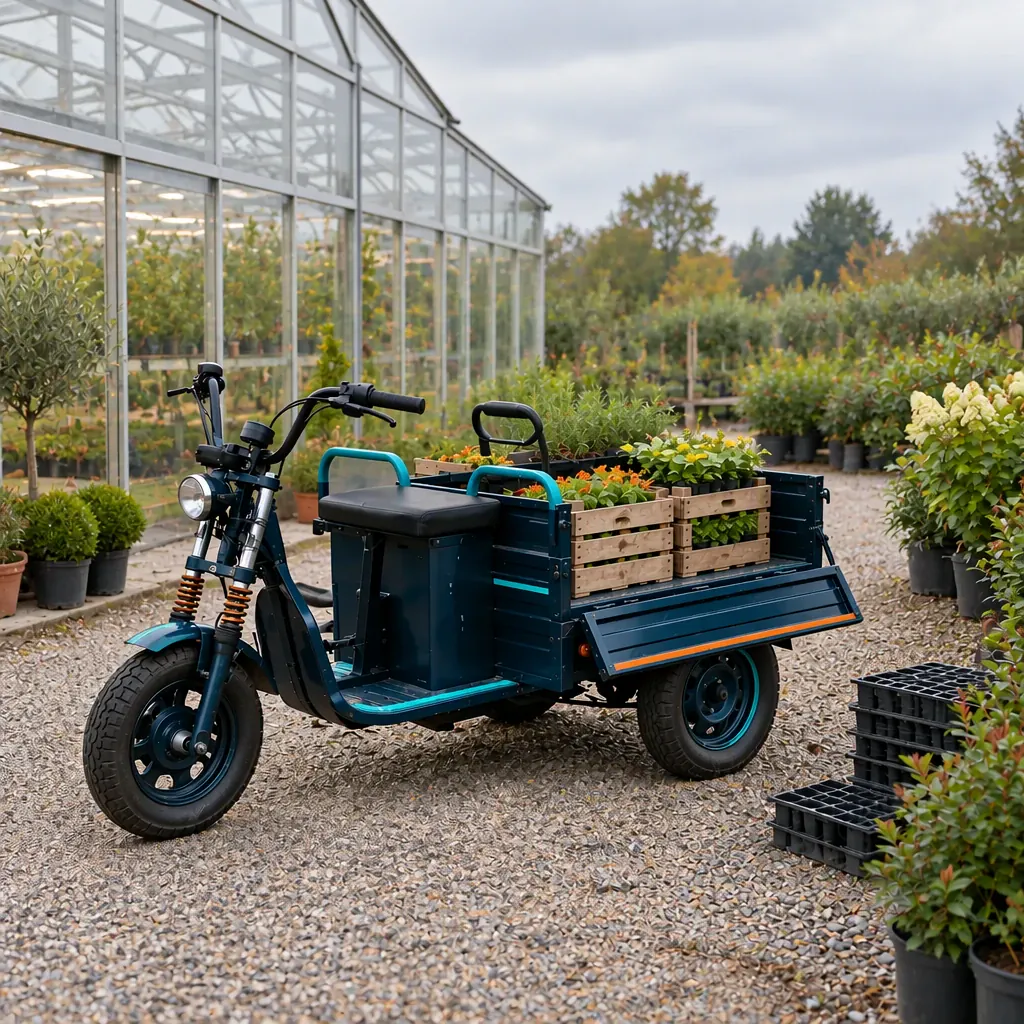
That distinction sounds like semantics until you watch a morning shift. A wholesale nursery run has one pickup, one drop, maybe twenty minutes of loading. A garden centre has a trolley bay at the front, a bulk aggregate bunker at the back, a bedding bench that needs fifty trays before ten o'clock, and a customer collection point that needs two bags of compost right now. The vehicle never travels far, and it never stops moving.
That pattern defeats both vehicles operators usually reach for. A panel van is expensive to buy, expensive to insure, and needs a driver with a full licence for a three hundred metre loop. A ride-on tractor is cheap to run but has no legal place on the public footway between the gate and the car park. What actually fits is a three-wheeled platform that carries between two hundred and five hundred litres, turns inside a stock aisle, and can be driven by a seasonal employee who started on Monday.
Volume and load distribution decide more about the right machine than brand or motor size. A garden centre moves a lot of light things and a few very heavy things, and those two jobs want different bodies on the same chassis.
Why a Garden Centre Round Is Not a Plant Nursery Run
The nursery and greenhouse article on this site already covers the grower's problem, which is moving benches, media and propagation stock across a working production area where every gram of growing media compounds. Garden retail is a different duty entirely, and operators who buy on nursery logic usually end up with the wrong body.
Three things separate the two. First, dwell time. A nursery run has long dwell periods while a bench is loaded; a garden retail round has dozens of thirty-second stops where the vehicle is left standing with a load on it. Second, product mix. A nursery moves one product class at a time; a garden centre moves compost, plants, pots, landscape timber, water features, bird food and Christmas trees through the same yard on the same day. Third, public exposure. Garden retail premises have customers walking the same surfaces the vehicle works on, which changes the specification on braking, noise, reversing and guarding far more than the load does.
The practical consequence is that a garden centre should be specified around the number of stops per shift and the heaviest single item lifted at each stop, not around a theoretical daily range. Electric tricycles in this class typically run fifty to eighty kilometres on a 200 kg flat-road load with a 60V 32Ah pack, which is more range than most garden centre rounds consume in a full day. Charging capacity matters more than pack size, because the vehicle returns to the same shed every night.
Five Duties on One Yard, and What Each Demands
Most garden retail sites are actually five separate logistics operations squeezed onto one ground plan. Buy the platform for the average of those duties and it will do none of them well.
**Bedding and plant bench replenishment.** Light, high-volume, bump-sensitive. Trays stack on a trolley that either rides on the platform or gets towed. The constraint is footprint, not weight. A drop-side bed of 150 to 250 litres covers this duty comfortably.
**Bulk aggregate and bagged compost.** This is the weight duty. A single 50-litre bag of moist compost weighs roughly 20 to 25 kg depending on composition, and a pallet of them is a genuine load. Moving bags in bulk wants the higher payload configuration and a bed that tips or drops its sides so unloading is not a manual lift.
**Timber, fencing panels and landscape materials.** Long, unwieldy and often two to three metres. Overhang is the issue, and overhang behind the rear axle is what makes a three-wheeler feel unstable. This duty wants side stakes or a bed long enough that the load sits inside the wheelbase envelope.
**Customer collection and car park service.** Short runs from the covered yard to the collection point, sometimes loaded, sometimes carrying a compost bag and a tray of pansies. This is the duty that most often justifies owning a vehicle at all, because it removes a staff member from a two-hundred metre walk with twenty kilos in each hand.
**Grounds and site upkeep.** Bins, pallets, packaging, empty trays, irrigation parts, signage. Genuinely continuous and entirely under-planned on most sites. This is where a platform with a tipper body earns its keep, because green waste and packaging build up all day and need clearing without a mid-shift trip.
Measure Four Things Before You Look at a Motor
Operators routinely start with motor wattage, which is the last thing that should be decided. Four measurements taken in an afternoon will determine the platform far more reliably.
**Measure the tightest turning point on the round.** Not the widest aisle, the tightest one, plus the corner from the stock aisle into the sales yard. A cargo three-wheeler with a 3.00-12 front tyre and 3.75-12 rear pair needs roughly 3.2 to 3.8 metres of clear width to do a full lock turn. If the tightest point is under that, the round has to be broken into two loops or the platform has to be sized down.
**Measure the steepest gradient on the loaded route.** Garden centres sit on slopes more often than operators admit because the yard is usually terraced. A loaded trike on a 12 percent gradient behaves very differently from the same trike on the flat, and the specification that matters is braking and gearing, not top speed. The 25 to 35 km/h ceiling is a governor setting, not a performance limit, and on site gradients the useful working speed is closer to 12 to 18 km/h loaded.
**Weigh the single heaviest item handled at any stop.** Not the total load, the one item. A large water feature, a bulk bag, a stone bird bath. That number sets the bed height, the tailgate arrangement and whether manual handling is acceptable at that stop at all.
**Count door widths and gate widths, including the pedestrian gap.** A vehicle that cannot pass the gap between the shop front and the trolley bay will be parked outside and become a storage problem rather than a work tool.
Specification table for garden retail duty:
| Duty | Typical load | Body that fits | Why this body |
|---|---|---|---|
| Bedding bench replenishment | 80-150 kg of trays | Low drop-side bed | Tray trolley rolls or tows; low sides let staff reach the load |
| Bagged compost and aggregate | 200-450 kg | High-payload bed or tipper | Weight is concentrated; tip or drop-side removes manual unloading |
| Timber and panels | 100-250 kg, 2-3 m long | Long bed with side stakes | Keeps load inside the wheelbase envelope, limits rear overhang |
| Customer collection runs | 30-80 kg | Any bed, canopy optional | Short hops; a canopy matters in wet climates for both goods and driver |
| Grounds and waste clearance | 100-200 kg, low density | Tipper body | Loose, frequent, needs to be emptied without handling |
For weight and stability arithmetic behind those figures, the platform geometry discussion in the electric trike stability guide is worth reading before the specification meeting, because the load distribution questions raised there are exactly the ones a garden centre gets wrong when it buys on the flat-bed assumption.
The Load Envelope That Covers All Five Duties
A single vehicle cannot be optimal for all five duties, but one configuration can be acceptable for all five, which is usually the correct purchase. That configuration is a mid-payload chassis with a drop-side bed, side stakes available as an insert, and a tipper option on the same body frame.
Working numbers for this class of platform, taken from the cargo tricycle specification range this site builds to: payload of 300 kg in EU configuration and 500 kg outside the EU, bed volume from 150 to 500 litres with drop sides, and a chassis that accepts hydraulic tipping on the same mounting points as the fixed bed. That means a garden centre can order one body frame and swap the tipping kit in later, rather than buying a second vehicle when the waste duty starts to hurt.
Three details decide whether that envelope actually works on a garden retail site.
**Bed floor height.** Every tray, bag and pot goes over the side or through the tailgate by hand unless a trolley rolls on. A bed floor around 600 to 700 mm from the ground is the practical compromise between low enough to lift onto and high enough to clear kerbs and gravel edges. Higher than that and the manual handling risk climbs quickly with the twenty-five kilo compost bag.
**Tailgate versus drop-side.** A full-width tailgate is better for trolleys and long timber. Drop sides are better for reaching in and out of trays. Sites that do both should specify a drop-side bed with a removable tailgate, which is a standard option rather than a custom build.
**Canopy or no canopy.** This is the one decision that is genuinely climate-driven. In wet climates a canopy keeps bagged goods dry and lets staff work a round without changing into wet gear at every stop. In dry climates the canopy is dead weight and a wind catch. Operators in coastal or northern European locations should treat it as mandatory; operators in arid regions should not order it by default.

Charging Around a Shift Pattern, Not a Range Figure
Garden centre vehicles live on a fixed nightly charging window, which makes charging arithmetic simple and makes pack size a second-order decision.
A 60V 32Ah pack on this platform charges in roughly six to ten hours at a 5A charger, which fits inside a single overnight window. A 72V 40Ah pack takes the upper end of that range but carries more energy for heavy aggregate days. The practical rule for garden retail is to size the pack to the longest day of the year rather than to the average, because the peak trading weeks in spring and pre-Christmas are two to three times the normal daily duty.
Two charging realities catch operators out. First, the charger is not a battery accessory, it is a shift accessory, and a 5A unit that takes eight hours leaves no room for a top-up between a morning and an afternoon round. Sites running two rounds per day should look at the higher-rate charger options covered in the electric tricycle charger guide rather than buying a larger battery. Second, the charging point has to be positioned where the vehicle actually parks, which on most garden retail sites is a covered goods-in bay rather than the workshop. Pulling a lead fifty metres across a customer car park every evening is the reason vehicles end up not being charged.
Charging arithmetic for a garden retail round:
| Round pattern | Daily distance | Energy use | Pack that covers it with margin |
|---|---|---|---|
| Single morning round, light duty | 8-15 km | Low | 60V 32Ah |
| Two rounds, mixed duty | 15-30 km | Moderate | 60V 32Ah with mid-day top-up |
| Peak season, continuous shift | 25-45 km | High | 72V 40Ah |
| Heavy aggregate plus waste in one day | 20-35 km | High | 72V 40Ah plus overnight full charge |
Working Safely Where Customers Are Walking
A garden retail yard is a shared surface, and that single fact changes more of the specification than any load figure. Customers with trolleys, children, dogs and cars reversing out of bays occupy the same ground the vehicle works on all day.
The specification responses are concrete. A reversing alarm is not optional on a site with public footfall. A speed governor set at a walking pace for the customer-facing zone, with a higher setting for the service yard, is worth specifying as a two-setting arrangement if the supplier offers it. Full LED lighting matters more than it appears, because garden retail yards are busy at dusk in the pre-Christmas trading period when the light is poor and the footfall is highest.
Braking gets specified for the surface, not the speed. Gravel, wet paving and the transition between them are where three-wheelers lose grip on a loaded stop. The platform's hydraulic front disc with twin rear drum arrangement and a parking brake is the minimum for public-facing work, and the parking brake specifically matters because the vehicle is left standing on slight gradients, and the wider set of safety features on public-facing sites deserves the same scrutiny dozens of times per shift.
One safety item gets routinely missed: load security at the point of leaving the vehicle. A garden centre round involves dozens of short stops with a part load on an open bed. Side stakes and a load net cost very little and prevent the single most common incident on these sites, which is a bag or tray sliding off a bed when the vehicle pulls away from a standing stop.
Where the Platform Pays Back, and Where It Does Not
The payback case for a garden centre is not fuel savings, because the vehicle it replaces is usually a diesel panel van doing very short trips or a staff member walking. The case rests on labour time recovered and on the cost of the alternative vehicle.
Payload figures only mean something once you know how the load is distributed, which the payload capacity guide works through in detail. A garden centre doing twenty collection-point runs per day at roughly four minutes of walking each is losing well over an hour of staff time per day to that duty alone, before counting the two-person lifts of heavy bags. At a modest loaded labour cost that hour exceeds the daily running cost of a charged electric platform by a wide margin. Add the aggregate and waste duties and the vehicle is in use for most of the trading day rather than parked between jobs.
Where it does not pay back is a genuinely small site with a single sales area, no bulk materials and no separate yard. Below roughly half a hectare with everything within a hundred metres, a hand trolley and a staff member are the correct answer, and no amount of specification changes that.
Cost comparison against the alternatives, for a garden centre running one vehicle:
| Option | Purchase cost band | Running cost | Licence and insurance | Fit to garden retail |
|---|---|---|---|---|
| Electric cargo tricycle | Low, in the range of a small trailer | Very low, electricity only | Usually no full licence needed at governed speed in many jurisdictions | Designed for the duty |
| Diesel panel van | High | High, plus servicing and depreciation | Full licence, commercial insurance | Over-specified for short loops |
| Ride-on tractor with trailer | Moderate | Moderate, fuel plus servicing | Not road legal on footways | Cannot leave the site |
| Hand trolley plus staff | Minimal | Labour cost per hour of every run | None | Fails the bulk material duty entirely |
The purchase price band for the cargo platform this site builds runs from around USD 1,250 to 1,550 FOB for the standard configuration, moving up through the higher-payload and longer-bed variants. For a full breakdown of where that money goes across battery, drivetrain, chassis and body, the cargo tricycle cost breakdown article sets out the component shares, which is useful when a garden centre is deciding whether the tipper body is worth the increment. Minimum order quantity for fleet buyers is fifty units, with production lead times of fifteen to thirty days and roughly ten days added for custom body work.
Specifying Your First Garden Centre Trike
The specification conversation should end with a written sheet rather than a verbal agreement, and these are the line items that matter.
**Body and payload.** Bed volume, drop-side or tailgate arrangement, side stakes included or optional, tipper kit available on the same frame. Confirm the payload figure in the configuration you are buying, not the headline range figure, and confirm whether the EU or non-EU rating applies to your market.
**Wheels and braking.** Front and rear tyre sizing, hydraulic front disc, twin rear drums, parking brake. Ask for the tyre specification in writing because garden retail surfaces, gravel and wet paving included, are harder on tyres than road duty.
**Electrical.** Pack voltage and capacity, charger rate, and whether a second charger is available for mid-day top-up. Confirm the display shows speed, charge state, load indication and reverse, because reverse is used constantly on a garden retail round.
**Safety and public-facing items.** Reversing alarm, LED lighting all round, speed governor settings and how they are adjusted, load net or stakes.
**Commercial terms.** Minimum order quantity, lead time on standard and on custom bodies, and the spare parts schedule. A garden centre needs fast access to tyres, brake pads and chargers, because a vehicle off the road for a week in peak season costs more than the part.
The final check is a trial on your own ground. Ask for a demonstration vehicle to do one real morning round before ordering, and watch three things: whether it turns at your tightest corner, whether the bed height is comfortable for the heaviest item you actually lift, and whether the driver can see behind it when reversing out of the bedding bench aisle. Those three observations will correct a specification faster than any catalogue.
If you are specifying for a garden retail group with several sites, the dealer and distributor guide covers how to structure a multi-site order and what to standardise across branches. Where the plan includes seasonal staffing, the fleet financing guide explains how to structure the purchase around a trading year that is anything but flat.
Size a Cargo Trike Around Your Yard, Not a Catalogue
Send us your tightest turning point, your heaviest single item and your two busiest weeks, and we will come back with a bed configuration, a payload rating and a charger rate that match the round you actually run. That is a shorter conversation than correcting a specification after the first peak season.
Size a Cargo Trike Around Your Yard
Send us your tightest turning point, your heaviest single item and your two busiest trading weeks. We will come back with a bed configuration, a payload rating and a charger rate that match the route you actually run.
