
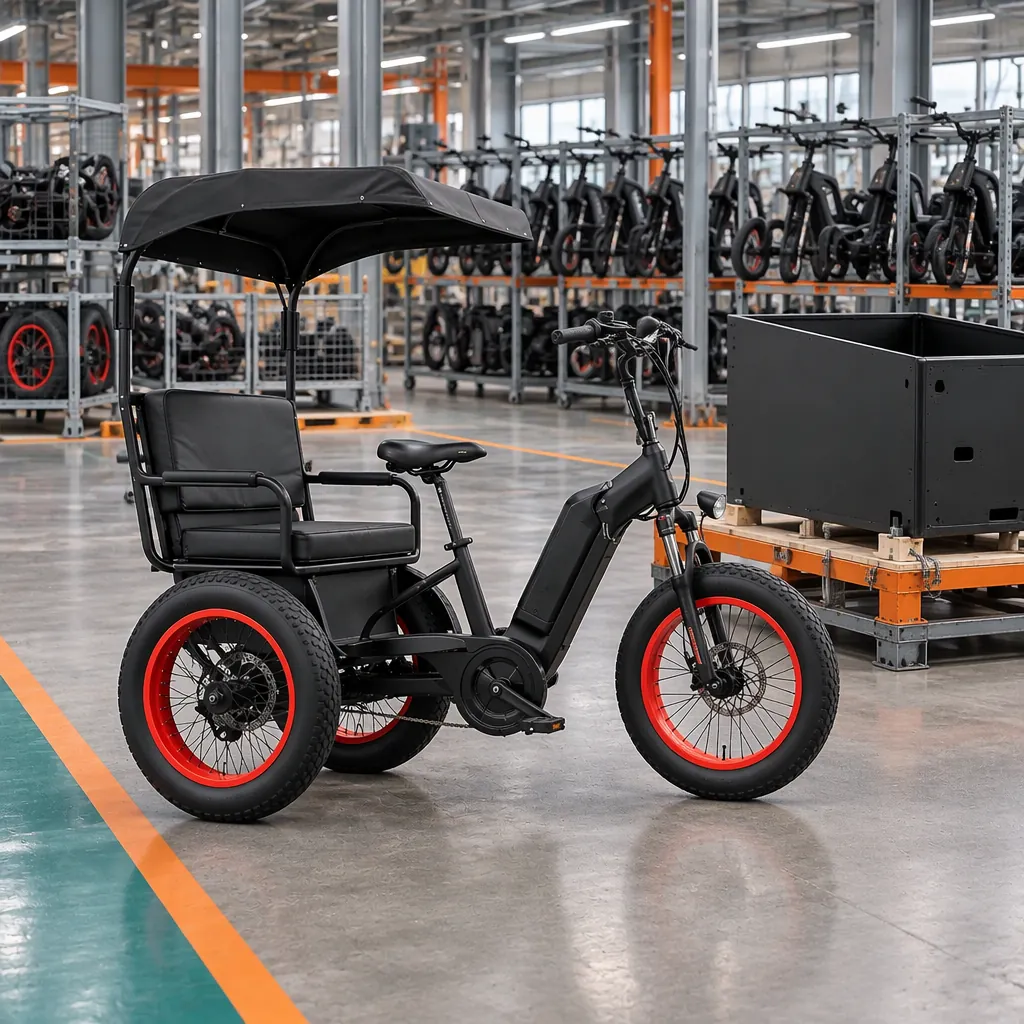
What a cargo trike assembly plant actually costs to stand up
The search phrase “electric cargo bike manufacturing plant cost” is usually typed by one of two people: a distributor in a protected market who has decided importing is no longer enough and wants to assemble locally, or an existing two-wheeler assembler adding a three-wheeler line to a building he already owns. Their budgets are wildly different, but the mistake they make is identical. They cost the building, the welding jigs and the paint line, then discover that the number which actually governs the business is none of those. It is the minimum economic batch the line can run without losing money on setup. The same logic drives our guide to auditing a tricycle factory’s real production capacity, which is the buyer-side mirror of the plant-side arithmetic here.
This guide prices the four blocks that make up a cargo trike assembly plant, states the volumes at which each block stops being a fixed cost and becomes a variable one, and gives the arithmetic for deciding which blocks to own and which to buy in. Every platform figure quoted here comes from the 800W / 1000W / 1200W cargo tricycle that this factory builds at 300 kg EU and 500 kg non-EU payload, so the volumes and cycle times are anchored to a real product rather than a generic spreadsheet.
The four cost blocks, and which one dominates at your volume
Almost every published figure for a vehicle assembly plant lumps everything into one number, which makes it useless for planning. Split it four ways and the decision changes completely depending on annual output.
- Block A — building and utilities. Covered floor area, three-phase power, compressed air, water for the wash and leak-test stations, and the extraction a paint or e-coat line demands.
- Block B — assembly tooling and stations. Torque-controlled stations, frame stands, wheel lacing and truing, brake bleed benches, the motor test bench, the IP54 spray chamber, the chassis dynamometer for the road simulation, and the packing line.
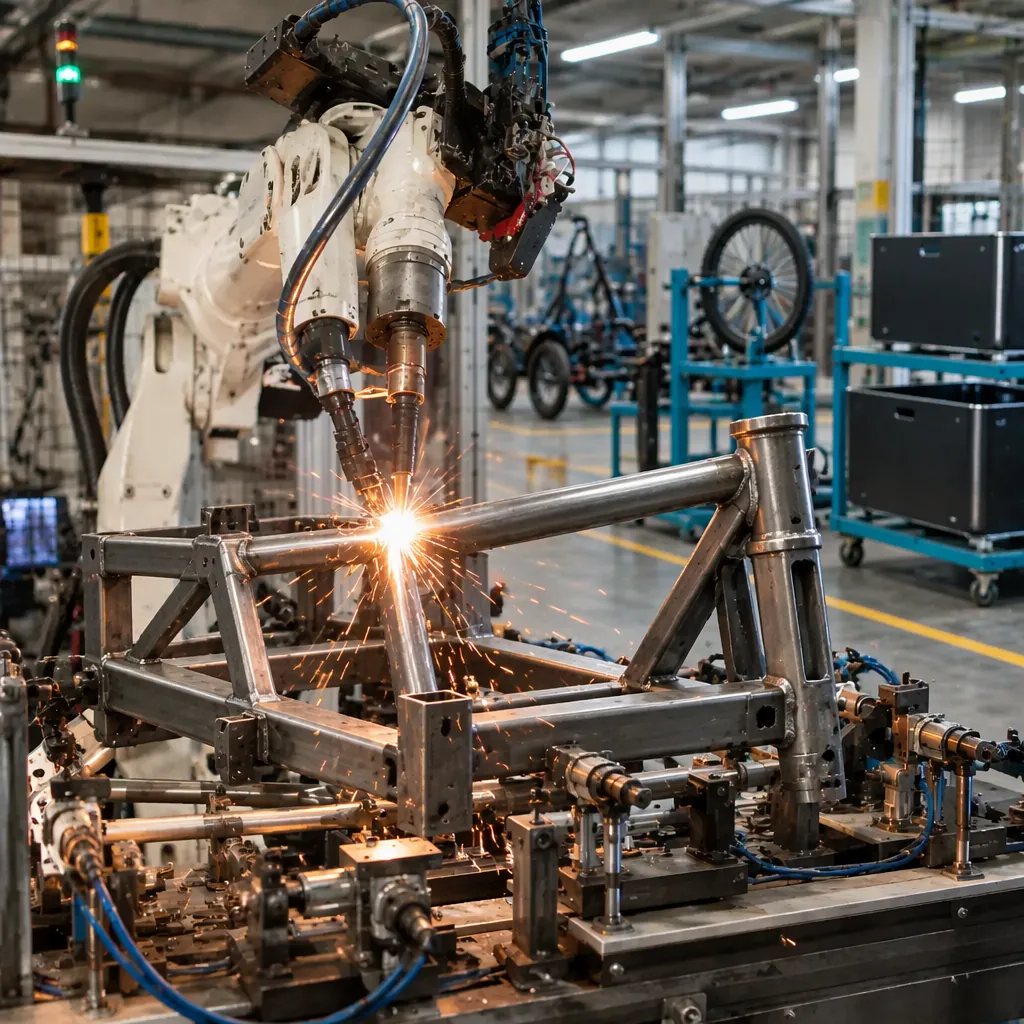
- Block C — fabrication. Tube bender, tube laser or saw, welding cells with fixtures, and the e-coat or powder line. This is the block that decides whether you are an assembler or a manufacturer.
- Block D — working capital. The parts you must hold to keep a line fed, the WIP between stations, and the finished goods waiting for a container. This block is invisible in a capex spreadsheet and is where most first-year plans actually fail.
At 2,000 units a year, Block D is larger than Block B. At 20,000 units a year, Block C pays back in under two years and Block D becomes the binding constraint on growth. Below roughly 1,500 units a year, none of the fabrication blocks pay back at all and the correct answer is to assemble from a CKD kit. What a CKD kit actually contains, and where the frame and box finish happens, is set out in our walkthrough of the tricycle manufacturing process.
What each block contains, in the order you should buy it
The sequence matters because stations bought out of order sit idle and consume the working capital you need for parts. On this platform, the order below reflects what the QC gates actually demand, since a station that cannot be verified is a station that will be argued about at the pre-shipment inspection.
- Torque-controlled final assembly stations. Safety-critical fasteners on this platform are specified at handlebar clamp 25 N·m, axle nuts 40 N·m and brake caliper mounts 18 N·m. Once you assemble rather than import, those values have to be logged against the unit serial, which means programmable torque tools and a recording layer, not hand wrenches.
- Brake bleed and balance bench. The platform runs a hydraulic disc at the front and dual drums at the rear plus a parking brake. Brake force distribution is verified on the roller bench, and a three-wheeler with an uneven rear pair will fail a loaded road test every time.
- Motor test bench. Cruise efficiency mapping at 15, 25 and 32 km/h plus a no-load current draw check. This is the station that catches a mis-wound hub motor before it is inside a laced wheel.
- IP54 spray chamber. 360-degree water spray at 10 L/min for three minutes with the electrical system live. Cheap to build, and the single most effective catch for a controller bay that was sealed badly.
- Chassis dynamometer. A 2 km road simulation with the unit loaded. This is the station most new plants skip and then re-buy in year two, because it is the only place a drivetrain fault shows up without a test rider and a road.
- Battery pack assembly and test. Only if you intend to build packs rather than buy them. Cell grading, spot welding, IR measurement and the UN 38.3 test summary trail are a separate capability with its own floor area and its own compliance exposure.
The batch size arithmetic that decides whether the line survives
Assembly plants do not fail on capex. They fail on changeover. Every time the line switches model, colour or market configuration, a fixed cost is incurred: stations are re-set, the first units are checked more heavily, and the line runs below rhythm for a shift. Divide that fixed cost by the batch size and you have the per-unit penalty that eats your margin.
On this cargo platform the market configuration alone forces changeovers. The EU build is rated 300 kg and the non-EU build 500 kg, which is a chassis rail and axle set difference, not a sticker. Speed governance is set at 25, 35 or 40 km/h per local regulation, battery chemistry shifts between 60V 32Ah NMC and 72V 40Ah LFP, and the cargo box runs 150–300 L, 200–400 L or 300–500 L across three price tiers. A plant that runs all of those on one line in batches of 25 will spend more time changing over than building.
The practical rule is to fix three variables and let the fourth flex. Fix the chassis spec per market, fix the motor tier per model, fix the box family per SKU, and let colour and graphics flex at the end of the line. Applied to the volumes above, that takes a changeover from a lost shift to a lost hour.
Own, buy or kit: the assembly depth decision
Assembly depth is a spectrum, and the right point on it is set by volume, not ambition. Four depths are worth pricing before any building is leased.
- Full CKD assembly. Frames, drivetrain components and boxes arrive painted and finished; you assemble, test and pack. Lowest capital, highest landed parts cost, and the only depth that works below about 1,500 units a year.
- Semi-knockdown with local fabrication. You weld and finish the cargo box and subframe locally because they are bulky to ship, and import the rest. This is the most common choice for a distributor in a market with high freight cost, because box volume is what makes container maths painful.
- Full fabrication. Tube cutting, bending, welding, e-coat or powder and final assembly all in-house. Only worth it above roughly 8,000 units a year, or where local content rules force it. Before committing to any tooling spend, the four MOQ tiers and what each unlocks are compared in our custom tooling guide for tricycle programmes; the baseline platform specification sits in the cargo e-tricycle OEM guide.
- Contract assembly. You own the brand, specification and compliance file; a third party owns the plant. Zero capital, and the correct answer for a first year in a market you have not yet proven.
The freight arithmetic that drives the semi-knockdown choice is concrete. A cargo tricycle chassis ships in a welded steel crate of roughly 260 × 120 × 145 cm with the box removed. A 20GP takes 8–10 units chassis-only with boxes flat-packed separately; a 40HQ takes 20–24 units standard and up to about 30 complete units with boxes nested. Fabricating the box locally removes the most volume-inefficient item from every container, which is why it is usually the first block to come in-house. The full container and landed-cost model, including port charges and freight bands, is in our first container shipment guide.
Why working capital, not machinery, is the first-year killer
A line running 40 units a week against a 15–30 day standard lead time on components and a 30–45 day lead time on a first custom-branded run holds an enormous amount of value in parts and WIP before it holds any finished goods. Add the payment structure that most suppliers quote, T/T 30% deposit with 70% before shipment, and the cash gap is easy to underestimate.
Work the gap explicitly. If a container of 24 units carries an average FOB of around $1,550 per unit across the $1,250–1,550 / $1,580–1,880 / $1,880–2,250 tier spread, the goods value in a single container is roughly $37,000 before freight and port charges. A plant that wants two weeks of buffer stock on the line and one container in transit is carrying the cost of that value for 60 to 90 days while paying for the next order. That is the number to put in front of a bank, not the welder. If the gap cannot be closed internally, the structures that spread it across a first order are covered in our fleet financing guide.
The mitigating move is to shorten the cash cycle rather than reduce the batch. A 15–30 day standard lead time already allows a distributor to quote short delivery windows that importers cannot, which converts into deposit-funded orders instead of stock-funded ones.
Floor area, power and the site requirements people forget
Building cost is quoted per square metre and then blows out on services. Four items dominate and all four are cheap to design in and expensive to retrofit.
- Compressed air at the right dew point. Torque tools, brake bleeds and any paint equipment all draw on it. A line that shares an undersized compressor with the welding cell produces wet air, and wet air in a brake circuit is a warranty claim in eighteen months.
- Three-phase power sized for simultaneous stations. A motor test bench, a dynamometer and a spray chamber will not all run continuously, but they will overlap at shift start. Size for the overlap rather than the average.
- Drainage and water treatment at the wash and leak-test bays. The IP54 chamber runs 10 L/min for three minutes per unit; multiply by your daily output and you have a real water and disposal volume, which in many jurisdictions requires a settling or separation arrangement.
- Container loading access. A 40HQ needs a loading platform at the right dock height with a hard standing that will take a laden forklift. Plants leased on the basis of the assembly hall alone frequently discover the yard cannot take a trailer at the right angle.
What the assembly floor actually needs, station by station
The building envelope above is a planning figure, not a layout. What a line builder actually has to schedule is the number of stations, their cycle time and the buffer between them, because that is what turns floor area into an output number.
Work it from the takt time. If the target is 40 units a week over five days on one shift, that is 8 units a day, or one unit every 60 minutes across an eight-hour shift with breaks removed. Any station whose cycle time exceeds 60 minutes becomes the bottleneck and sets the real output, regardless of how many people are on the floor. On this platform the usual bottleneck at low volume is not assembly at all — it is the loaded road test and dynamometer run, because each unit occupies the bench for a fixed period that cannot be compressed by adding labour.
The practical consequence is to treat the test line as the rhythm-setter and staff assembly backwards from it. A plant with three dynamometer positions each taking roughly 20 minutes per unit, running one shift, has a hard ceiling of about 72 units a day on test alone — well above the 8 units a day in the example, which is why test capacity is usually only the constraint once a second shift starts.
Container and export maths the plant has to be designed around
An assembly plant that ignores container geometry builds vehicles it cannot ship economically. The packing line is a design constraint on the product, not an afterthought at the end of the building.
The geometry is fixed for this platform. The chassis travels in a welded steel crate of roughly 260 × 120 × 145 cm, and the cargo box is packed flat on pallets and nested to reduce volume. A 20GP takes 8–10 units chassis-only; a 40HQ takes 20–24 units standard and up to about 30 complete units when the boxes nest at maximum density. Packaging is specified to exceed ISTA 3A drop-test standards because the crate will spend 40-plus days at sea and be handled several times.
That arithmetic tells you where the packing line belongs in the layout. A plant shipping complete units gets roughly a third more vehicles per container than one shipping standard-density loads, but only if the box nesting is done on a proper pallet jig at the end of the line. Put the packing station next to the container dock, not at the far end of the hall, because a nested box that has to be moved twice loses the density advantage to handling damage.
Compliance obligations that attach to the assembler, not the importer
One commercial argument for local assembly is that it removes import friction. That is only half true, and the half that is false is where new assemblers get caught. Assembling in-market generally moves the conformity obligation onto you.
Three document families travel with this product and each lands differently once you assemble locally. UN 38.3 covers lithium battery transport and attaches to the pack as shipped, so if you assemble packs locally you become the party responsible for the test summary rather than the importer of a documented pack. EN 15194 and the equivalent market schemes govern the vehicle, and a locally assembled vehicle needs its own technical file rather than a copy of the supplier’s. Market-specific registration and speed-class rules attach to the finished vehicle you put on the road.
The traceability expectation is rising in parallel. Batch-level records linking cells, frame welds and QC checkpoints to a vehicle serial are already the norm in the EU supply chain, and an assembly plant that cannot produce that chain for a unit it built has no answer when a distributor asks. Build the serial-based record from day one; retrofitting traceability onto an existing line is dramatically more expensive than starting with it. The gate sequence a new line has to reproduce, from AQL-described incoming inspection to final vehicle release, is documented in our golden sample and first article approval guide.
Frequently asked questions
How many units a year before a cargo trike assembly plant pays back?
Roughly 1,500 units is the floor for full CKD assembly, about 8,000 for in-house fabrication including e-coat, and 20,000 or more before a plant justifies its own battery pack line. Below 1,500 units, contract assembly or importing complete units is cheaper than any capex.
Can the same line build EU 300 kg and non-EU 500 kg variants?
Yes, but not without cost. The payload difference is a chassis rail and rear axle set change, so the line needs either two chassis sub-lines or a re-set between batches. Plan those as separate runs rather than mixed flow.
What is the smallest sensible batch on a mixed line?
Around 50 units per configuration is the practical minimum once changeover is charged against the batch, which aligns with the 50 unit MOQ this platform is quoted at. Running below that concentrates changeover cost into unit price very quickly.
Do I need my own battery pack assembly line?
No. Buying packs from the platform supplier keeps cell grading, spot welding, IR measurement and the UN 38.3 test summary with the party that already documents them. Building packs is a second capability with its own floor area and its own compliance exposure, and it only pays above very high volume.
Which block should come in-house first?
The cargo box and subframe. It is the most container-inefficient item to ship, it needs the least specialised tooling of the fabrication blocks, and it gives a local-content story that helps in regulated markets.
Plan the plant against your container maths, not your brochure
Send us your target annual volume, the market configuration you are building to, and whether the cargo box will be fabricated locally or imported. Those three answers decide which of the four cost blocks belong in year one and which should stay outsourced, and they let us quote the platform specification and container loading against the plant you are actually planning to run rather than an idealised one.
Tell Us Your Annual Volume and Where You Want the Line to Stop
Share your target output, the market configuration you are building to, and whether the cargo box will be fabricated locally. Those three answers decide which cost blocks belong in year one, and they let us quote platform specification and container loading against the plant you are actually planning.
